What Is Proof-Driven AppSec? Why “No PoC, No Finding” Changes Application Security
A complete guide to Proof-Driven AppSec in 2026: what “No PoC, no finding” means, how proof differs from CVSS, EPSS and KEV, the stages from hypothesis to re-tested fix, and the limits every team should know.
Beyond ASPM
Proof-Driven AppSec for teams building with AI
Plexicus uses AI Swarm Pentest to explore authorized application paths, validate what is exploitable, and give teams evidence they can use to prioritize remediation.
Explore AI Swarm PentestMost security backlogs are lists of claims.
A scanner says a line of code might be injectable. A dependency report says a library version has a CVE. A severity label says the issue is critical.
None of those claims says whether an attacker can actually use the weakness in your application.
Proof-Driven AppSec is an approach to application security in which a vulnerability is reported as verified only when reproducible evidence shows it can be exploited in the target, inside an authorized scope.
The short form is No PoC, no finding. If the proof of concept cannot be reproduced, the issue stays a hypothesis. It is not deleted, but it is not presented as a verified finding either.
The idea is not new. Good penetration testers have always shown their work. What has changed is the volume: more code, more dependencies, more AI-generated changes, and more automated findings than any team can read.
This guide explains what Proof-Driven AppSec is, how proof differs from severity scores and exploit predictions, what counts as proof, how the workflow runs from hypothesis to re-tested fix, and where the approach has limits.
What Is Proof-Driven AppSec?
Proof-Driven AppSec is a way of running an application security program where the unit of work is a demonstrated attack path, not an alert.
A demonstrated attack path has four parts:
- A target. The application, API or component that was tested, inside a scope someone authorized.
- Steps. The requests, inputs or code paths that lead from an entry point to the weakness.
- Observed impact. What actually happened: data read, identity obtained, an action performed that should have been refused.
- A way to repeat it. A replay, a script or a test that another person or system can run again and get the same result.
If any part is missing, the item is still useful information. It is just not proof.
What does “proof of concept” mean here?
CISA gives a plain definition on its Known Exploited Vulnerabilities criteria page: a PoC is code that, if someone runs it, would let them exploit the vulnerability.
In Proof-Driven AppSec the PoC is narrower and more practical. It is the evidence that this weakness can be exploited in your application, not that a similar weakness was exploitable somewhere else.
A public exploit for a library version is a reason to test. A replayed request that reads another tenant’s records in your API is a finding.
What does “No PoC, no finding” mean?
It is a reporting rule, not a detection rule.
Your tools can still raise hypotheses: a suspicious data flow, a missing authorization check, a vulnerable dependency. Proof-Driven AppSec only changes what is allowed to enter the queue that engineers must act on.
A verified finding has proof attached. Everything else is labelled as unverified and handled differently.
Why Proof-Driven AppSec Matters in 2026
Three findings explain why proof has moved from a nice-to-have to a requirement.
Exploitation is now the main way in. The Verizon 2026 Data Breach Investigations Report found that exploitation of vulnerabilities is the most common initial access vector for breaches, at 31%, up from 20% the year before. Credential abuse, the previous leader, fell to 13%.
Teams are falling behind on the vulnerabilities that matter most. The same report found that only 26% of the vulnerabilities in the CISA Known Exploited Vulnerabilities (KEV) catalog were fully remediated by organizations in 2025, down from 38%. The median time to full resolution rose to 43 days, from 32.
Only a small share of known vulnerabilities is ever exploited. According to the FIRST EPSS FAQ, the KEV catalog lists roughly 0.5% of published CVEs, and in any 30-day window exploitation activity is observed for roughly 2.5% to 3% of published CVEs.
Put those together and the problem is clear.
Attackers are using vulnerabilities more. Defenders are fixing the dangerous ones more slowly. And most of the items in a typical backlog are not the ones attackers will use.
A program that treats every alert as equal spends its limited engineering time evenly across a list where the real risk is concentrated in a small part.
Trust is the hidden cost
Detection tools have a well-documented credibility problem.
The OWASP page on source code analysis tools lists “high numbers of false positives” among the weaknesses of static analysis. It also notes that these tools struggle to show that a flagged issue is a real vulnerability.
Google measured the same effect from the developer side. In “Lessons from Building Static Analysis Tools at Google” (Communications of the ACM, 2018), the authors define an “effective false positive” as an issue developers did not act on, and set a limit of 10% effective false positives for checks shown during code review.
When developers stop trusting the queue, true findings get ignored along with the false ones. Proof is how a security team earns that trust back.
AI makes both sides faster
AI coding assistants increase the amount of code your team ships. AI tooling also lowers the cost of producing findings, on both sides.
That makes the gap between a claim and a proof more expensive. A model can generate a plausible vulnerability description in seconds. It cannot make that description true.
Proof-Driven AppSec vs. Detection-Driven AppSec
Most programs today are detection-driven. Tools find candidates, and humans sort them.
| Detection-driven AppSec | Proof-Driven AppSec | |
|---|---|---|
| Unit of work | An alert or a CVE match | A demonstrated attack path |
| Entry to the engineering queue | Severity above a threshold | Reproducible proof in your target |
| Prioritization | Severity score, sometimes plus exploit prediction | Demonstrated impact plus context |
| What engineers receive | A location and a description | Steps, evidence and a way to replay |
| Fix verification | Scanner no longer reports it | The original proof no longer works |
| Unverified items | Mixed into the same queue | Kept in a separate, labelled state |
The two approaches can use the same tools. The difference is the bar for what counts as done at each step.
Detection asks “could this be a problem?” Proof asks “did it work, and can we show it again?”
Detection-driven programs are not wrong. They are incomplete. A scanner that finds candidates is the right first step. Stopping there is the mistake.
Proof of Concept vs. Severity Score
The most common confusion in vulnerability prioritization is treating severity as if it were evidence.
The CVSS version 4 specification from FIRST is explicit about what the Base score measures. It rates the severity of a vulnerability from its intrinsic traits, which do not change over time, and it assumes a reasonable worst case across the different environments where the software is deployed.
CVSS has other metric groups for that reason:
- Threat metrics adjust severity for factors such as the availability of proof-of-concept code or active exploitation.
- Environmental metrics refine the score to a specific environment, including the mitigations present there.
The same specification notes that assessment providers such as the National Vulnerability Database typically provide only the Base score, written as CVSS-B.
So the score most teams see in their tools is, by design, a worst case that ignores their environment.
| Question | CVSS Base score | Proof of concept in your target |
|---|---|---|
| How bad could this vulnerability be? | Yes | Partly |
| Is it reachable in our application? | No | Yes |
| Do our controls stop it? | No | Yes |
| What did an attacker actually get? | No | Yes |
| Can we confirm the fix? | No | Yes, by replaying it |
A CVSS score is still useful. It describes the potential of a weakness and helps compare issues. A PoC answers a different question: whether that potential is real in your system today.
Exploitable vs. Exploited: Where PoC, EPSS and KEV Fit
Three signals are often mixed up. Each measures something different.
CISA draws the line clearly on its KEV criteria page. “Exploitable” describes how easily an attacker can take advantage of a vulnerability, and includes factors such as the availability of a public PoC. “Exploited” means there is reliable evidence that an actor ran malicious code against a system without the owner’s permission, and CISA counts attempted exploitation as well as successful exploitation.
CISA also states that a public PoC does not automatically indicate a vulnerability has been or will be exploited, and that scanning, security research and PoC exchange do not count as active exploitation for the catalog.
| Signal | What it tells you | Scope | Source |
|---|---|---|---|
| CVSS Base | Worst-case severity of the weakness | Every environment | FIRST, usually published by NVD or the vendor |
| EPSS | Probability of exploitation activity in the next 30 days | Global, from activity seen by its data partners | FIRST EPSS |
| CISA KEV | Exploitation has been observed in the wild | Global, from reported exploitation | CISA KEV catalog |
| PoC in your target | The weakness can be exploited in your application | Your scope only | Your own testing |
The EPSS FAQ is direct about its limits: EPSS is not a complete risk score, and it does not measure whether a vulnerability affects your environment. It also says that a KEV listing records history, while EPSS is a forecast.
EPSS and KEV tell you where attackers are looking. A PoC tells you whether they would find something in your system.
The signals work best together. KEV and EPSS help decide what to test first. Proof decides what enters the engineering queue as verified.
As of catalog version 2026.11.20, the KEV catalog lists 1,790 vulnerabilities, 306 of them added in 2026. That is a short list compared with the number of CVEs published every year, which is the point: KEV is evidence-based by design.
Proof-Driven AppSec vs. a Traditional Pentest Report
Penetration testing already expects evidence. The reporting chapter of the OWASP Web Security Testing Guide, in its current stable release, says the findings section of a report should give the technical team everything it needs to understand each vulnerability, reproduce it and fix it.
So what does Proof-Driven AppSec add?
| Traditional pentest report | Proof-Driven AppSec | |
|---|---|---|
| Frequency | A point in time, often yearly | Continuous or per release |
| Format of evidence | Narrative, screenshots | Replayable steps attached to the finding |
| Where the finding goes | A PDF, then a ticket | The engineering workflow, with evidence intact |
| Fix confirmation | Next year’s test, or a paid re-test | The original proof is replayed against the fix |
| Connection to code | Often none | The code path and the change that fixes it |
The difference is not the quality of the proof. It is what happens to the proof after the report.
In a proof-driven program the evidence travels with the finding: into triage, into the pull request that fixes it, and into the re-test that closes it.
For a broader comparison of testing methods, see our guide on SAST vs. DAST.
What Counts as Proof?
Not all evidence is equal. These are the forms that hold up best, from strongest to weakest.
1. A replayable exploit
A request, a sequence of requests or a script that reproduces the impact against the authorized target. Anyone can run it again and see the same outcome.
Strengths: easy to verify, easy to turn into a regression test, hard to argue with.
Limitations: some impacts cannot be replayed safely, and a replay depends on the state of the target (accounts, data, configuration).
2. An attack chain
A sequence of linked steps where each step uses what the previous one obtained. For example: an exposed API description reveals an endpoint, the endpoint accepts a user-controlled object key, and the key gives access to another user’s data.
Strengths: shows business impact that no single finding shows. Low-severity issues often become serious only in a chain.
Limitations: each link needs its own evidence. A chain is only as strong as its weakest unverified link.
3. A code path confirmed at runtime
A data flow from an input source to a dangerous sink, found in the code, and then confirmed by a test that drives input along that path.
Strengths: connects the finding to the exact lines that need to change.
Limitations: the static path alone is a hypothesis. It becomes proof only when execution confirms it.
4. A failing test that passes after the fix
A unit or integration test that reproduces the weakness. It fails before the fix and passes after it.
Strengths: lives in the repository and protects against regressions.
Limitations: a test can be too narrow and miss variants of the same weakness.
5. Proof of absence
Sometimes the useful proof is that a vulnerability does not apply. The OpenVEX specification requires every not_affected statement to carry either a justification label or an impact statement explaining why the product is not affected.
Its justification labels include vulnerable_code_not_in_execute_path and vulnerable_code_cannot_be_controlled_by_adversary. The specification notes that the second one “could be difficult to prove conclusively”.
A proof-driven program applies the same standard in both directions: “affected” needs evidence, and so does “not affected”.
How Proof-Driven AppSec Works
The workflow has seven stages. Each stage passes its evidence to the next one.
DETECT        candidate weaknesses from code, dependencies and running apps
   │
UNDERSTAND    code path, reach, data and roles involved
   │
VALIDATE      attempt the exploit inside the authorized scope
   │
VERIFY        a separate pass reproduces the result
   │
PRIORITIZE    demonstrated impact plus business context
   │
REMEDIATE     a reviewed change with the evidence attached
   │
RE-TEST       replay the original proof against the fix
1. Detect candidates
Static analysis, dependency analysis, dynamic testing and manual review all produce candidates. At this stage volume is fine. Nothing here is a finding yet.
2. Understand the context
Before testing, gather what the candidate touches: the endpoint, the parameter, the code path, the data it can reach and the role needed to trigger it.
Context decides which candidates are worth testing first and how to test them safely.
3. Validate inside the scope
Attempt the exploit against an authorized target, under rules of engagement agreed in advance. Record what was sent and what came back.
Validation without a written scope is not security testing. It is the first rule of the practice, not a footnote.
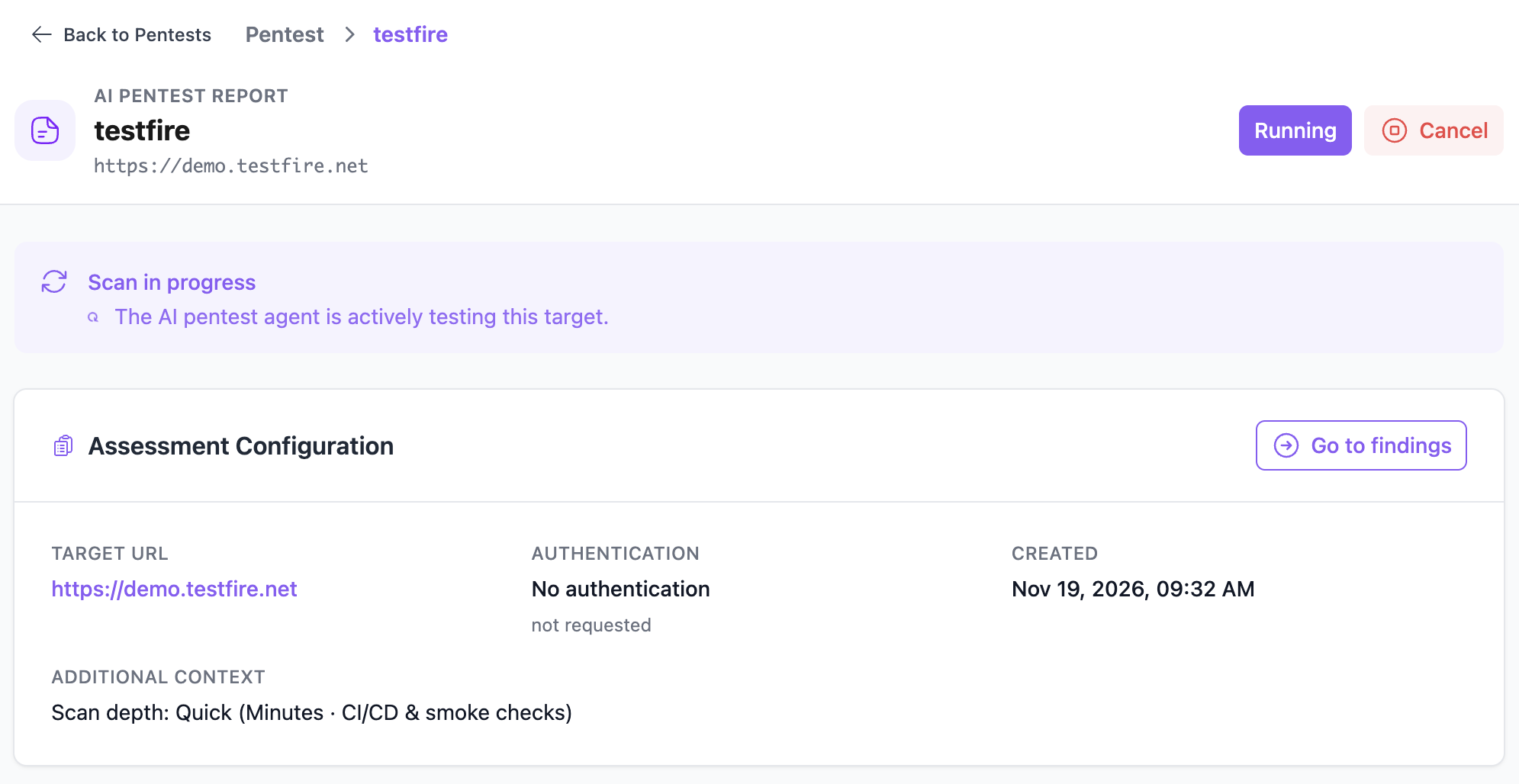
Screenshot: an AI Pentest run in progress in the Plexicus platform against a public demo target, with its assessment configuration. Captured November 2026.
4. Verify independently
The process that found the issue should not be the only one that confirms it. A second, separate pass reproduces the result from the recorded evidence.
If the second pass cannot reproduce it, the finding is marked unverified or discarded, with the reason recorded.
Independence matters because self-confirmation is easy. A system that generated a hypothesis is inclined to accept its own evidence.
5. Prioritize by demonstrated impact
Rank verified findings by what was actually achieved, combined with business context: exposure, the data involved and the systems that depend on it.
A verified chain that reads customer records outranks an unverified critical score.
6. Remediate with the evidence attached
The fix is written against the finding, not against a generic description of the weakness class. The reviewer sees the evidence, the affected code path and the reasoning behind the change.
Human review stays in the loop. Proof makes the review faster and better informed. It does not replace it.
7. Re-test with the original proof
Replay the original exploit against the fixed version. If it still works, the fix is not done.
Research on automated security patching shows why this step cannot be skipped. A 2024 study of LLM agents patching OSS-Fuzz vulnerabilities found that patches with high code-similarity scores still failed against the exploit input, and concluded that patch correctness needs dynamic checks such as test execution.
A fix is closed when the proof that opened the finding no longer works.
What “No PoC, No Finding” Does Not Mean
A strict rule needs clear limits. These are the most common misreadings.
It does not mean “no PoC, no risk”
Failing to reproduce an exploit is not proof that the weakness is harmless. The test may have lacked access, data or time. Unverified items stay visible, with their reason, and are re-tested when conditions change.
It does not mean ignoring what cannot be exploited safely
Some issues cannot be demonstrated without causing harm: denial of service, destructive writes, actions on real customer data. For these, the proof is a controlled reproduction in a test environment, or a code-level demonstration that the condition is reachable.
It does not cover every type of risk
Weak cryptography, an outdated component without a known exploit path, or a missing security header may not have a PoC at all. They still need an owner. Inventory evidence, such as a software bill of materials with VEX statements, handles the first two better than an exploit. Configuration checks handle the third.
It does not mean attacking production
Proof is collected inside an authorized scope, under rules of engagement agreed in writing. Where possible, collect it in staging or a dedicated test environment. A practice that produces proof by breaking production has failed at its first job.
It does not remove human judgement
Proof informs the decision. People still decide what to fix first, how to fix it and whether to merge the change.
Where Proof Comes From: Static, Dynamic and Inventory Evidence
Proof-Driven AppSec is not a single tool category. It combines three sources of evidence.
Static evidence
Static analysis shows where a weakness sits in the code and which data flows reach it. It sees code that dynamic testing never exercises.
On its own, static evidence is a hypothesis. Combined with runtime confirmation, it tells engineers exactly what to change. Our SAST guide covers the method in depth.
Dynamic evidence
Dynamic testing, from automated scanning to full penetration testing, shows whether a weakness can be triggered in a running system. It sees configuration, deployment and business logic that code alone does not show.
On its own, dynamic evidence can be hard to tie back to the code that needs to change.
Inventory evidence
Software composition analysis and bills of materials show what is in your software: components, versions, algorithms and models. VEX statements record whether a known vulnerability in a component affects the product, and why.
Our XBOM guide explains how SBOM, CBOM and AIBOM fit into one inventory.
The strongest finding uses all three: the component, the code path and the demonstrated exploit.
Best Practices for a Proof-Driven Program
1. Write the scope first
Define the targets, environments, accounts and rules of engagement before any testing starts. Put it in writing. Review it when the application changes.
2. Define what “verified” means for your team
Agree on the evidence each finding type needs. A replayed request for an access-control flaw. A runtime-confirmed data flow for an injection. A justification label for a “not affected” statement.
3. Keep unverified items in their own state
Use a separate status for hypotheses, with the reason they were not verified. Do not delete them, and do not mix them into the engineering queue.
4. Separate the finder from the verifier
Use a second, independent pass to reproduce each result. Record who or what verified it and when.
5. Attach evidence where engineers work
The proof should be one click away from the ticket and the pull request, not in a PDF on a shared drive.
6. Turn the PoC into a regression test
Where it is safe, convert the proof into an automated test that runs in CI. It protects against the same weakness coming back.
7. Close only on re-test
A finding moves to closed when the original proof fails against the fixed version, not when a ticket is marked done.
8. Fix the class, not just the instance
When one verified finding appears, look for the same pattern elsewhere in the code. NIST’s Secure Software Development Framework calls for exactly this review.
Common Mistakes
- Treating a CVSS score as proof. A score describes potential severity, not what happened in your system.
- Treating a public exploit as proof. A PoC for a library version shows the weakness exists somewhere. It does not show it is reachable in your code.
- Calling an LLM explanation evidence. A model describing how a weakness could be exploited is a hypothesis. Evidence is what was observed when the exploit ran.
- Discarding everything without a PoC. Unverified is not the same as false. Keep the item and its reason.
- Verifying with the same process that found the issue. Self-confirmation inflates confidence.
- Closing on “scanner no longer reports it”. The scanner may have stopped seeing the issue while the exploit still works.
- Collecting proof outside the agreed scope. It creates legal and operational risk that no finding is worth.
Standards and Frameworks That Support a Proof-Driven Program
Proof-Driven AppSec is a practice, not a standard. The public standards and frameworks below point in the same direction.
NIST SSDF (SP 800-218)
The Secure Software Development Framework, published by NIST in February 2022, is still the current final version; a revised version was released as an initial public draft in December 2025. The final version includes a practice group on responding to vulnerabilities:
- RV.1.2 asks teams to examine or test their code to find vulnerabilities that have not been detected yet, or to confirm that a suspected one is really there.
- RV.2.1 asks teams to analyze each vulnerability to gather enough information about risk to plan its remediation, with risk calculations based on exploitability and potential impact as an example.
- RV.3.3 asks teams to review the software for similar vulnerabilities to eradicate a class of vulnerabilities.
Confirmation, exploitability and class-level fixes are the core of a proof-driven program.
OWASP Web Security Testing Guide
The WSTG reporting chapter asks that findings carry enough detail to understand, replicate and resolve each vulnerability, and lists working exploit code among the factors for likelihood.
CVSS version 4, EPSS and CISA KEV
These are prioritization inputs, described in the sections above. In a proof-driven program they decide what to test first, and the proof decides what is verified.
CISA BOD 26-04
For US federal civilian agencies, Binding Operational Directive 26-04, issued on June 10, 2026, revoked BOD 22-01. It sets remediation urgency from four factors: asset exposure, KEV status, whether exploitation can be automated, and technical impact. The directive says the timelines for each asset are dynamic as facts change.
It applies to federal agencies, not to private companies. Its logic is still a useful model: urgency follows evidence and exposure, not a single score.
VEX
The OpenVEX specification and CISA’s minimum requirements for VEX give a machine-readable way to state whether a product is affected. A not_affected statement must give its justification: a statement of absence, with its reasons, in a format other systems can read.
How to Measure a Proof-Driven Program
Counting findings rewards noise. Measure what proof changes instead.
| Metric | What it shows |
|---|---|
| Share of findings with proof attached | How much of the queue is verified |
| Reproduction rate in the second pass | How reliable the first pass is |
| Time from verified finding to merged fix | How quickly proof turns into action |
| Re-test pass rate on first fix attempt | How well fixes address the actual exploit |
| Reopened findings | Whether closure on re-test holds over time |
| Unverified items older than a set age | Whether hypotheses are being re-tested or forgotten |
Track these per application and per team. A falling reproduction rate means the detection stage is producing weaker candidates. A rising re-test failure rate means fixes are written against descriptions, not against evidence.
Where Plexicus Fits
Proof-Driven AppSec is the category Plexicus works in. The four product pillars map to the stages above.
AI SWARM PENTEST     validate and verify attack paths, with evidence
        │
DEEP CODE ANALYSIS   code path, reach and impact for each finding
        │
REMEDIATION          reviewer-ready change with the evidence attached
        │
XBOM                 components, algorithms and models, with VEX
Validate: AI Swarm Pentest
AI Swarm Pentest validates exploitable paths across your application, API and source code, and gives your team the evidence, impact context and a remediation path to review.
The scope and rules of engagement are agreed in writing before work starts, and Plexicus makes no automatic production changes. A second pass independently confirms each finding before it is marked verified. If that pass cannot reproduce the result, the finding is marked unverified or discarded.
The product page puts the rule in one line: No reproducible proof, no verified finding.
The deliverable includes the complete attack chain: target, steps, demonstrated impact and the context your team needs. For the method behind the swarm, read Introducing AI Swarm Pentest.
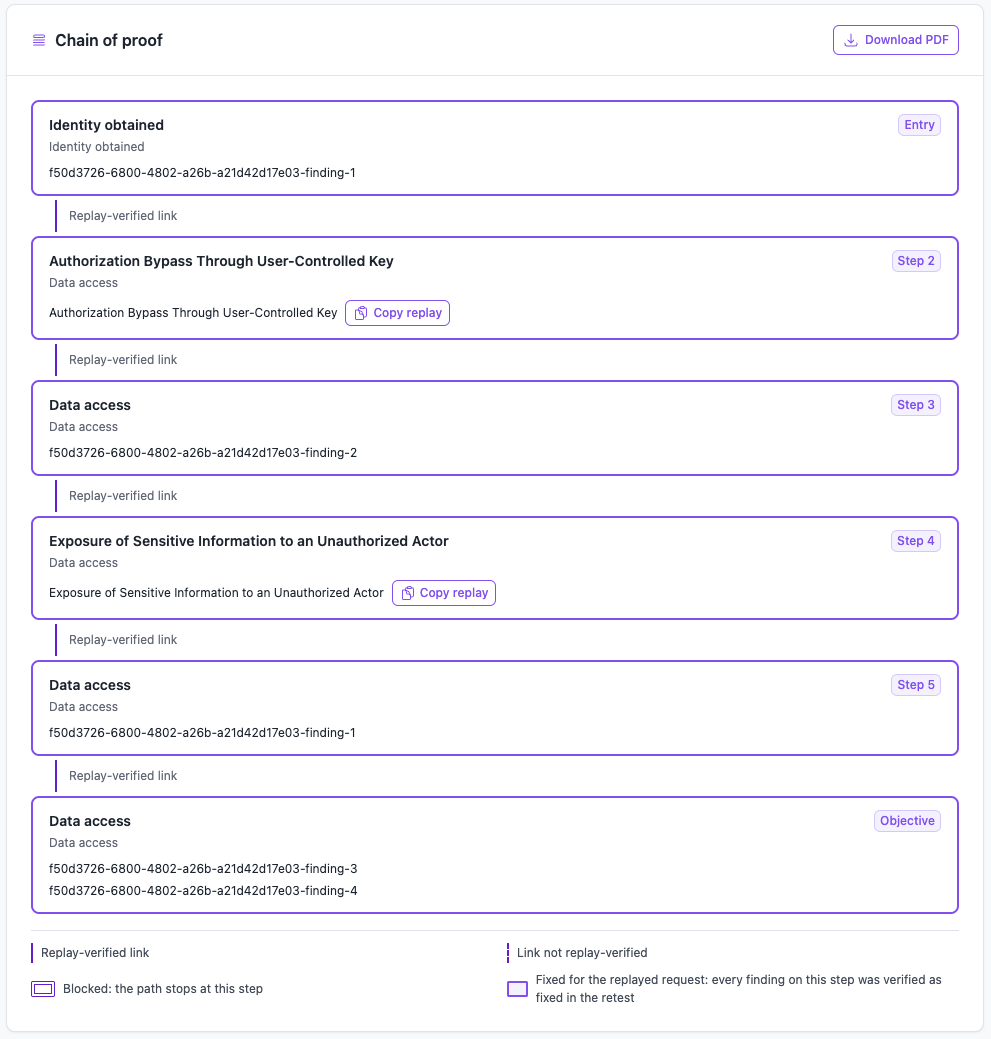
Screenshot: the Chain of proof panel of an AI Pentest run in the Plexicus platform, six linked steps from the entry point to the objective, each link marked replay-verified. Lab target, captured November 2026.
Understand: Deep Code Analysis
Deep Code Analysis connects code, data flow and business impact. It traces the affected code path so engineers see the endpoints, parameters and business logic a finding touches, and binds each finding to the data it can reach and the role that can trigger it.
Deep Code Analysis adds the context, and AI Swarm Pentest validates the highest-priority findings. The background is in What Is Deep Code Analysis?
Remediate: Remediation
Remediation starts once a finding is verified. Plexicus prepares the remediation context and a suggested change, with the affected flow, reach, weakness class and rationale bundled into it, and regression tests and notes where relevant.
The change lands in your existing repository with reviewer assignment and a re-test hook wired to CI. Your team keeps merge control, and Plexicus never pushes to production. The full workflow is in Introducing AI-Native Remediation.
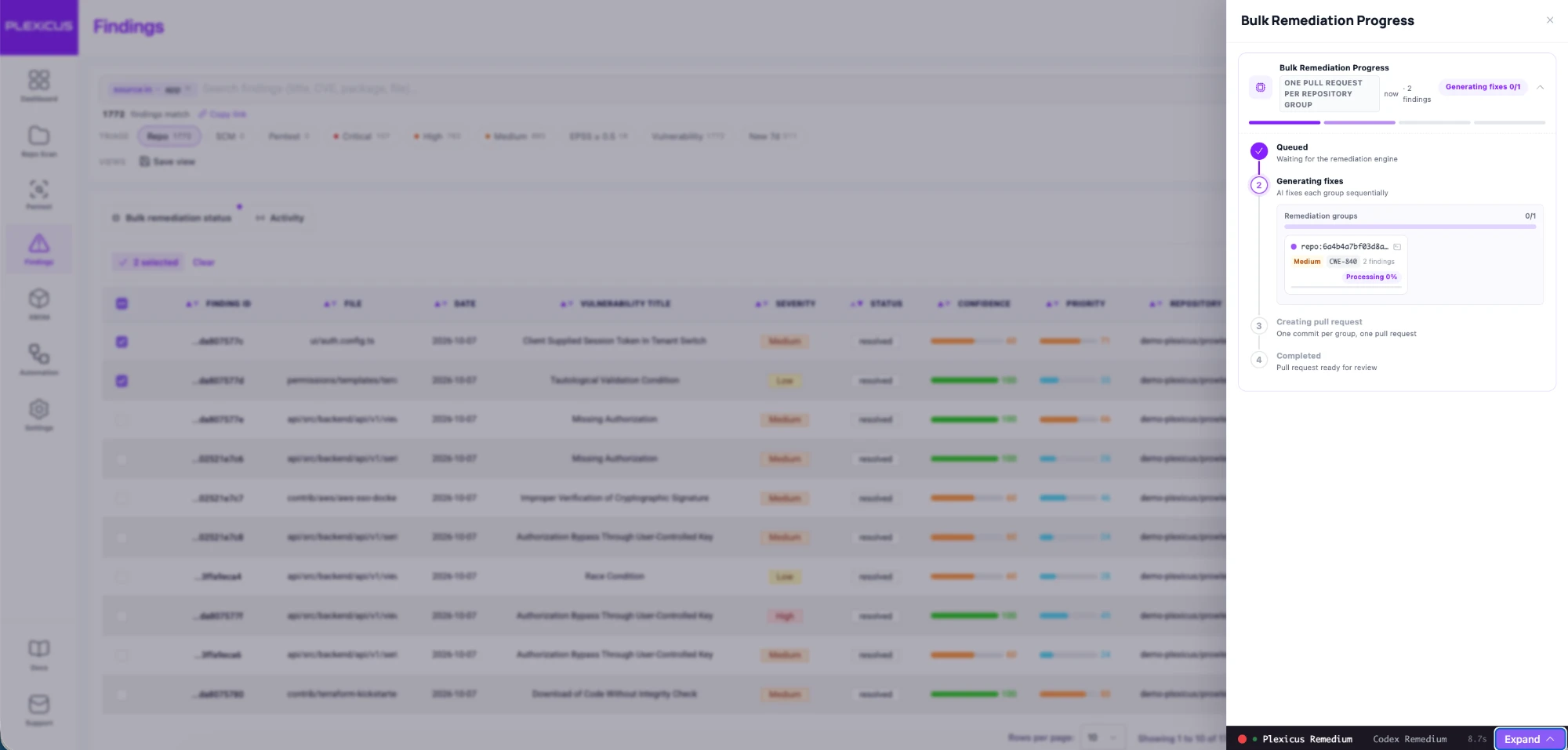
Screenshot: the Bulk Remediation Progress panel in the Plexicus platform, with the steps Queued, Generating fixes, Creating pull request and Completed for a group of findings. Demo data, captured October 2026.
Inventory: XBOM
XBOM unifies SBOM, CBOM and AIBOM into a single source of truth, with VEX statements attached to components: affected, not affected, fixed or under investigation, with a justification. Plexicus links those VEX justifications to the reachability path, the agent verdict and the source commit.
That gives your inventory evidence-backed VEX statements, not bare labels.
Proof-Driven AppSec also has a process view, the detect, verify, fix and audit loops described in From Alert to Fix. For where it sits in a full program, see What Is Application Security?
Frequently Asked Questions
What is Proof-Driven AppSec in one sentence?
It is an approach to application security in which a vulnerability is reported as verified only when reproducible evidence shows it can be exploited in the target, inside an authorized scope.
What does “No PoC, no finding” mean in practice?
An issue without a reproducible proof of concept is not presented as a verified finding. It stays in a separate, labelled state as a hypothesis, with the reason it was not verified.
Is Proof-Driven AppSec the same as penetration testing?
No. Penetration testing is one source of proof. Proof-Driven AppSec is the operating model around it: proof decides what enters the engineering queue, travels with the finding into the fix, and closes it on re-test.
Does Proof-Driven AppSec replace SAST and SCA?
No. Static analysis and software composition analysis produce the candidates and the inventory. Proof-Driven AppSec changes how their output is verified and prioritized.
Is a high CVSS score enough to treat a vulnerability as verified?
No. The CVSS Base score describes worst-case severity across environments. It does not show whether the weakness is reachable or exploitable in your application.
How is a PoC different from a CISA KEV listing?
A KEV listing means exploitation has been observed in the wild, somewhere. A PoC in your target means the weakness can be exploited in your application. Both are useful, and they answer different questions.
What happens to vulnerabilities that cannot be proven?
They are kept as unverified, with the reason recorded, and re-tested when the code, the configuration or the threat information changes. Some, such as weak cryptography, are handled through inventory evidence instead.
Is it safe to exploit vulnerabilities to prove them?
Only inside an authorized scope, under rules of engagement agreed in writing, and preferably in a test or staging environment. Destructive impacts are demonstrated in controlled conditions, not on live data.
Does proof remove the need for human review?
No. Proof gives reviewers better information. People still decide what to fix, approve the change and merge it.
How do I start with Proof-Driven AppSec?
Pick one application. Write the scope, define what counts as verified, and separate verified findings from hypotheses in your tracker. Then add re-testing with the original proof before any finding is closed.
Prove It, Fix It, Re-Test It
Put verified findings and their evidence in front of your engineers, and re-test every fix before it merges.
Want to see what your code looks like first? Run the free SAST tool on a GitHub repository.