What Is XBOM? SBOM, CBOM and AIBOM in One Inventory: The 2026 Guide
A complete guide to XBOM in 2026: what SBOM, CBOM and AIBOM each cover, how VEX turns an inventory into decisions, the standards and rules that apply, and how to build one that stays current.
Beyond ASPM
Proof-Driven AppSec for teams building with AI
Plexicus uses AI Swarm Pentest to explore authorized application paths, validate what is exploitable, and give teams evidence they can use to prioritize remediation.
Explore AI Swarm PentestMost of the code in your product was not written by your team.
It arrived as open-source packages, as cryptographic libraries, and now as AI models and the providers behind them.
An XBOM (extended bill of materials) is one inventory that joins three records: the software components you ship (SBOM), the cryptography they use (CBOM) and the AI models and datasets they depend on (AIBOM), with one identity for each item across all three views.
The software bill of materials is the part most teams know. It answers “which libraries are in this build?”.
It does not answer “which of our services still sign tokens with RSA?” or “which repositories call an external model API?”. Those questions now come from auditors, from regulators and from your own incident response team.
The pressure is measurable. In its 2026 Data Breach Investigations Report executive summary, Verizon reported that breaches with third-party involvement reached 48% of the breaches in its dataset, up 60% from the year before. The same report found that exploitation of vulnerabilities was the most common known initial access vector in breaches not caused by error or misuse, at 31%.
You cannot patch, replace or explain a component you do not know you have.
This guide covers what an XBOM is, how SBOM, CBOM and AIBOM differ, where VEX fits, which standards and rules apply in 2026, and how to build an inventory that stays current instead of going stale in a folder.
What Is XBOM?
An XBOM is an inventory of everything your software is made of, not only its packages.
The “X” stands for “extended”. It extends the software bill of materials with other kinds of bills of materials that describe the same product from different angles.
In this guide, and in Plexicus, XBOM means three BOMs joined together:
| BOM | What it lists | The question it answers |
|---|---|---|
| SBOM | Libraries, packages and dependencies, with versions, licenses and identifiers | Which third-party code is in this product? |
| CBOM | Algorithms, key sizes, primitives and where they are used | Which cryptography does this product rely on? |
| AIBOM | Models, datasets, providers and their risk flags | Which AI does this product depend on, and where did it come from? |
“XBOM” is not the name of a standard. It is a name for a practice, and the term is used in different senses across the industry.
The standards underneath are the data formats: CycloneDX and SPDX.
That distinction matters when you talk to an auditor. Nobody asks for “an XBOM file”.
They ask for an SBOM in a recognized format, a list of cryptographic assets, or documentation about the models and data in an AI system. An XBOM is how you answer all three from one source.
What does “one identity across views” mean?
A component, a key or a model should be the same record whether you look at it from the software view, the cryptography view or the AI view.
If a payment service pulls in a TLS library, that library is a component in the SBOM. The algorithms it uses are cryptographic assets in the CBOM. Both should point to the same repository, the same version and the same owner.
Without a shared identity you have three spreadsheets. With one, you have an inventory.
Why XBOM Matters in 2026
Four things changed between 2024 and 2026, and each of them pushes inventories past the SBOM.
1. The SBOM baseline itself was rewritten. On July 29, 2026, CISA, NSA, FBI and international partners released the 2026 Minimum Elements for a Software Bill of Materials. According to CISA, the document updates and replaces the minimum elements that NTIA published in 2021.
The CISA announcement says the new minimum elements apply to SBOMs for all software, including open-source software, AI software and software as a service. It also lists new elements such as Component Hash Algorithm, Component License, SBOM Tool Name and SBOM Generation Context.
An SBOM built to the 2021 checklist no longer meets the current baseline.
2. Cryptography now has a deadline. In August 2024 NIST released its first three finalized post-quantum encryption standards: FIPS 203 (ML-KEM), FIPS 204 (ML-DSA) and FIPS 205 (SLH-DSA).
In October 2026 NIST published the final version of NIST IR 8547, Transition to Post-Quantum Cryptography Standards. It states that NIST will deprecate quantum-vulnerable public-key cryptography after 2030 and disallow it under NIST standards and guidelines after 2035.
The report tells organizations to treat the migration as a current priority, “beginning with cryptographic inventories”. You cannot migrate an algorithm you have not found.
3. AI components entered the supply chain. Your product may now call a hosted model, ship a self-hosted model file or depend on a dataset.
The CISA 2026 document says AI systems may have components that the minimum elements do not capture, and points to the kind of information engineers call model cards and data cards. It then says plainly that it does not add elements for AI systems.
Instead, the same document points to separate joint guidance on minimum elements for AI SBOMs, released by CISA and its G7 partners in May 2026.
An AIBOM is how you put that guidance into practice in your own software.
4. Regulation turned inventories into obligations. The EU Cyber Resilience Act (Regulation (EU) 2024/2847) requires manufacturers of products with digital elements to draw up a software bill of materials. Its reporting obligations have applied since September 11, 2026, and its main obligations apply from December 11, 2027, according to the European Commission.
Add the remediation numbers from Verizon’s 2026 executive summary: only 26% of critical vulnerabilities listed in the CISA Known Exploited Vulnerabilities catalog were fully remediated by organizations in 2025, down from 38% the year before, and the median time to full resolution rose to 43 days.
Slow remediation starts with slow discovery. An inventory you can query is the first step to knowing which systems a new advisory touches.
SBOM vs. XBOM: What Is the Difference?
An SBOM is a list of software components. An XBOM is a set of linked lists about the same product.
| SBOM | XBOM | |
|---|---|---|
| Scope | Third-party and first-party software components | Software components, cryptographic assets and AI models and datasets |
| Typical question | ”Are we using log4j-core 2.14.1?" | "Are we using it, which algorithms does the service use, and which model does it call?” |
| Standards | CycloneDX, SPDX, CISA 2026 minimum elements | The same formats, using their cryptography and AI capabilities |
| Main users | Security, legal, procurement | Security, legal, procurement, cryptography owners, AI governance |
| Failure mode | Lists packages, misses crypto and models | Becomes three disconnected lists if identity is not shared |
An XBOM does not replace the SBOM. The SBOM is its first and largest part, and every rule that applies to SBOMs still applies inside an XBOM.
SBOM vs. CBOM vs. AIBOM
The three BOMs answer different audit questions and are read by different people.
| SBOM | CBOM | AIBOM | |
|---|---|---|---|
| Unit of inventory | Component (package, library, module) | Cryptographic asset (algorithm, key, certificate, protocol) | Model, dataset, provider |
| Key fields | Name, version, producer, identifiers, license, hash, dependencies | Algorithm, key size or parameters, primitive, where it is used | Provider, version, dataset provenance, license, model card |
| Main risk it surfaces | Known vulnerabilities, license conflicts, outdated components | Deprecated or quantum-vulnerable algorithms, weak key sizes | Unsafe serialization, external data flows, restricted licenses, missing documentation |
| Driven by | CISA 2026 minimum elements, EU CRA | NIST post-quantum transition | EU AI Act documentation duties, internal AI governance |
| CycloneDX support | SBOM | CBOM | ML-BOM |
| SPDX support | Core and Software profiles | No dedicated profile in SPDX 3.0.1 | AI and Dataset profiles |
XBOM vs. Asset Inventory
An IT asset inventory lists machines, accounts and licenses you bought. An XBOM lists what your own software is built from.
The two meet at deployment, but they answer different questions. An asset inventory tells you which servers run a service. An XBOM tells you what is inside the service.
The Software Bill of Materials (SBOM)
The SBOM is the formal record of the components in your software and how they relate.
The CRA uses almost the same definition: a formal record containing details and supply chain relationships of components included in the software elements of a product with digital elements.
What must an SBOM contain in 2026?
The CISA 2026 document defines 17 data fields in two groups. The full PDF lists them in its Appendix A.
| Group | Data fields |
|---|---|
| SBOM metadata (9) | SBOM Author, SBOM Author Signature, SBOM Data Format Name, SBOM Data Format Version, SBOM Generation Context, SBOM Timestamp, SBOM Tool Name, SBOM Tool Version, SBOM Version |
| Component data (8) | Component Producer, Component Name, Component Version, Component Identifiers, Component Hash Value, Component Hash Algorithm, Component License, Component Dependency Relationship |
The document adds six practice elements on top of the fields: Accommodation of Updates to SBOM Data, Coverage, Distribution and Delivery, Explicitly Identifying Unknown Information, Frequency and Machine-Processable Data.
Two changes stand out for practitioners.
SBOM Generation Context records the lifecycle phase in which the SBOM was produced. An SBOM generated from a source manifest describes intent. One generated from a build artifact describes what shipped.
Component Hash fields let a consumer check that the component in the SBOM is the one in the artifact, not just one with the same name.
Strengths:
- Mature formats and tooling. CISA names SPDX and CycloneDX as the two formats in wide use.
- Direct link to vulnerability data through identifiers such as package URLs (PURLs).
- License visibility for legal review.
Limitations:
- An SBOM says what is present. It does not say whether a vulnerable function is reachable or exploitable.
- A snapshot goes stale with the next build. CISA’s Frequency element asks for a new SBOM with every new build or release.
- It says nothing about cryptography or AI models unless you extend it.
For a broader look at how dependency scanning tools build and use SBOMs, see our guide to software composition analysis tools.
The Cryptographic Bill of Materials (CBOM)
A CBOM is an inventory of the cryptographic assets in your software: algorithms, keys, certificates and protocols, and where each one is used.
CycloneDX describes its CBOM capability as a way to represent algorithms, keys, certificates and their relationships to software components, so organizations can find deprecated algorithms or expired certificates.
Why a CBOM matters now
NIST IR 8547 lists the public-key algorithms that a large enough quantum computer would break, with their transition dates. The dates apply to the parameter sets shown; weaker parameters are not covered by this window.
| Algorithm family | Use | Parameters | NIST IR 8547 transition |
|---|---|---|---|
| RSA | Digital signatures and key establishment | ≥ 112 bits of classical security | Deprecated after 2030, disallowed after 2035 |
| ECDSA | Digital signatures | ≥ 112 bits of classical security | Deprecated after 2030, disallowed after 2035 |
| EdDSA | Digital signatures | ≥ 128 bits of classical security | Deprecated after 2030, disallowed after 2035 |
| Finite field DH and MQV | Key establishment | ≥ 112 bits of classical security | Deprecated after 2030, disallowed after 2035 |
| Elliptic curve DH and MQV | Key establishment | ≥ 112 bits of classical security | Deprecated after 2030, disallowed after 2035 |
The replacements include the standards NIST finalized in 2024: ML-KEM for key establishment, and ML-DSA and SLH-DSA for signatures.
A post-quantum migration is a search problem before it is an engineering problem. The algorithm hides in a JWT library, a TLS configuration, a disk encryption call or a signing step in your release pipeline.
What a useful CBOM records:
- The algorithm and its parameters, for example a key size or a named curve.
- The primitive: block cipher, signature, key agreement, hash.
- The context: TLS, token signing, data at rest, code signing.
- The repository and component where it was found.
- A classification you can act on: quantum-safe, quantum-vulnerable, deprecated or weak.
Strengths:
- Turns a post-quantum plan into a list of concrete changes.
- Finds weak configurations that are a problem today, not only after 2030.
Limitations:
- Static discovery finds algorithms named in code and configuration. Keys negotiated at runtime, or cryptography inside closed binaries, may need other evidence.
- A CBOM entry is not a migration. Each item still needs an owner, a replacement and a test.
We covered the quantum side of this in depth in Quantum Readiness for the Software Supply Chain. This guide stays on the inventory itself.
The AI Bill of Materials (AIBOM)
An AIBOM is an inventory of the AI in your software: the models, the providers that serve them, the datasets behind them and the risk flags attached to each.
CycloneDX calls its version the ML-BOM. It represents models, datasets and their dependencies, including dataset provenance and the configuration of AI frameworks.
The third major version of SPDX, released in April 2024, organizes the specification into profiles. The SPDX 3.0.1 specification includes AI and Dataset profiles next to Core, Software, Security and Build, and its AI profile defines how to document AI software packages, models and datasets.
What an AIBOM should answer:
- Which models does each repository use, at which version, from which provider?
- Is the model called through an external API, or shipped and run by you?
- Which datasets were used, and what is known about their provenance and license?
- Is there a model card? Is the license restricted?
- Is the model file in a format that can execute code when loaded?
The last question is easy to miss. Some model files are saved with Python’s pickle format, and the Python documentation warns that malicious pickle data can execute arbitrary code during unpickling. An AIBOM that flags unsafe serialization turns a hidden risk into a line item.
Strengths:
- Gives AI governance a factual starting point instead of a survey.
- Makes external data flows to model providers visible to security and privacy teams.
Limitations:
- AI SBOM guidance is young. CISA’s 2026 document adds no AI-specific elements and refers readers to the separate G7 guidance from May 2026.
- Provenance is only as good as what the model producer publishes. A missing model card is a finding, not a gap you can fill by guessing.
For the agent side of AI risk, see how AI coding agents became a supply chain attack path.
VEX: Turning an Inventory Into Decisions
An inventory that lists 40 known vulnerabilities does not tell you which ones matter.
VEX (Vulnerability Exploitability eXchange) is a machine-readable statement about whether a known vulnerability actually affects a specific product.
CycloneDX describes VEX as a way to convey the exploitability of vulnerable components in the context of the product in which they are used. CISA published Minimum Requirements for VEX on April 21, 2023.
The OpenVEX specification defines four statuses:
| Status | Meaning |
|---|---|
not_affected | No remediation is required. A justification or an impact statement must be added. |
affected | Actions are recommended to remediate or address the vulnerability. |
fixed | These product versions contain a fix. |
under_investigation | It is not yet known whether these versions are affected. |
A not_affected statement needs either a free-text impact statement or one of five justification labels: the component is not present, the vulnerable code is not present, the vulnerable code is not in the execute path, the vulnerable code cannot be controlled by an adversary, or inline mitigations already exist.
A VEX statement is a claim. Its value depends on the evidence behind it. “Not in the execute path” means something only if someone traced the path.
This is where Proof-Driven AppSec meets the inventory: the strongest VEX statement is one linked to a reproduced result, not to an opinion.
How an XBOM Is Built
Building an XBOM is a pipeline, not a one-time export.
Discover -> Normalize and link -> Assess -> Explain (VEX) -> Diff -> Export
1. Discover
Scan every repository for dependency manifests and lock files, for cryptographic calls and configuration, and for model references, model files and provider SDKs.
Coverage is the first quality bar. The CISA 2026 Coverage element asks for all components that make up the software, including transitive dependencies, with no minimum depth. If the SBOM does not list a component, the reader should be able to conclude that a vulnerability in it does not affect them.
2. Normalize and link
Give each item a stable identifier: a package URL for components, an algorithm name with parameters for cryptography, a provider plus model name plus version for AI.
Then connect the three views. A component points to the cryptographic assets found in it and to the models it calls. Each item points to its repository.
3. Assess
Attach what is known about risk: vulnerabilities and license category for components, quantum readiness and deprecation for algorithms, risk flags for models.
4. Explain with VEX
For each vulnerability on each component, record a status and, for not_affected, a justification with evidence.
5. Diff
Compare each scan with the previous one for the same repository. Added, removed and changed items are where new risk enters.
6. Export
Produce the format the reader needs: CycloneDX or SPDX for machines, a readable report for auditors.
Formats and Standards You Will Meet
CycloneDX. CycloneDX is an OWASP project. It is also published as an Ecma standard: ECMA-424, whose 2nd edition, from December 2025, defines the current version of CycloneDX.
CycloneDX has native capabilities for SBOM, CBOM, ML-BOM and VEX, among other BOM types. One specification can therefore describe all three BOMs.
SPDX. SPDX 2.2.1 was published as the international standard ISO/IEC 5962
, according to the SPDX release notes. The current release is SPDX 3.0.1, with profiles that include AI and datasets.CISA 2026 Minimum Elements. The US baseline for what an SBOM contains, covered above. It names SPDX and CycloneDX as the two widely used formats and advises against accepting SBOMs for new software generated in deprecated versions of any format.
BSI TR-03183-2. Germany’s Federal Office for Information Security publishes TR-03183, Cyber Resilience Requirements. Part 2 covers SBOMs and is at version 2.1.0, which adds a mapping between its data fields and SPDX and CycloneDX. The BSI states that the guideline is not binding and is not a presumption of conformity.
The TR also requires recent versions of both formats (for SPDX, 3.0.1 or higher), so check which format version your tools export.
What the Rules Require in 2026
EU Cyber Resilience Act. Annex I, Part II, point 1 of the CRA requires manufacturers to identify and document vulnerabilities and components, including by drawing up an SBOM in a commonly used and machine-readable format covering at the very least the top-level dependencies.
The key dates, from Article 71 of the regulation:
| Date | What applies |
|---|---|
| December 10, 2024 | The regulation entered into force |
| June 11, 2026 | Chapter IV, on notification of conformity assessment bodies |
| September 11, 2026 | Article 14 reporting of actively exploited vulnerabilities and severe incidents |
| December 11, 2027 | The rest of the regulation, including the SBOM duty |
Three details matter in practice.
The SBOM does not have to be public. The CRA lets the manufacturer decide whether to make it available to users. It is part of the technical documentation, and a market surveillance authority can request it.
Top-level dependencies are a floor, not a target. The text says “at the very least”, and the Commission may specify the SBOM format and elements through implementing acts under Article 13(24).
Reporting already applies. Since September 11, 2026, manufacturers must report actively exploited vulnerabilities, as the Commission’s CRA reporting page explains. Knowing whether an exploited component is in your product is the first step of that report.
EU AI Act. The AI Act (Regulation (EU) 2024/1689) requires technical documentation for high-risk AI systems. In the text as published in 2024, its Annex IV asks, where relevant, for datasheets describing the training data sets used, including their provenance, scope and main characteristics.
According to the European Commission, after the AI Omnibus amendment entered into force on July 27, 2026, the rules for high-risk use cases in Annex III apply from December 2, 2027, and those for high-risk systems embedded in regulated products from August 2, 2028.
An AIBOM does not make a system compliant on its own. It gives the documentation a factual inventory to start from.
NIST post-quantum transition. NIST IR 8547 sets the 2030 and 2035 dates in the CBOM section above. For US federal systems, the report also points to Executive Order 14412 and OMB Memorandum M-26-15, which set earlier deadlines for the most sensitive systems.
Best Practices for an XBOM
1. Generate from builds, not only from manifests
A manifest says what you asked for. A build says what you got. Record the generation context so readers know which one they have.
2. Keep one identity per item
Use package URLs for components and consistent names for algorithms and models. Deduplicate across repositories before you count anything.
3. Treat diffs as the main signal
New dependencies, removed components and version changes are where risk enters. Review the diff on every scan, not the whole list once a year.
4. Attach VEX with evidence
Never mark a vulnerability not_affected without a justification you can show. A blanket “all clear” is worth nothing to an auditor.
5. Watch what you cannot fix today
Keep a watchlist of components and CVEs you care about, so a new exploitation report reaches the owner the same day.
6. Classify cryptography and AI risks now
Start with algorithms that protect long-lived data and with weak configurations that are a problem today. Flag the AI risks you can already see in code and metadata: external API calls, unsafe serialization, restricted licenses and missing model cards.
7. Export in standard formats
Support CycloneDX and SPDX. Do not let your inventory live only in a vendor dashboard that a customer or regulator cannot read.
Common XBOM Mistakes
- Treating the SBOM as a compliance file. An SBOM generated once for a contract and never updated is a receipt, not an inventory.
- Listing without linking. Three separate lists for software, cryptography and AI cannot answer a question that crosses them.
- Counting vulnerabilities instead of exploitable ones. A raw CVE count without VEX drives work toward components that cannot be reached.
- Ignoring transitive dependencies. The CRA floor is top-level dependencies, but the CISA 2026 Coverage element asks for transitive ones too. Attackers do not stop at the first level.
- Waiting for 2030 to find RSA. The deprecation date is a deadline for finishing, not for starting the search.
- Forgetting hosted models. A model you call over an API is still a dependency, with its own data flow and license.
A Practical Example
Here is how the three views work together on one illustrative advisory. The services and versions in it are invented.
A critical vulnerability is published in a widely used logging library, the way Log4Shell (CVE-2021-44228) was in December 2021, when CISA described active, widespread exploitation of the Log4j 2 releases it listed, ending at 2.14.1. In a 2022 update to that page, which CISA has since archived, it advised organizations to consider every asset, including internally developed software.
With only a folder of SBOM files, your team opens each one and searches by hand.
With an XBOM:
- SBOM view. You search the component name and find it in three repositories, at two versions.
- VEX. One repository already has a
fixedstatement from an earlier upgrade. The other two areunder_investigation. - Evidence. A validation run on one service reproduces the issue, so its status becomes
affected. The other shows the vulnerable class is not loaded, so it becomesnot_affectedwith the justification and the evidence attached. - CBOM view. The affected service also signs session tokens with RSA-2048. That is not part of this incident, but the owner adds it to the migration plan while the code is open.
- Diff. After the fix, the next scan shows the old version removed and the new one added, with the VEX status carried across.
- Export. You hand the auditor a CycloneDX document and a readable report with the same statuses.
The inventory did not fix anything. It made every step of the fix faster to find and easier to prove.
What XBOM Is Not
- Not a scanner on its own. It is the record that scanners, analysis and testing feed.
- Not proof of exploitability. It tells you where a vulnerable component is. Validation tells you whether it can be exploited.
- Not a compliance certificate. It supports CRA, AI Act and procurement evidence. It does not replace a conformity assessment.
- Not a one-off export. An XBOM that is not regenerated with each build describes software you no longer ship.
Where Plexicus Fits
Plexicus XBOM unifies SBOM, CBOM and AIBOM into a single source of truth, with VEX statements, watchlists, drift detection and standards-ready exports in CycloneDX, SPDX and PDF.
The same component, key or model keeps one identity across every view. This is the Unified XBOM, one of the four pillars of Proof-Driven AppSec.
Here is the software view in the Plexicus platform:
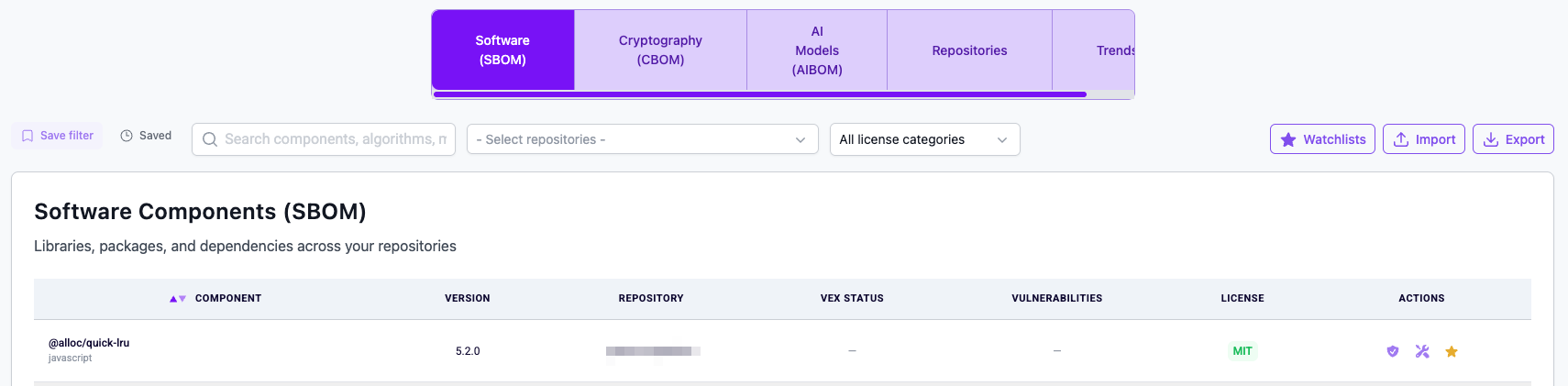
Screenshot: the XBOM inventory in the Plexicus platform, with tabs for software, cryptography and AI models, the filters and the software components table; the repository name is pixelated. Captured November 2026.
According to the XBOM product page, each view covers:
- SBOM: libraries, packages and dependencies across every repository, with license category, VEX status and provenance, CycloneDX and SPDX compatibility, license risk scoring, and a diff between scans.
- CBOM: algorithms, key sizes, primitives and context, with quantum-readiness scoring against the NIST 2030 and 2035 deadlines, a quantum-safe, vulnerable or deprecated classification, and a post-quantum migration roadmap per algorithm.
- AIBOM: models, datasets, providers and risk flags, including unsafe serialization, external API use, restricted or unknown licenses and missing model cards.
This is the cryptography view:
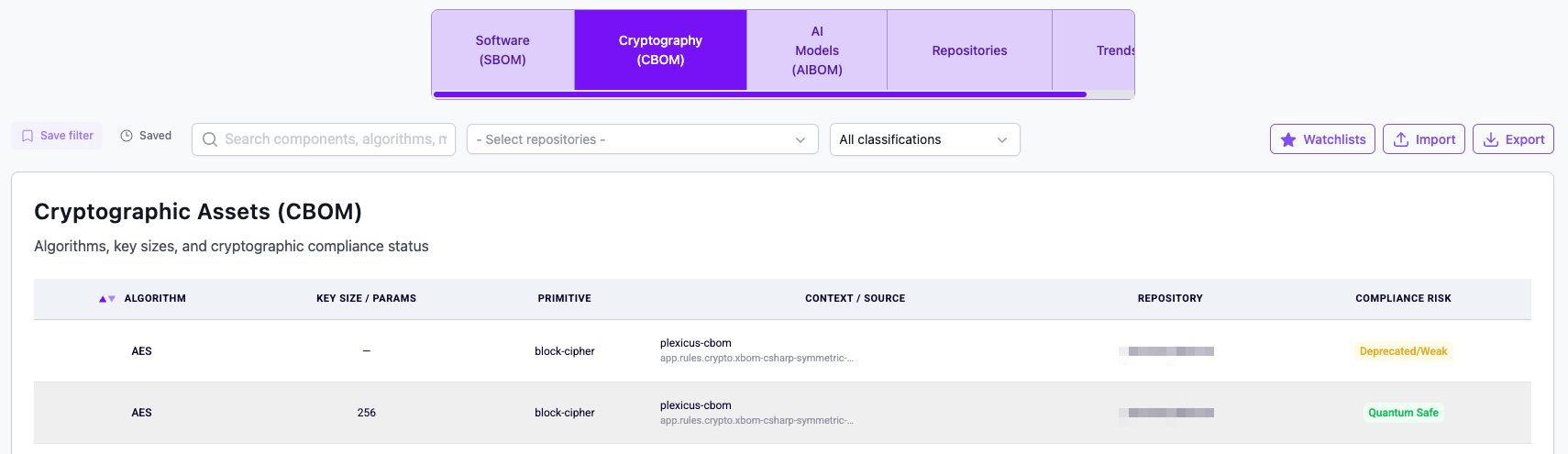
Screenshot: the Cryptography (CBOM) tab of the XBOM inventory in the Plexicus platform, listing algorithms with key size, primitive and a compliance risk such as Quantum Safe; repository names are pixelated. Captured November 2026.
The product page describes how the inventory stays explainable and current:
- Per-component VEX: one statement per CVE per component, with the statuses affected, not affected, fixed or under investigation.
- Linked to the evidence: VEX justifications reference the reachability path, the agent verdict and the source commit.
- Bulk VEX import: import a supplier SBOM and VEX in one upload; Plexicus reconciles package URLs and surfaces the components you own.
- Watchlists: watch any name, package URL or CVE, and get notified when a new finding matches.
- Diff, not snapshots: every scan is compared with the previous one for the same repository, and VEX is preserved across the diff.
- Exports: CycloneDX and SPDX in JSON, and a PDF attestation.
No PoC, no finding. The evidence behind a VEX statement can come from the rest of the closed loop: AI Swarm Pentest validates exploitable paths across your application, API and source code, Deep Code Analysis adds code and impact context, and Remediation turns a verified finding into a reviewed, merge-ready fix with a verification re-test.
To see how those pieces fit into a full program, read What Is Application Security?, our guide to SAST and our introduction to AI-native remediation.
Frequently Asked Questions
What does XBOM stand for?
XBOM stands for extended bill of materials. It extends the software bill of materials with other inventories of the same product, such as cryptography (CBOM) and AI models and datasets (AIBOM).
What is the difference between an SBOM and an XBOM?
An SBOM lists software components. An XBOM links that list with the cryptographic assets and AI components of the same product, so one item keeps one identity across all views.
What is a CBOM?
A cryptographic bill of materials lists the algorithms, keys, certificates and protocols in your software, with their parameters and where they are used. It is the starting point of a post-quantum migration.
What is an AIBOM?
An AI bill of materials lists the models, providers and datasets your software depends on, with provenance, licenses and risk flags such as unsafe serialization or a missing model card.
Do I need an XBOM for the Cyber Resilience Act?
The CRA requires an SBOM covering at least top-level dependencies, with the main obligations applying from December 11, 2027. It does not require a CBOM or an AIBOM, but a linked inventory makes the vulnerability handling and reporting duties easier to meet.
What changed in the CISA 2026 SBOM minimum elements?
The July 2026 document replaces the 2021 NTIA minimum elements. It defines 17 data fields, adding elements such as Component Hash Algorithm, Component License, SBOM Tool Name and SBOM Generation Context, plus six practice elements.
What is VEX and why does it matter?
VEX is a machine-readable statement of whether a known vulnerability affects a specific product. It turns a list of CVEs into a list of decisions: affected, not affected, fixed or under investigation.
Which format should I use, CycloneDX or SPDX?
CISA names both as widely used and asks organizations to accept any widely used, machine-processable format. CycloneDX covers SBOM, CBOM, ML-BOM and VEX in one specification; SPDX 3.0.1 includes AI and Dataset profiles. Check which version of each format your auditor or customer expects.
How often should an XBOM be updated?
With every build or release. The CISA 2026 Frequency element asks for a new SBOM whenever a component producer releases a new build, and the same logic applies to cryptography and models.
One Inventory for Everything You Ship
Know every component, algorithm and model in your software, and prove what each finding means before your team spends a day on it.