What Is Application Security? The Complete AppSec Guide for 2026
A complete guide to application security in 2026, from secure design and software supply chains to testing, exploit validation, remediation, and Proof-Driven AppSec.
Beyond ASPM
Proof-Driven AppSec for teams building with AI
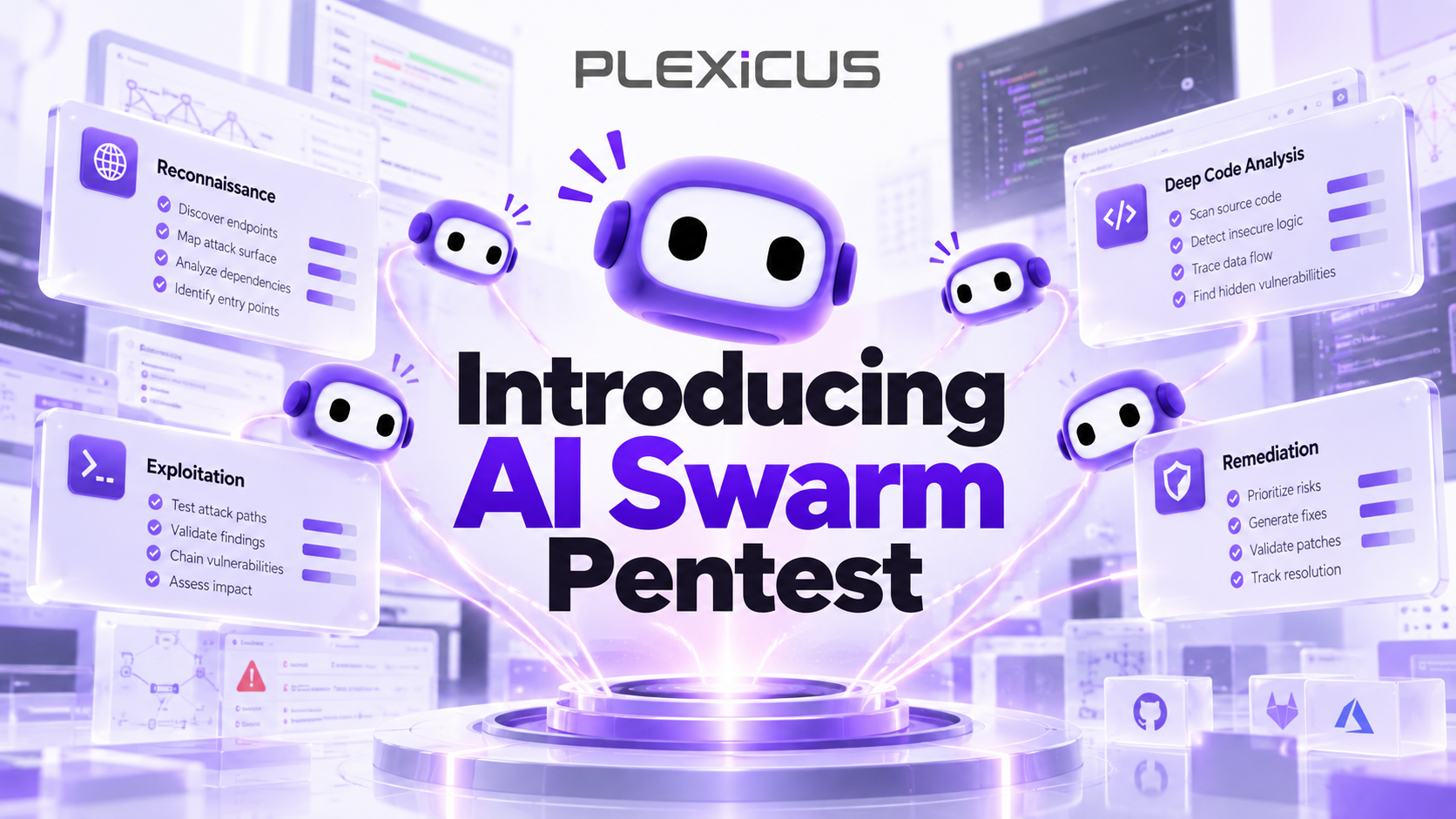
Plexicus uses AI Swarm Pentest to explore authorized application paths, validate what is exploitable, and give teams evidence they can use to prioritize remediation.
Explore AI Swarm PentestApplication security, usually shortened to AppSec, is the practice of protecting software applications from vulnerabilities, attacks, unauthorized access, and misuse throughout their lifecycle.
That sounds simple.
In practice, application security has become much broader than finding bugs in source code.
Modern applications are assembled from proprietary code, open-source packages, APIs, cloud infrastructure, containers, CI/CD pipelines, secrets, third-party services, AI-generated code, configuration files, and increasingly autonomous software agents.
An application can therefore be perfectly valid code and still be insecure.
That distinction matters more in 2026 than ever.
Verizon’s 2026 Data Breach Investigations Report says exploitation of software vulnerabilities has become the leading initial breach vector, accounting for 31% of breaches analyzed in the report. Verizon
At the same time, the latest OWASP Top 10
elevates Security Misconfiguration to second place and expands its former “Vulnerable and Outdated Components” category into the much broader Software Supply Chain Failures category. OWASP Top 10For organizations operating in Europe, application security has also become increasingly tied to regulatory responsibility. Since 11 September 2026, manufacturers covered by the EU Cyber Resilience Act must report actively exploited vulnerabilities and severe security incidents under specific deadlines. Digital Strategy
Application security is no longer something performed once before release.
It is an engineering discipline that extends from architecture to production.
What Is Application Security?
Application security is the combination of technologies, processes, architecture, testing, and secure development practices used to prevent, identify, validate, remediate, and monitor security weaknesses in software applications.
Its objective is not simply to eliminate every possible vulnerability.
That would be unrealistic.
The objective is to continuously reduce the likelihood that weaknesses in an application can be exploited to produce meaningful business impact.
A mature AppSec program therefore asks questions such as:
- Can an unauthorized user access another customer’s data?
- Can an attacker manipulate an API request to perform privileged actions?
- Does the application expose secrets or credentials?
- Are vulnerable open-source dependencies being shipped?
- Could configuration mistakes expose infrastructure?
- Can attacker-controlled input reach a dangerous code path?
- Are security controls implemented correctly?
- Can identified vulnerabilities actually be exploited?
- Which vulnerabilities matter most?
- Can developers fix them quickly enough?
This makes AppSec both a software engineering problem and a risk-management problem.
OWASP makes a similar distinction in its risk model: the severity of an application security problem depends not only on a technical weakness, but also on exploitability, threat actors, exposure, technical impact, and ultimately business impact. OWASP Top 10
Why Application Security Matters in 2026
Software development has changed dramatically.
Applications are being built faster, development environments are more interconnected, software supply chains are larger, and AI-assisted development can generate substantial amounts of code in minutes.
Security teams are therefore protecting more code, dependencies, services, APIs, cloud environments, and releases than traditional review processes were designed to handle.
Three developments are particularly important.
1. Vulnerability exploitation is becoming a primary entry point
The 2026 Verizon DBIR reports that vulnerability exploitation has overtaken stolen credentials as the leading breach entry point in its dataset. Verizon
That changes the economics of vulnerability management.
A vulnerability backlog containing thousands of findings is no longer merely a compliance problem. Somewhere inside that backlog may be the attack path that actually gives an attacker access to sensitive infrastructure or data.
The challenge is increasingly:
Which vulnerability can really be exploited, through which path, and with what impact?
That is a very different question from:
How many vulnerabilities did the scanner find?
2. The software supply chain is now part of AppSec
Modern developers rarely write an application entirely from scratch.
Applications depend on:
- npm, PyPI, Maven, NuGet and other package ecosystems
- container base images
- GitHub Actions and CI/CD components
- infrastructure modules
- SDKs
- APIs
- third-party services
- build environments
- artifact repositories
That is why the OWASP Top 10
introduced Software Supply Chain Failures as A03.OWASP explicitly broadened the former vulnerable-components category to include compromises across dependencies, build systems, and software distribution infrastructure. OWASP Top 10
Scanning your own source code is therefore necessary, but insufficient.
3. Security is moving from optional practice to product responsibility
Secure-by-design principles increasingly place responsibility on software producers rather than expecting customers to compensate for insecure products.
CISA’s Secure by Design guidance emphasizes that technology manufacturers should take ownership of customer security outcomes and make security part of product design rather than treating it as an optional add-on. CISA
Europe is taking this further through regulation.
The Cyber Resilience Act requires products with digital elements to be designed, updated, and maintained with cybersecurity requirements in mind. Its vulnerability and severe incident reporting obligations entered into application on September 11, 2026, while its broader obligations become fully applicable in December 2027. Digital Strategy
For many software organizations, AppSec is becoming part of product governance.
Application Security vs. Cybersecurity
Application security is part of cybersecurity, but the two terms are not interchangeable.
| Cybersecurity | Application Security |
|---|---|
| Protects organizations, systems, infrastructure, networks and data | Focuses specifically on software applications |
| Includes endpoint, identity, network, cloud and operational security | Includes secure design, code, dependencies, APIs and application behavior |
| Often detects or prevents attacks at infrastructure level | Attempts to remove or mitigate weaknesses inside the application itself |
| Examples: EDR, SIEM, firewalls, IAM | Examples: SAST, DAST, SCA, penetration testing |
Consider an SQL injection vulnerability.
A web application firewall might detect or block some attempts to exploit it.
That is cybersecurity protection.
Fixing the unsafe database query in the application’s source code removes the underlying weakness.
That is application security.
Strong security programs use both.
Application Security vs. DevSecOps
AppSec describes the security discipline.
DevSecOps describes an operating model for integrating security into software delivery.
DevSecOps attempts to make security part of development and operations workflows rather than a separate security gate near the end of development.
That typically means security checks become part of:
Code → Pull Request → Build → Test → Deploy → Monitor
For example:
Developer commits code
        ↓
Secret scanning
        ↓
SAST
        ↓
Dependency / SCA checks
        ↓
Build
        ↓
DAST or API testing
        ↓
Security validation
        ↓
Deployment
        ↓
Runtime monitoring
DevSecOps therefore helps operationalize AppSec at scale. For a closer look at complementary testing methods, see SAST vs. DAST: the difference and why to use both.
What Does Application Security Protect?
Application security covers considerably more than application source code.
A modern AppSec program may protect the following layers.
Source code
Security weaknesses introduced directly by application logic.
Examples include:
- injection
- insecure deserialization
- unsafe file handling
- weak authentication logic
- improper authorization checks
- hard-coded secrets
Open-source dependencies
Third-party libraries can introduce vulnerabilities even when an organization’s own code is secure.
APIs
APIs introduce risks around authentication, authorization, object access, rate limiting, sensitive data, and business logic.
OWASP maintains a separate API Security Top 10 because many API risks require specialized testing. OWASP API Security Top 10
Authentication and authorization
Application security controls who can access the application and what authenticated users are permitted to do.
Secrets
API keys, access tokens, passwords, private keys, and cloud credentials can accidentally enter source control or application artifacts.
Software supply chain
AppSec increasingly includes protecting build pipelines, dependencies, artifacts, CI/CD workflows, and package integrity.
Application configuration
A secure application can become vulnerable through insecure settings.
Examples include:
- debug mode enabled in production
- unnecessary services
- permissive CORS policies
- exposed administration interfaces
- insecure cloud permissions
- default credentials
Business logic
Some vulnerabilities cannot be identified by searching for an obviously dangerous line of code.
Examples include:
- bypassing payment logic
- manipulating discount flows
- abusing account recovery
- bypassing transaction limits
- changing another user’s resources
- exploiting race conditions
These often require understanding how the application behaves as a system.
The OWASP Top 10 in 2026
The current released edition is the OWASP Top 10
, making it one of the most important reference points for AppSec teams in 2026. OWASP Foundation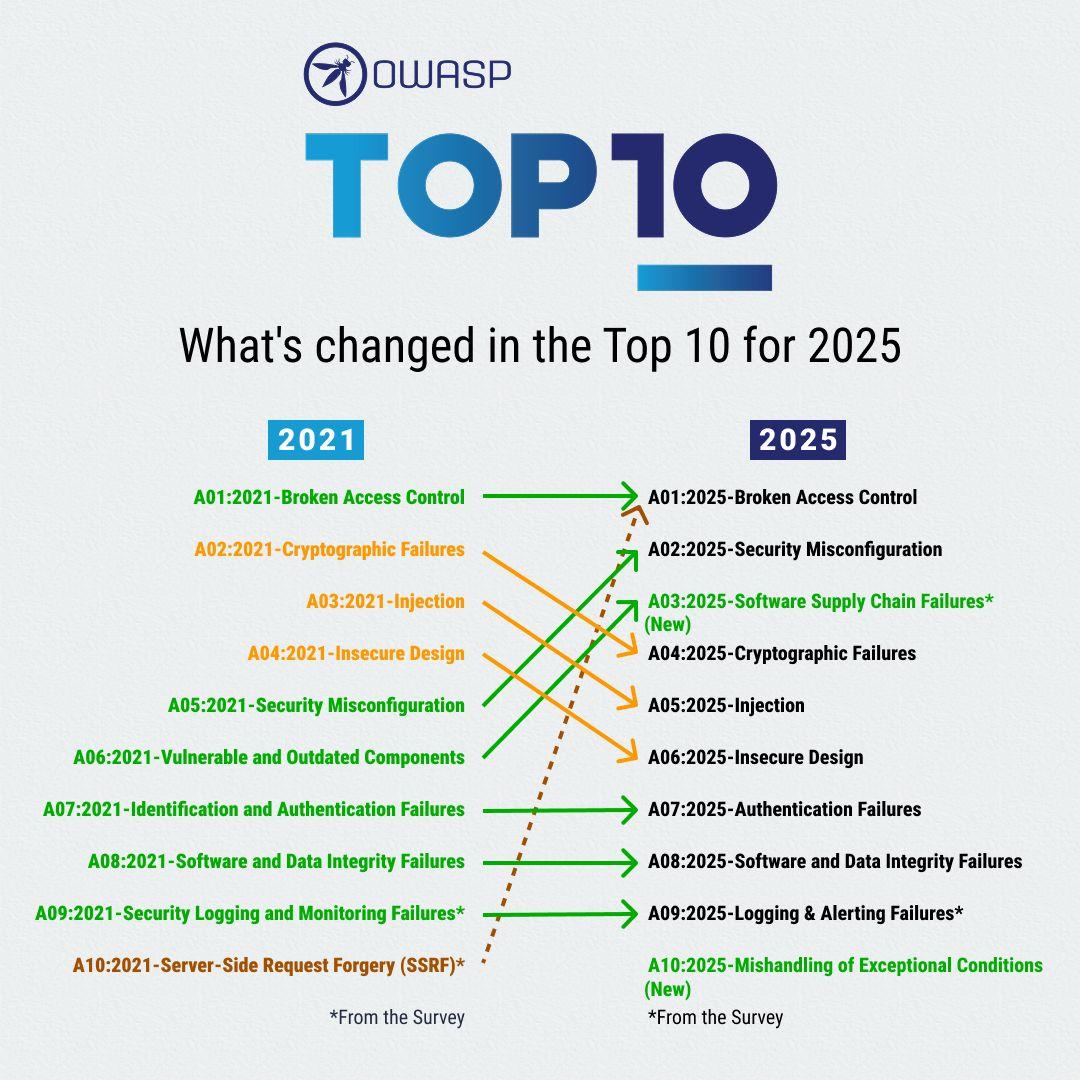
OWASP Top 10
compared with the 2021 edition. The graphic shows category changes; the official category names appear in the table below.The categories are:
| Rank | OWASP Top 10 |
|---|---|
| A01 | Broken Access Control |
| A02 | Security Misconfiguration |
| A03 | Software Supply Chain Failures |
| A04 | Cryptographic Failures |
| A05 | Injection |
| A06 | Insecure Design |
| A07 | Authentication Failures |
| A08 | Software or Data Integrity Failures |
| A09 | Security Logging and Alerting Failures |
| A10 | Mishandling of Exceptional Conditions |
Two changes are particularly revealing.
Security Misconfiguration is now #2
Cloud infrastructure, containers, SaaS integrations, Kubernetes, infrastructure-as-code and complex deployment environments make configuration increasingly important.
An application may contain no obvious source-code vulnerability and still expose sensitive functionality through configuration.
Software Supply Chain Failures is now #3
This category reflects a major change in how software is built.
The attack surface no longer ends at the organization’s repository.
It extends into dependencies, build environments, packages and distribution infrastructure.
The OWASP Top 10 Is Not an AppSec Program
This distinction is important.
The OWASP Top 10 is an awareness document, not a complete application security standard.
OWASP itself warns against treating Top 10 coverage as equivalent to comprehensive application security. It recommends the Application Security Verification Standard (ASVS) when organizations need a more complete and testable set of requirements. GitHub
The latest stable version of ASVS is 5.0.0. OWASP Foundation
This means organizations should be skeptical of claims such as:
“Our scanner provides 100% OWASP Top 10 coverage.”
Some categories involve architecture, design and business logic that cannot be fully evaluated by a single automated scanner.
AppSec requires multiple layers of evidence.
How Application Security Works
Modern application security typically follows the software lifecycle.
1. Requirements and security planning
Security should begin before code exists.
Teams identify:
- sensitive data
- regulatory requirements
- critical assets
- trust boundaries
- authentication requirements
- authorization requirements
- expected attacker capabilities
- unacceptable business outcomes
This determines what level of security assurance the application actually needs.
A public marketing website and an online banking platform should not receive identical security treatment.
2. Secure architecture and threat modeling
Threat modeling asks how the system could be attacked before implementation is complete.
Teams analyze:
- trust boundaries
- data flows
- external services
- APIs
- privileged operations
- authentication mechanisms
- administrative interfaces
- failure conditions
The goal is to identify weaknesses that scanners may never discover.
For example, a security tool may confirm that a payment endpoint contains no SQL injection vulnerability.
But only architectural or business-logic analysis may reveal that users can submit negative quantities and receive credit.
3. Secure development
Developers implement security controls while writing code.
Typical practices include:
- secure coding standards
- input validation
- parameterized database queries
- authorization enforcement
- secure session management
- strong cryptography
- safe error handling
- secrets management
- peer review
Security tooling can also provide feedback directly in repositories and IDE workflows.
4. Automated application security testing
Automated analysis allows teams to detect large classes of problems continuously.
This commonly includes SAST, SCA, secret scanning, IaC scanning, API testing and DAST.
We will examine each shortly.
5. Exploit validation and penetration testing
Finding a weakness and proving that it can be exploited are different things.
Consider two vulnerabilities with identical CVSS scores.
One might exist in unreachable code.
The other may expose an internet-facing endpoint that leads directly to sensitive customer data.
Their practical risk is dramatically different.
This is where penetration testing, attack-path analysis and modern autonomous security testing can add important context.
6. Remediation
Security findings ultimately need to reach the developers capable of fixing them.
Effective remediation requires:
- evidence
- vulnerable location
- attack context
- severity
- business impact
- recommended fix
- validation after remediation
A scanner that produces thousands of alerts without helping developers determine what matters may increase security workload without proportionally reducing risk.
7. Continuous monitoring
Applications change continuously.
So does their attack surface.
New commits, dependencies, infrastructure changes and disclosures can make previously safe applications vulnerable.
AppSec therefore continues after deployment.
Types of Application Security Testing
No single testing method can identify every application security problem.
Strong programs combine complementary techniques.
SAST: Static Application Security Testing
SAST analyzes source code or compiled artifacts without executing the application.
It is useful for detecting issues such as:
- injection patterns
- unsafe APIs
- weak cryptographic usage
- data-flow problems
- coding mistakes
Strengths
- can run early
- works directly on code
- easy to integrate into CI/CD
- can identify the vulnerable source location
Limitations
Static analysis may produce false positives and may struggle to understand runtime context or complex business logic.
DAST: Dynamic Application Security Testing
DAST analyzes a running application from the outside.
Instead of reading source code, it interacts with the application similarly to an external user or attacker.
DAST can help detect:
- injection vulnerabilities
- server misconfiguration
- authentication problems
- exposed endpoints
- runtime security weaknesses
Strengths
It observes actual application behavior.
Limitations
It typically has less visibility into the exact code responsible for the vulnerability.
SCA: Software Composition Analysis
Software Composition Analysis identifies third-party dependencies and known vulnerabilities associated with them.
It can help answer questions such as:
- Which open-source packages are we using?
- Are vulnerable versions present?
- Which applications contain them?
- Are licenses acceptable?
- Is a patched version available?
SCA has become especially important as software supply chain risk grows.
Secret Scanning
Secret scanners search repositories and development environments for credentials such as:
- API keys
- private keys
- database passwords
- cloud credentials
- access tokens
Secrets require a different response from normal vulnerabilities.
If a production credential has leaked into a public repository, deleting the string from a later commit may not be sufficient.
The credential often needs to be revoked or rotated.
API Security Testing
API testing examines application interfaces directly.
Important areas include:
- Broken Object Level Authorization
- authentication
- function-level authorization
- resource consumption
- inventory management
- unsafe third-party API consumption
OWASP maintains a dedicated API Security project because API vulnerabilities can differ significantly from traditional browser-based web vulnerabilities. OWASP API Security Top 10
Infrastructure-as-Code Security
Modern applications increasingly define infrastructure through files such as:
- Terraform
- Kubernetes manifests
- CloudFormation
- Dockerfiles
Security testing can identify configuration problems before infrastructure is deployed.
Examples include:
- public storage
- overly permissive IAM policies
- containers running as root
- exposed ports
- missing encryption
- insecure network rules
Penetration Testing
Penetration testing attempts to actively exploit weaknesses.
Testing must be authorized and constrained to agreed targets, accounts, actions, and stop conditions.
The primary advantage is evidence.
Instead of reporting:
“This endpoint may be vulnerable.”
A pentest may demonstrate:
“An unauthenticated attacker can exploit this endpoint to retrieve another customer’s records.”
That difference dramatically improves prioritization.
Traditional pentesting remains valuable, particularly for complex logic and high-risk systems, but it can be expensive and difficult to perform continuously.
This is one reason automated and AI-assisted pentesting is becoming increasingly relevant.
What Is AI Pentesting?
AI pentesting uses AI models to assist with parts of the penetration-testing process.
Depending on the system, AI may help:
- analyze applications
- select attack techniques
- generate payloads
- interpret responses
- discover attack paths
- reason across findings
- reduce repetitive manual work
However, simply adding an LLM to a vulnerability scanner does not automatically create an autonomous penetration tester.
The more important question is whether the system can execute and validate security hypotheses against the application.
From AI Scanning to AI Swarm Pentesting
One emerging direction is the use of multiple specialized agents rather than a single sequential AI agent.
In a swarm-based approach, different agents can investigate different portions of the attack surface or perform specialized security tasks while sharing evidence.
Conceptually:
                  Application
                       │
              Attack Surface Map
                       │
        ┌──────────────┼──────────────┐
        ↓              ↓              ↓
 Authentication    Injection      API Logic
    Agent            Agent          Agent
        │              │              │
        └──────────────┼──────────────┘
                       ↓
               Evidence Correlation
                       ↓
                Validated Findings
This approach can potentially provide broader exploration and faster validation than a single-agent workflow.
The important output should not merely be a vulnerability label.
It should be proof.
Detection vs. Exploitability
This is one of the most important concepts in modern AppSec.
Suppose an organization has 12,000 security findings.
Traditional vulnerability management may rank them primarily through:
- CVSS
- vulnerability type
- package version
- scanner severity
But severity is not the same as exploitability.
A better prioritization model considers:
Risk =
Technical Severity
× Reachability
× Exposure
× Exploitability
× Asset Importance
× Business Impact
This multiplication is an illustrative prioritization heuristic, not a validated scoring equation. The factors need organization-specific definitions and calibration; they should not be multiplied mechanically or treated as an official risk score.
The exact approach will differ between organizations.
The principle does not.
A vulnerability that is theoretically severe but unreachable may deserve less immediate attention than a medium-severity vulnerability that provides an attacker with a direct path to critical data.
This is why modern AppSec is increasingly becoming evidence-driven.
What Is Proof-Driven AppSec?
Proof-driven AppSec prioritizes findings using evidence showing how a vulnerability manifests or can be exploited.
Instead of simply reporting:
Possible broken access control.
The security system attempts to establish:
User A can request
/api/account/8421and retrieve data belonging to User B.
Evidence may include:
- HTTP requests
- HTTP responses
- payloads
- affected parameters
- vulnerable code paths
- exploit sequences
- screenshots
- runtime behavior
This gives both security teams and developers something concrete to investigate.
It also helps reduce one of AppSec’s largest operational problems: alert fatigue.
GitHub has similarly highlighted how security tools that generate large numbers of non-actionable alerts can create developer fatigue and make remediation less effective. The GitHub Blog
The Modern Application Security Stack
A mature AppSec program usually combines several security layers.
| Layer | Primary Question |
|---|---|
| Threat modeling | What could go wrong? |
| SAST | Is insecure code present? |
| SCA | Are vulnerable dependencies present? |
| Secret scanning | Have credentials leaked? |
| IaC scanning | Is infrastructure configured insecurely? |
| DAST | Does the running application expose weaknesses? |
| API security | Can APIs be abused? |
| Pentesting | Can weaknesses actually be exploited? |
| Runtime monitoring | Is the deployed application being attacked? |
| Remediation | Can developers fix and verify the problem? |
The goal should not be to accumulate tools.
The goal is to establish security coverage with actionable evidence.
Shift Left Is Not Enough
For years, the dominant AppSec advice was:
Shift security left.
Meaning: test earlier.
That remains useful.
Finding a coding mistake before production is generally cheaper than fixing it after deployment.
But modern AppSec also needs to shift right.
Why?
Because many vulnerabilities only become meaningful when code interacts with:
- real infrastructure
- authentication systems
- deployment configuration
- external APIs
- production-like data flows
- runtime permissions
The better model is therefore:
Secure continuously.
PLAN
 ↓
DESIGN
 ↓
CODE
 ↓
BUILD
 ↓
TEST
 ↓
DEPLOY
 ↓
OPERATE
 ↺
This aligns closely with NIST’s Secure Software Development Framework concept: security practices should be integrated throughout the software development lifecycle rather than added as a separate final-stage process. NIST Computer Security Resource Center
Application Security and AI-Generated Code
AI coding assistants have changed how quickly software can be produced.
A developer can now generate:
- authentication systems
- REST APIs
- database queries
- infrastructure files
- frontend applications
- backend services
in a fraction of the time previously required.
But faster code generation does not automatically produce faster security validation.
That creates a new imbalance:
Code Generation Speed
        ↑↑↑

Security Review Capacity
        ↑
If development throughput increases while security review remains manual, security becomes a bottleneck.
The solution cannot simply be to ask developers to slow down.
Security testing must become more automated, contextual and scalable as well.
The rise of AI-assisted development therefore increases the importance of automated AppSec rather than reducing it.
Application Security Best Practices for 2026
Organizations do not need to implement every security control simultaneously.
A risk-based approach works better.
The following practices provide a strong foundation.
1. Know what applications you own
You cannot secure an unknown attack surface.
Maintain an inventory of:
- applications
- repositories
- APIs
- dependencies
- internet-facing systems
- owners
- criticality
OWASP’s modern AppSec guidance explicitly recommends a risk-based application portfolio approach. OWASP Top 10
2. Define a security baseline
Establish minimum requirements for:
- authentication
- authorization
- encryption
- secrets
- dependencies
- logging
- error handling
- code review
- security testing
For deeper verification, OWASP recommends ASVS rather than relying solely on the Top 10. OWASP Top 10
3. Integrate security into developer workflows
Security checks should happen where developers already work.
Prefer integrations with:
- source control
- pull requests
- CI/CD
- issue tracking
- IDE workflows
The objective is to reduce context switching.
4. Scan dependencies continuously
A safe dependency today may become vulnerable tomorrow.
Software composition analysis should therefore continue after release.
5. Protect the build pipeline
Repository security alone is not enough.
Protect:
- CI/CD credentials
- package registries
- build runners
- signing keys
- deployment pipelines
- artifact repositories
The prominence of software supply chain failures in OWASP Top 10
makes this increasingly important. OWASP Top 106. Test applications from both inside and outside
Source-code analysis and runtime testing reveal different classes of problems.
Use complementary methods.
For example:
SAST → understands code

DAST → understands runtime behavior

SCA → understands dependencies

Pentesting → understands exploitation

Threat modeling → understands design
7. Prioritize exploitability, not scanner volume
Do not measure AppSec success through the number of findings generated.
More findings do not necessarily mean more security.
Prioritize using context such as:
- internet exposure
- reachable code
- authentication requirements
- available exploit path
- sensitive data
- asset importance
8. Give developers evidence
A developer should ideally understand:
- what is vulnerable
- where the problem exists
- how it can be exploited
- what impact it creates
- how to fix it
- how to confirm the fix
This reduces back-and-forth between development and security teams.
9. Retest after remediation
A closed ticket does not prove a vulnerability was fixed.
Security fixes should be validated.
10. Measure risk reduction
Useful AppSec metrics include:
- mean time to remediate
- critical vulnerabilities reaching production
- exploitable findings
- recurrence rate
- application coverage
- remediation rate
- time from introduction to detection
Avoid vanity metrics such as total scans performed.
How to Build an Application Security Program
A practical AppSec roadmap can be implemented in stages.
Stage 1: Visibility
Identify:
- applications
- repositories
- APIs
- owners
- internet exposure
- critical systems
Stage 2: Baseline testing
Deploy:
- SAST
- SCA
- secret scanning
- infrastructure checks
Stage 3: Development integration
Move security into:
- pull requests
- CI/CD pipelines
- ticketing
- developer workflows
Stage 4: Runtime validation
Add:
- DAST
- API testing
- penetration testing
- exploit validation
Stage 5: Risk-based prioritization
Correlate findings using:
- exploitability
- application context
- exposure
- business criticality
Stage 6: Continuous improvement
Measure the program with an established maturity model.
OWASP SAMM provides a risk-driven framework specifically designed to help organizations assess and improve software security maturity. OWASP Foundation
Application Security Standards and Frameworks
Several frameworks are particularly relevant.
OWASP Top 10
Best for:
- awareness
- education
- common risk categories
It should be treated as a starting point, not a comprehensive verification standard.
OWASP ASVS
Best for:
- application security requirements
- technical verification
- secure development standards
- testing requirements
The latest stable release is ASVS 5.0.0. OWASP Foundation
OWASP SAMM
Best for:
- measuring AppSec program maturity
- establishing improvement roadmaps
- organizational governance
NIST Secure Software Development Framework
NIST SSDF provides secure development practices designed to be integrated into existing software development lifecycles.
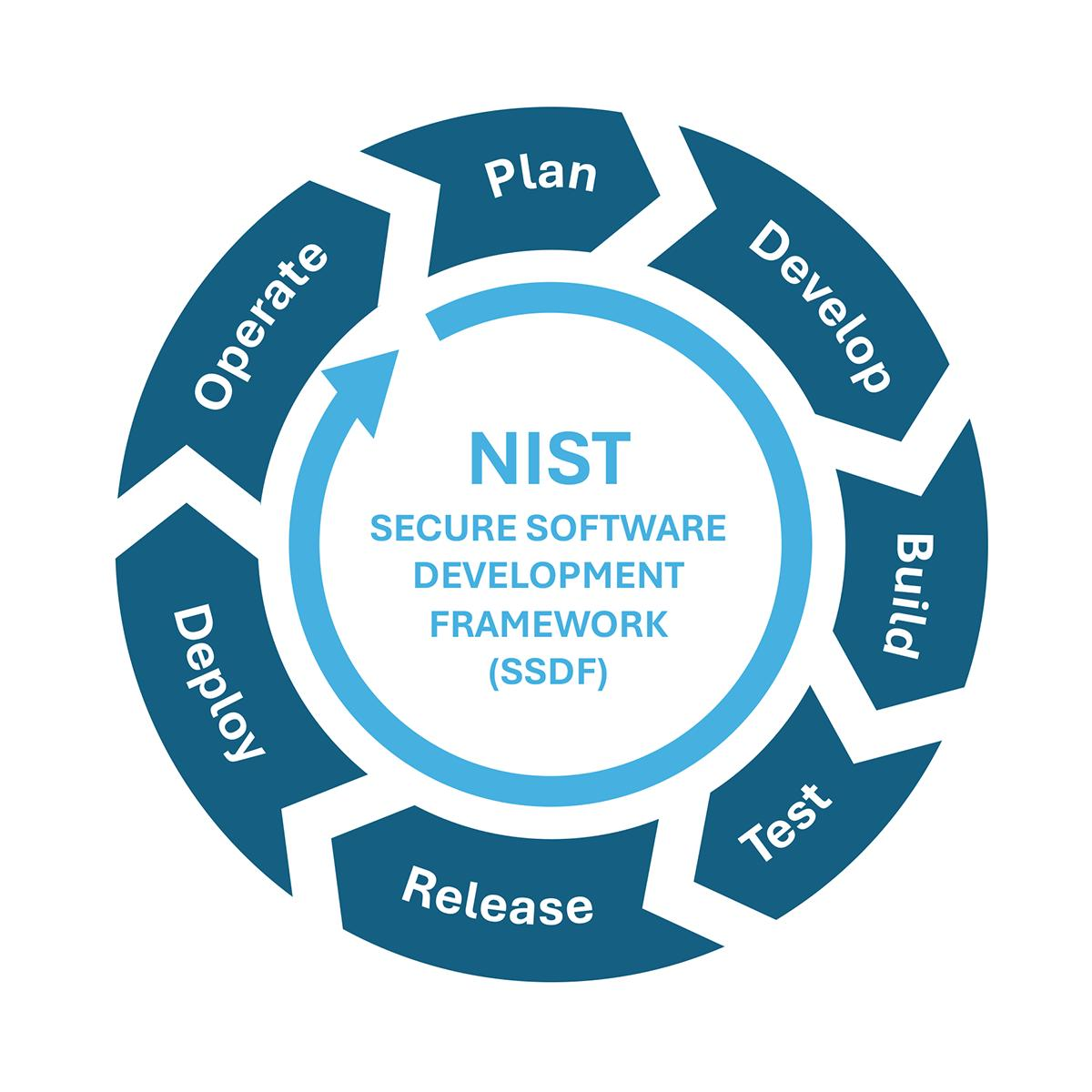
Conceptual illustration of security throughout the software lifecycle. These lifecycle stages are not the four official SSDF practice groups: Prepare the Organization, Protect the Software, Produce Well-Secured Software, and Respond to Vulnerabilities.
The current final SSDF remains Version 1.1, while NIST released a draft Version 1.2 in December 2025 containing proposed updated practices and examples. NIST Computer Security Resource Center
That distinction is important: SSDF 1.2 is not yet the final replacement for 1.1.
Application Security in the EU: Cyber Resilience Act
For companies distributing qualifying software or products with digital elements in the European Union, AppSec increasingly intersects with regulatory obligations.
The Cyber Resilience Act entered into force in December 2024.
Its broader requirements become fully applicable on 11 December 2027, but important reporting obligations became effective on 11 September 2026. Digital Strategy
Manufacturers must report qualifying actively exploited vulnerabilities and severe security incidents through the CRA Single Reporting Platform.
For actively exploited vulnerabilities, the process includes an early warning within 24 hours and a fuller notification within 72 hours, followed by additional reporting requirements. Digital Strategy
This makes capabilities such as:
- vulnerability discovery
- ownership
- prioritization
- investigation
- remediation
- evidence collection
increasingly important not only operationally, but for governance.
Common Application Security Mistakes
Many AppSec programs fail for operational reasons rather than because the organization lacks security tools.
Mistake #1: Buying more scanners instead of improving prioritization
Five scanners producing overlapping alerts may create more work without materially reducing risk.
Mistake #2: Treating CVSS as business risk
CVSS provides useful technical severity context.
It does not know whether the vulnerable asset contains your most valuable customer data.
Mistake #3: Security only before release
Applications continue changing after launch.
Security testing must continue too.
Mistake #4: Ignoring business logic
Automated scanners are strongest when testing recognizable vulnerability patterns.
Attackers are not restricted to predefined rules.
Mistake #5: Measuring vulnerabilities instead of exposure
The relevant question is not:
“How many vulnerabilities exist?”
It is:
“Which vulnerabilities create realistic paths to material impact?”
Where Plexicus Fits Into Modern AppSec
Modern application security requires both broad visibility and deeper validation.
Plexicus approaches this through Proof-Driven AppSec.
Instead of treating every detection as equally meaningful, the objective is to provide stronger evidence around which security issues can become realistic attack paths.
The Plexicus platform combines capabilities such as:
Deep Code Analysis
Deep Code Analysis analyzes applications and code context to identify security weaknesses earlier in development. Learn how it differs from isolated scanning in our Deep Code Analysis guide.
AI Swarm Pentest
AI Swarm Pentest uses specialized AI agents to investigate applications from an offensive perspective and attempt to validate attack paths rather than relying exclusively on static scanner results. Our AI Swarm Pentest introduction explains the investigation and independent verification workflow.
Remediation
Validated findings can then be connected with the code and context developers need to understand and address the issue.
The idea is not to replace secure architecture, threat modeling, governance, or expert security teams.
It is to close one of the largest gaps between traditional AppSec tools:
Detection
    ↓
“Something might be vulnerable.”

Validation
    ↓
“Here is evidence that it can be exploited.”

Remediation
    ↓
“Here is the context needed to fix it.”
That transition—from alerts to evidence—is becoming increasingly important as application environments grow faster than security teams can manually investigate them.
The Future of Application Security
Application security is moving toward greater automation.
But automation alone is not the destination.
The more important evolution is toward autonomous validation.
Traditional AppSec often works like this:
Scan
 ↓
Generate Findings
 ↓
Security Analyst Reviews
 ↓
Developer Investigates
 ↓
Pentester Validates
 ↓
Developer Fixes
 ↓
Retest
The process contains multiple manual handoffs.
Future AppSec platforms will increasingly attempt to compress this workflow:
Discover
 ↓
Reason
 ↓
Attempt
 ↓
Validate
 ↓
Prioritize
 ↓
Remediate
 ↓
Retest
Human expertise remains important.
But humans can increasingly focus on decisions, architecture and high-impact risks rather than manually triaging every scanner alert.
Frequently Asked Questions
What is application security?
Application security, or AppSec, is the practice of protecting software applications from vulnerabilities and attacks throughout their lifecycle using secure design, secure development, security testing, vulnerability management and continuous monitoring.
What is an example of application security?
Examples include scanning source code for injection vulnerabilities, testing an API for broken authorization, identifying vulnerable dependencies, protecting credentials, conducting penetration tests and fixing security weaknesses before exploitation.
What is the difference between AppSec and cybersecurity?
Cybersecurity protects the wider organization, including networks, endpoints, identities, infrastructure and data. AppSec focuses specifically on securing software applications and their supporting components.
What are the main types of application security testing?
Common techniques include SAST, DAST, SCA, secret scanning, API security testing, infrastructure-as-code scanning and penetration testing.
What is SAST?
Static Application Security Testing analyzes application code without executing the application to identify potential security weaknesses.
What is DAST?
Dynamic Application Security Testing evaluates a running application externally by sending requests and analyzing its behavior.
What is SCA?
Software Composition Analysis identifies open-source components, dependencies and known vulnerabilities used by an application.
Is penetration testing part of application security?
Yes. Penetration testing complements automated scanners by attempting to actively exploit vulnerabilities and demonstrate their real-world impact.
Is the OWASP Top 10 enough for application security?
No. OWASP describes the Top 10 primarily as an awareness document. Organizations requiring deeper verification should consider standards such as OWASP ASVS and broader secure development practices. GitHub
What is the latest OWASP Top 10?
As of 2026, the latest released version is the OWASP Top 10
. OWASP FoundationCan AI replace penetration testers?
AI can automate growing portions of reconnaissance, testing, reasoning and exploit validation, but expert human oversight remains valuable for complex business logic, novel attack techniques, architectural risks and high-stakes decisions.
What is AI Swarm Pentesting?
AI Swarm Pentesting uses multiple specialized AI agents that cooperate on security testing tasks. Instead of relying on a single scanner or agent, different agents can investigate different attack hypotheses and correlate evidence.
Application Security Is Becoming Proof-Driven
The core challenge in AppSec is changing.
For years, organizations focused on finding more vulnerabilities.
Modern development environments have largely solved that problem.
Security tools can now generate enormous numbers of findings.
The harder problem is determining which findings matter.
In 2026, an effective AppSec program needs to combine secure design, code analysis, software supply chain security, runtime testing, API security, penetration testing and continuous remediation.
But the next step is even more important:
turning security findings into evidence.
Because security teams do not ultimately need more alerts.
They need to know what attackers can actually do.
See Proof-Driven AppSec in Action
Plexicus combines Deep Code Analysis, AI Swarm Pentest and remediation workflows to help security and development teams move from potential vulnerabilities to validated security evidence.
Explore Plexicus AI Swarm Pentest →
Start with a repository check using the free SAST tool.