AI Swarm Pentest
We get in before they do.
It takes a swarm to stop a swarm.
Right now, a swarm of AI agents is looking for a way in.
No humans. No sleep.
Then it picks one.
More code. More doors.
About 4 in 10 AI coding tasks ship a security flaw. Veracode, 2026You guard every door.
They only need one left open.
Your cloud keys. Taken.
Your customers' data. Copied.
Your backups. Wiped.
Your company. Theirs.
This is not fiction.
- 20 min for one AI agent to pull credentials out of a domain controller, with no human guiding it. CrowdStrike, 2026
- 22 zero-days exploited in August 2026 alone. In 2025 the average was 8 a month. Google Threat Intelligence Group, 2026-11
- FBI warns that attackers automate whole intrusions with open-source AI. FBI, via Industrial Cyber, 2026-11
From the outsideOur swarm attacks you. With your permission.
It finds the open door. And proves it.
From the insideIt reads all your code. Every application.
One remediatorWherever the flaw was found, the fix goes into your code.
We do not close one door. We protect the whole building.
They come back.
No door left open.
Trusted by security teams across every codebase









Already happening
Intrusions now happen at machine speed.
Google has observed several actors using open-source multi-agent frameworks to automate phases of live intrusions. The techniques are the old ones, stolen credentials and unpatched systems. What is new is the speed and the scale.
- 2 open-source multi-agent frameworks that Google saw deployed in real intrusions.
- 150+ tools and more than 12 autonomous sub-agents in a single framework, still at the experimentation stage.
- 4 days after a flaw was disclosed, a campaign that likely used AI had reached hundreds of organizations, according to research the report cites.
- 0 people in the loop: the first time Google has seen the discovery and exploitation of flaws automated end to end.
If they attack at machine speed, you have to find and fix at machine speed.
Source: Google Threat Intelligence Group, 16 November 2026Every flaw, proven. Every fix, in a pull request.
A scanner says what could fail. Plexicus delivers the proven flaw, the proof and the patch.
- From the outside It finds the open door. And proves it.
- From the inside It reads all your code. Every application.
- One remediator Wherever the flaw was found, the fix goes into your code.
- Verify They come back. No door left open.We run the attack again to confirm the door stayed closed.
An attack under your control.
- A scope you authorize
- Human review at the guardrails
- Evidence your team can review
What it analyzes
- Code
- Dependencies
- Secrets
- Infrastructure as code
- Running application
- Deployment pipeline (CI/CD)
Your first step
Start with proof,
not a sales deck.
- 1 30 minutes with the founder. A video call, no forms.
- 2 One staging app and the repo behind it. You agree on the scope before anything runs.
- 3 If we don't find a serious vulnerability, you don't pay.

Book 30 min with José
José Ramón Palanco · Founder · video call
HubSpot Meetings · your local time
No installation and no change of tools: it connects to your repository and starts. Trust Center
The evidence
Ready for your audit.
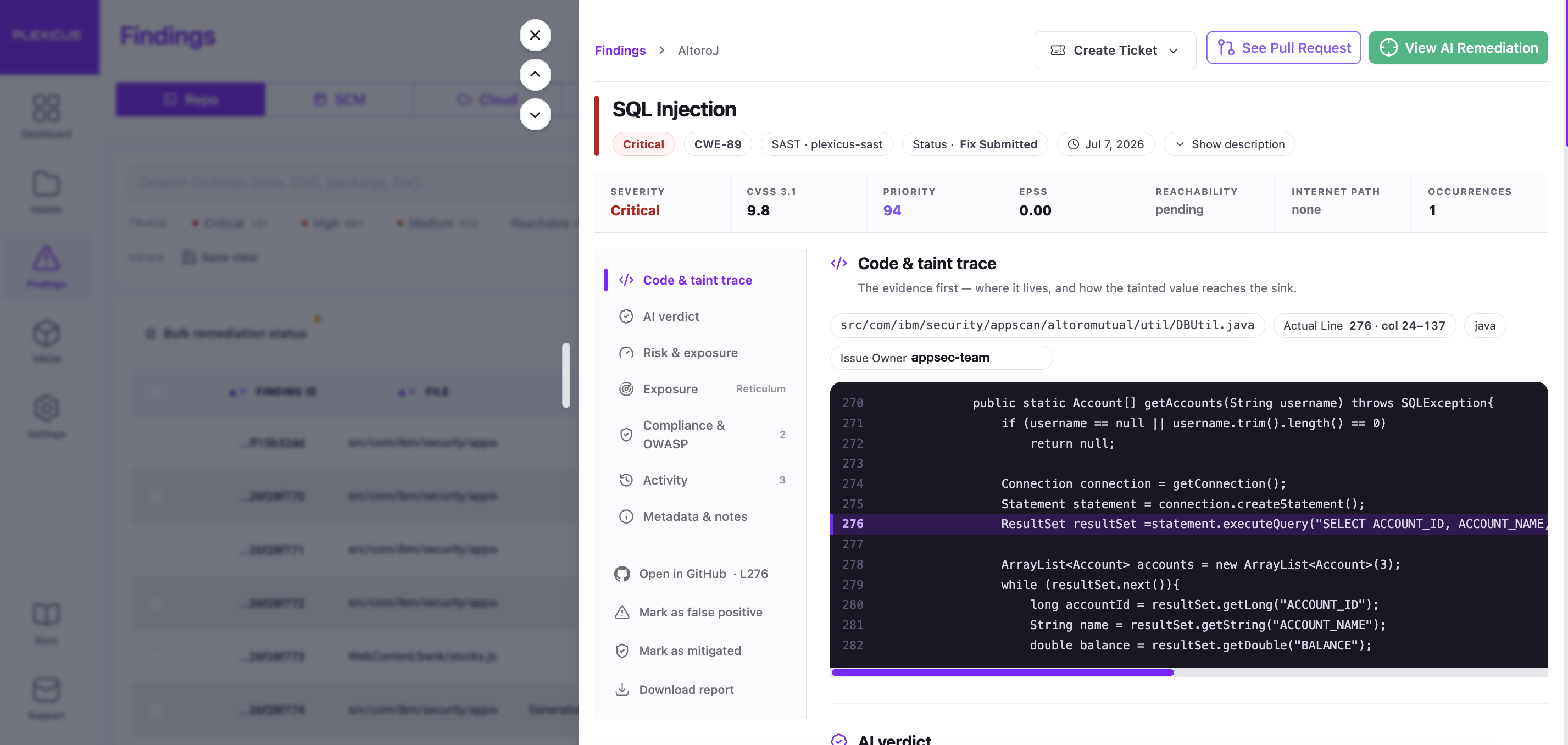
Every finding arrives with its proof, tied to its regulatory requirement and with its closure verified.
- 1Finding
- 2Proof
- 3Regulatory requirement
- 4Verified closure
What security leaders say about Plexicus
“The AI agent gives our team verified findings with the evidence attached. Our engineers review with confidence instead of chasing noise.”
 David WilsonHead of Security, HuMaIND
Plexicus is the most innovative AI-native platform we've evaluated. Their pace of evidence-backed remediation context is what sets them apart.
 Toni de la FuenteFounder, Prowler
As one of Plexicus's first customers, we've witnessed firsthand how their platform has evolved into an indispensable security solution. Reviewed changes with prioritized context have dramatically reduced our vulnerability management overhead and allowed our security team to focus on strategic initiatives.
 Jose Fernando DominguezCISO, Ironchip
From the Plexicus blog
View all posts- What Is Penetration Testing? The Complete Guide to Types, Process and Reports for 2026 A complete guide to penetration testing in 2026: what a pentest is, how it differs from scanning and red teaming, the phases, the types, what the report should contain and what it cannot tell you.
- What Is an SBOM? Software Bill of Materials Explained: The 2026 Guide A complete guide to the software bill of materials in 2026: what an SBOM contains under the new CISA minimum elements, the six SBOM types, SPDX and CycloneDX, the rules that require one, and how to generate and use it.
- What Is Software Composition Analysis (SCA)? The Complete Guide for 2026 A complete guide to software composition analysis in 2026: what SCA finds, how it works step by step, how to prioritize what it reports, where it stops, and how it connects to SBOMs, VEX and reviewed fixes.