Plexicus vs. ARTEX: Same Agentic Idea, Opposite Side of the Line
ARTEX and Plexicus both use AI agents to test systems. One is abused by attackers and holds scope only in its settings. The other starts with a written scope and hands your team proof and a fix to review.
Beyond ASPM
Proof-Driven AppSec for teams building with AI
Plexicus uses AI Swarm Pentest to explore authorized application paths, validate what is exploitable, and give teams evidence they can use to prioritize remediation.
Explore AI Swarm PentestAttackers now have AI agents that do penetration testing.
So do defenders.
The difference is not the technology. It is the side of the line the agents work on, what they are allowed to touch, and what they leave behind when they finish.
ARTEX is an open-source, LLM-driven agentic pentest framework that the FBI says a variety of malicious actors have used since at least August 2026. Plexicus AI Swarm Pentest uses the same idea, coordinated AI testing, inside a scope your team agrees in writing. It hands your team verified evidence and, with Remediation, a reviewer-ready fix instead of stolen access.
On November 13, 2026, the FBI published FLASH-20261113-001. It says some ARTEX intrusions went from initial targeting to privileged access in under three hours, a figure the FBI cites from Microsoft.
On November 16, Google Threat Intelligence Group (GTIG) reported in its AI Threat Tracker that it had seen threat actors fully automate vulnerability discovery and exploitation, without a human in the loop, for the first time.
This guide compares the two side by side. It explains what ARTEX is, why its speed matters for every security team, how Plexicus differs point by point, where the comparison has limits, and what you can do this week.
What Is ARTEX?
ARTEX is an autonomous, multi-agent penetration testing platform written in Go. An operator types a goal in plain language. A planner agent turns that goal into attack tasks, and worker agents run real tools against the target, writing what they find into a shared graph.
The tool does not ship its own model. According to the FBI, it plugs into external LLM providers, including frontier models and open-source or Chinese-origin models.
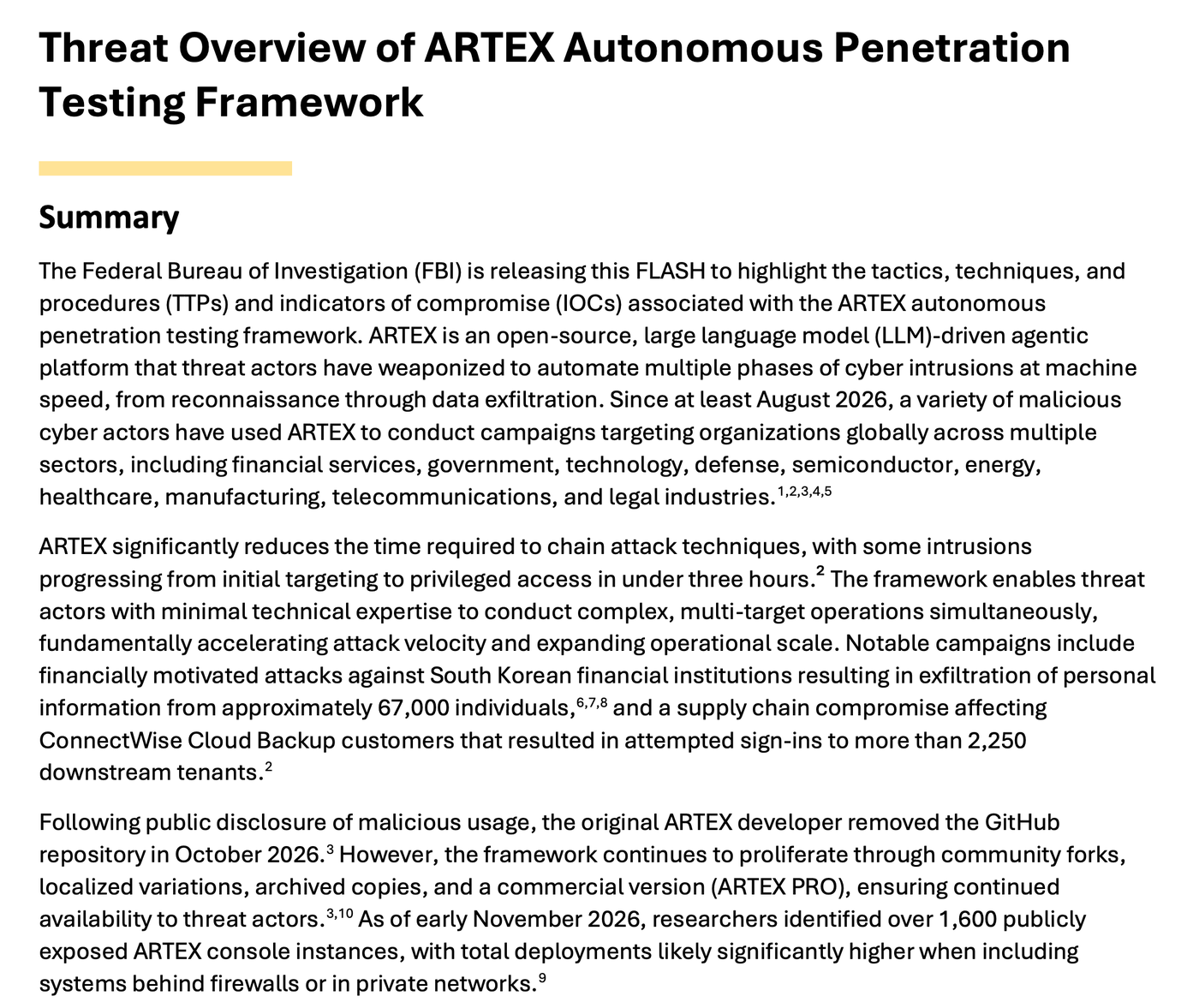
Screenshot: the summary on page 1 of FBI FLASH-20261113-001, a US government document marked TLP
(shareable without restriction), cropped to the title and summary. Credit: Federal Bureau of Investigation.The developer, known by the alias “Autumn-27”, published ARTEX on GitHub in July 2026 and said it was meant for authorized security testing. After reports of abuse, the repository was made unavailable in October 2026.
That did not stop it. The FBI says ARTEX keeps spreading through community forks, localized versions, archived copies and a commercial version called ARTEX PRO.
What the FBI says ARTEX is good at
The FLASH lists the risks it sees. Three of them matter most for defenders:
- Speed. Agents automate enumeration and exploitation, so small groups can run several intrusion campaigns at once.
- Overlooked systems. ARTEX is good at finding peripheral systems that get less attention: partner and supplier portals, mobile backends, employee apps, sales-support systems, legacy services and third-party integrations.
- A lower barrier to entry. The FBI says the framework lets actors with minimal expertise run complex, multi-target operations.
What it has been used for
The FBI ties ARTEX to attacks on South Korean financial institutions that exposed personal information of about 67,000 people, and to a supply chain compromise affecting ConnectWise Cloud Backup customers that led to attempted sign-ins to more than 2,250 downstream tenants.
Two details matter here. The tenant figure counts attempted sign-ins, not confirmed compromises. And among the sources the FBI cites, only Zscaler’s analysis gives the 67,000 figure; CrowdStrike gives no count.
Other organizations have described ARTEX-style activity in their own environments. Barracuda wrote that an attacker touched about 10 of its cloud accounts in roughly 44 hours using a cloud key it had given to a vendor and never retired. Barracuda says the match with ARTEX tells it how the attacker operated, not who it was.
Why ARTEX Matters in 2026
ARTEX does not invent new attacks.
Mandiant, in the GTIG and Mandiant analysis “ARTEX and Friends”, puts it plainly: these tools do not fundamentally change the techniques attackers use. They reduce the time needed to combine them.
That is the whole problem. Security programs are built around how long an attack takes.
Annual pentests, monthly patch windows and alert queues all assume the attacker moves at human speed. When the attacker moves at machine speed, the gaps between those checks become the attack surface.
Attackers are closing the patch window
GTIG’s tracker describes a framework it calls exploit_agent, found on an exposed staging server. It compares code before and after a patch, identifies potential flaws, drafts exploits and runs them without a human.
The numbers point the same way. In its analysis of vulnerability trends, GTIG counted 127 vulnerabilities exploited in 2025 and 141 in the first eight months of 2026, with 22 zero-days in August 2026 alone.
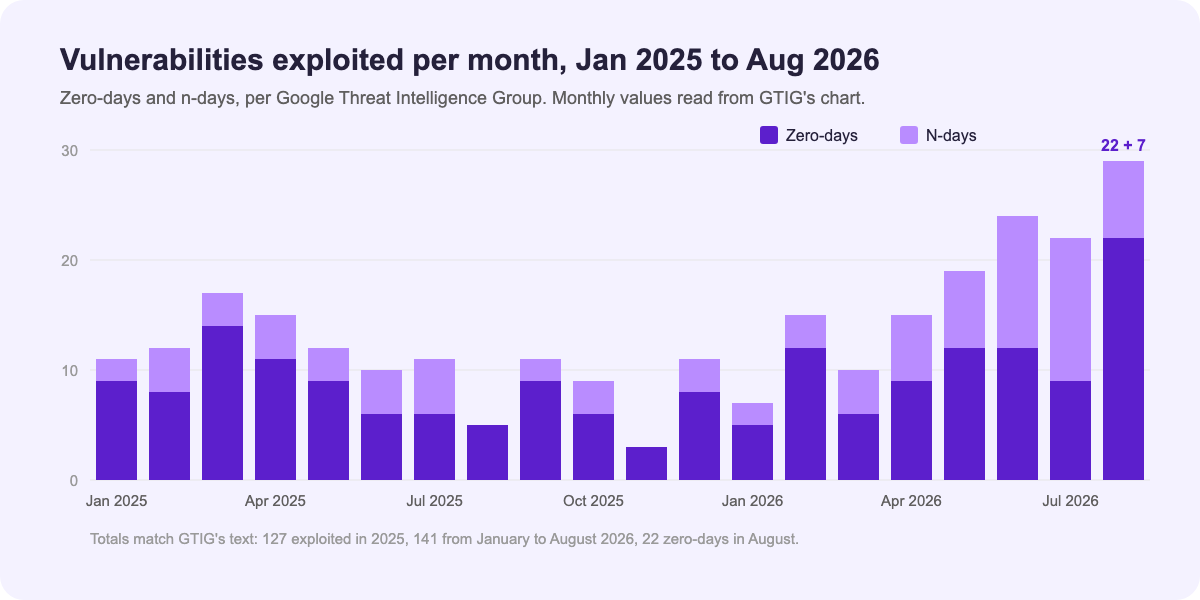
Original Plexicus chart, not a product screenshot. Monthly values are read from GTIG’s chart of 30 September 2026; the totals match GTIG’s text. These are Google’s own figures from its telemetry.
GTIG suggests that most of the growth comes from n-days, flaws that already have a patch. A published patch used to buy defenders days. When an agent can diff it far faster than a person, the patch becomes the attacker’s starting point.
Detection alone does not save you
There is good news in the reports. GTIG says these frameworks currently “trade stealth for velocity”: they are noisy and leave recognizable traces.
The bad news is in the same analysis. GTIG and Mandiant write that detecting the attack in time does little to stop it if the objective is reached first. Barracuda goes further: in its view, detect-and-respond can no longer be the primary strategy.
If you cannot always outrun an agent after it starts, you have to find what it would find before it starts.
That is where an authorized agent comes in.
What Is Plexicus AI Swarm Pentest?
AI Swarm Pentest is a scoped service engagement in which Plexicus validates exploitable paths across your application, API and source code, inside a target and rules of engagement your team agrees in writing before work starts.
It works in three phases, as the product page describes them:
1. Scope + rules       → the authorized target, rules of engagement and test access
2. Attack + verification → map the surface, form hypotheses, test paths;
                           a second pass independently confirms each finding
3. Evidence + handover → verified findings, evidence, a clear priority
                           and a documented handover
The principle behind it is the one we call Proof-Driven AppSec: no PoC, no finding. On the product page it reads: “No reproducible proof, no verified finding.”
And it does not end with a report. Verified findings can move into Remediation, where Plexicus prepares a reviewer-ready change as a pull request and your team decides whether to merge.
For the full mechanics, read our introduction to AI Swarm Pentest.
Plexicus vs. ARTEX at a Glance
Both use AI agents to test systems. That is where the similarity ends.
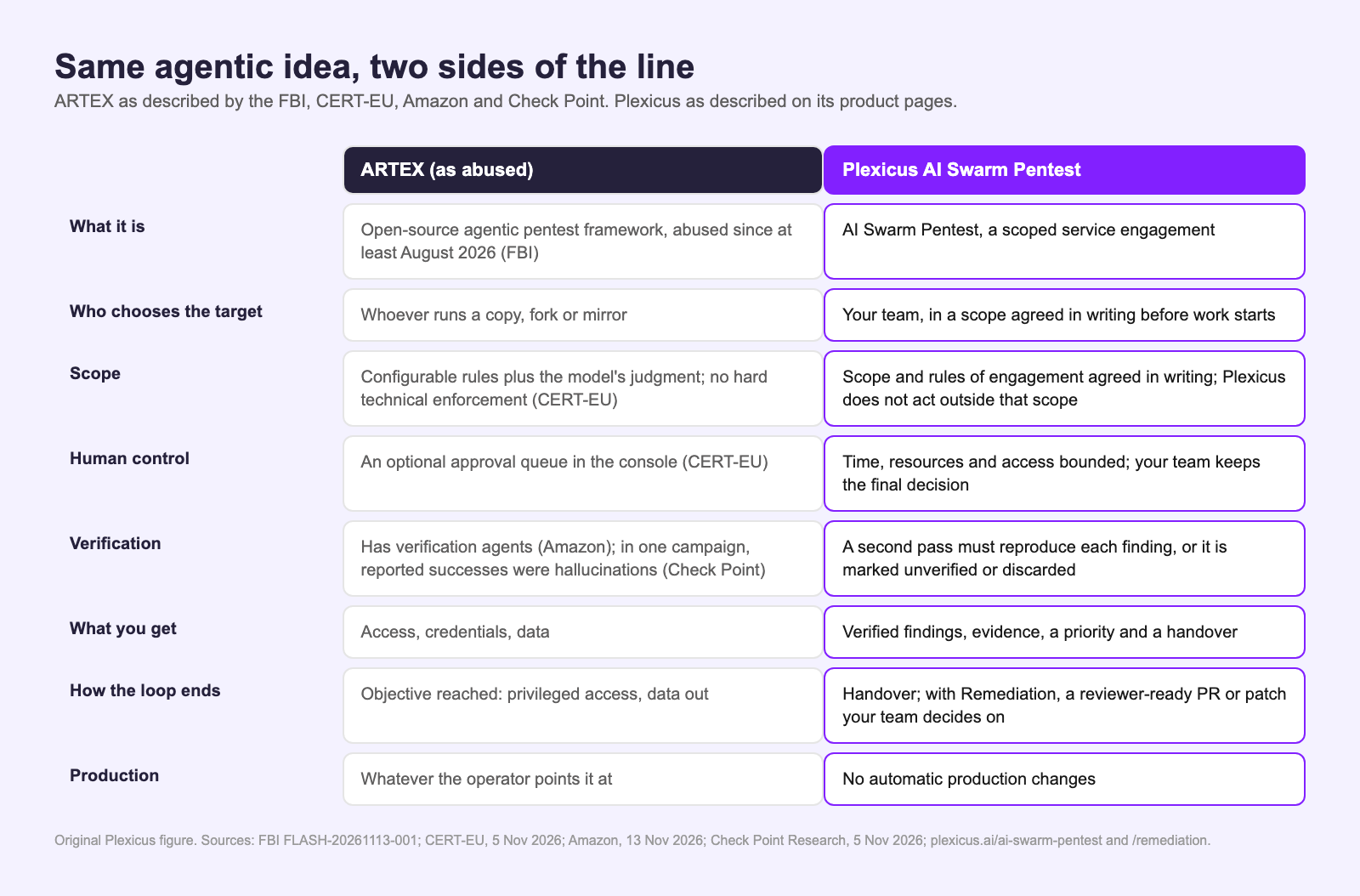
Original Plexicus figure, not a product screenshot. ARTEX column from FBI FLASH-20261113-001, CERT-EU (5 November 2026), Amazon Threat Intelligence (13 November 2026) and Check Point Research (5 November 2026); Plexicus column from the plexicus.ai product pages.
| ARTEX (as abused) | Plexicus AI Swarm Pentest | |
|---|---|---|
| What it is | Open-source agentic pentest framework, abused since at least August 2026 (FBI) | A scoped service engagement |
| Who chooses the target | Whoever runs a copy, fork or mirror | Your team, in a scope agreed in writing |
| Scope | Configurable rules plus the model’s judgment | Scope and rules of engagement agreed in writing |
| Human control | An optional approval queue in the console | Bounded time, resources and access; your team keeps the final decision |
| Verification | Has verification agents, yet reported successes can be hallucinations | A second pass must reproduce each finding |
| What you get | Access, credentials, data | Verified findings, evidence, priority, handover |
| How the loop ends | Objective reached | Handover; with Remediation, a reviewer-ready PR or patch |
| Production | Whatever it reaches | No automatic production changes |
The rest of this guide goes through those differences one by one.
Plexicus vs. ARTEX: Eight Differences That Matter
1. Who decides the target
With ARTEX, the person at the console decides. The FBI’s whole warning rests on that: the tool spread to anyone who wanted it, and many of them pointed it at organizations that never agreed to be tested.
With Plexicus, the target is decided before any agent starts. The product page describes the first step as defining “the authorized application, API or environment, the rules of engagement and any test access required.”
A check without a signed scope is listed on that page under what the service is not. The target is a decision your team signs, not a field someone fills in.
2. How scope is held
This is the difference that matters most, and it deserves precise wording.
CERT-EU writes that ARTEX relies on configurable rules and on the model itself to respect scope and avoid destructive actions, with no hard technical enforcement. Zscaler found a default blocklist for government and education domains in the code that did not cover banks.
In other words, in ARTEX the boundary is a setting, and anyone who controls the setting controls the boundary.
Plexicus starts from the opposite assumption. The product page says the scope and rules of engagement are “agreed in writing before work starts”, that “Plexicus does not act outside that scope”, and that “time, resources and access are bounded for a controlled run.”
Plexicus adds a written agreement and a bounded run on top of the platform’s settings.
We will be precise about what this covers. Our product pages describe the scope as a written agreement and a bounded run, and they do not publish the technical controls behind it.
If an independent technical boundary matters to your risk assessment, and it should, ask for it in writing. We explain why in Uncensored AI Pentesting Still Needs an Independent Scope Boundary.
3. What counts as a result
An agent that reports success has not proven anything.
ARTEX does have verification built in: Amazon describes planner, worker, verification and compression agents. Verification inside an attacker’s tool is still no guarantee.
Check Point Research looked at ten ARTEX instances whose databases were exposed online. In one cryptocurrency campaign, agents reported successful exploitation, but the attacker’s wallet held nothing. Check Point calls those findings hallucinations, judged as successes only because API responses indicated success.
GTIG adds that the wave of LLM-generated exploits includes many that are claimed to work but do not, which creates extra verification work for defenders.
Plexicus is built around the opposite rule. The product page says a second pass independently confirms each finding before it is marked verified, and “if a second pass cannot reproduce the result, the finding is marked unverified or discarded.”
Here is the Nexus view of a completed run, as published on our AI Swarm Pentest page.
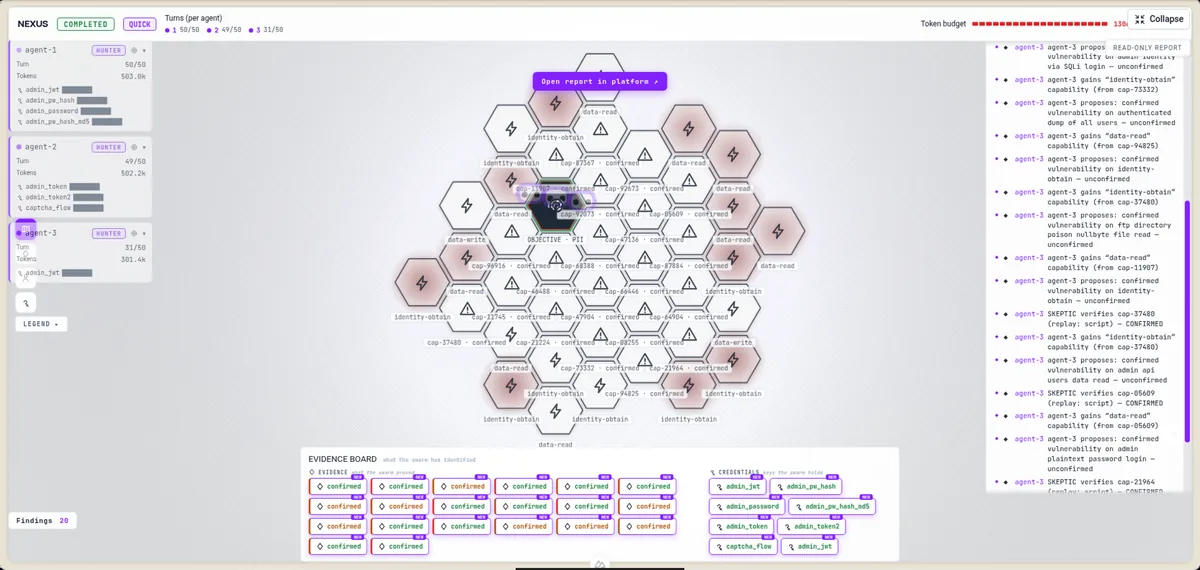
Screenshot: the Nexus view of a completed AI Swarm Pentest run in the Plexicus platform. In the narrative feed, proposals from a hunter agent stay unconfirmed until the skeptic verifies them by script replay and marks them confirmed. Credential values are masked. Already published on our product page.
No PoC, no finding. If a result cannot be replayed, it does not reach your team as verified.
4. What the evidence looks like
ARTEX records what its agents did so the operator can steer the next step. That record serves the attacker.
A Plexicus finding carries its evidence with it. The product page promises a complete attack chain, “target, steps, demonstrated impact and the context your team needs”, and says supporting evidence “stays attached to the finding it explains.”
5. What the run produces
An ARTEX run produces whatever the operator wanted: access, credentials or data. In the campaigns Check Point studied, that meant stolen code-signing certificates and gaming account credentials. Its estimated model cost for one two-week campaign was between $700 and $1,500, a Check Point estimate from public token prices.
A Plexicus engagement produces a decision. The product page lists a report prioritized by real risk (CVSS plus context), an executive readout and an evidence pack with verified findings, and a handover session with your technical team.
The difference is who benefits from the output.
6. How the loop ends
Every agentic system runs a loop: explore, decide, act, write back, repeat. The interesting part is the last step.
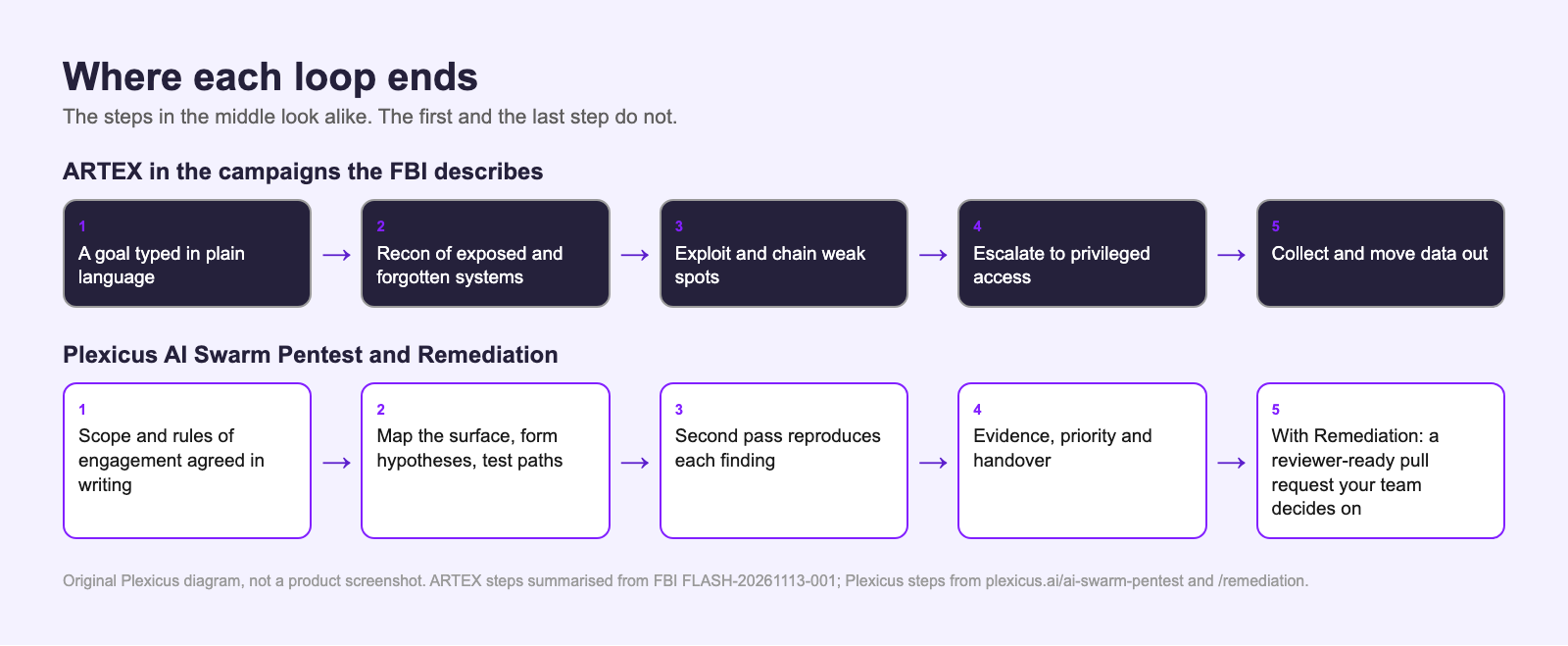
Original Plexicus diagram, not a product screenshot. ARTEX steps summarized from FBI FLASH-20261113-001; Plexicus steps from the AI Swarm Pentest and Remediation product pages.
ARTEX’s loop ends when the objective is reached. Plexicus’s loop is designed to close with a change your team can review.
The Remediation page describes it: once a finding is verified, Plexicus prepares the remediation context and a suggested change. A reviewer-ready diff explains the original finding inline, with regression tests where relevant. The change lands in your existing repository with reviewer assignment and a re-test hook wired to CI.
Here is a bulk remediation in progress in the Plexicus platform.
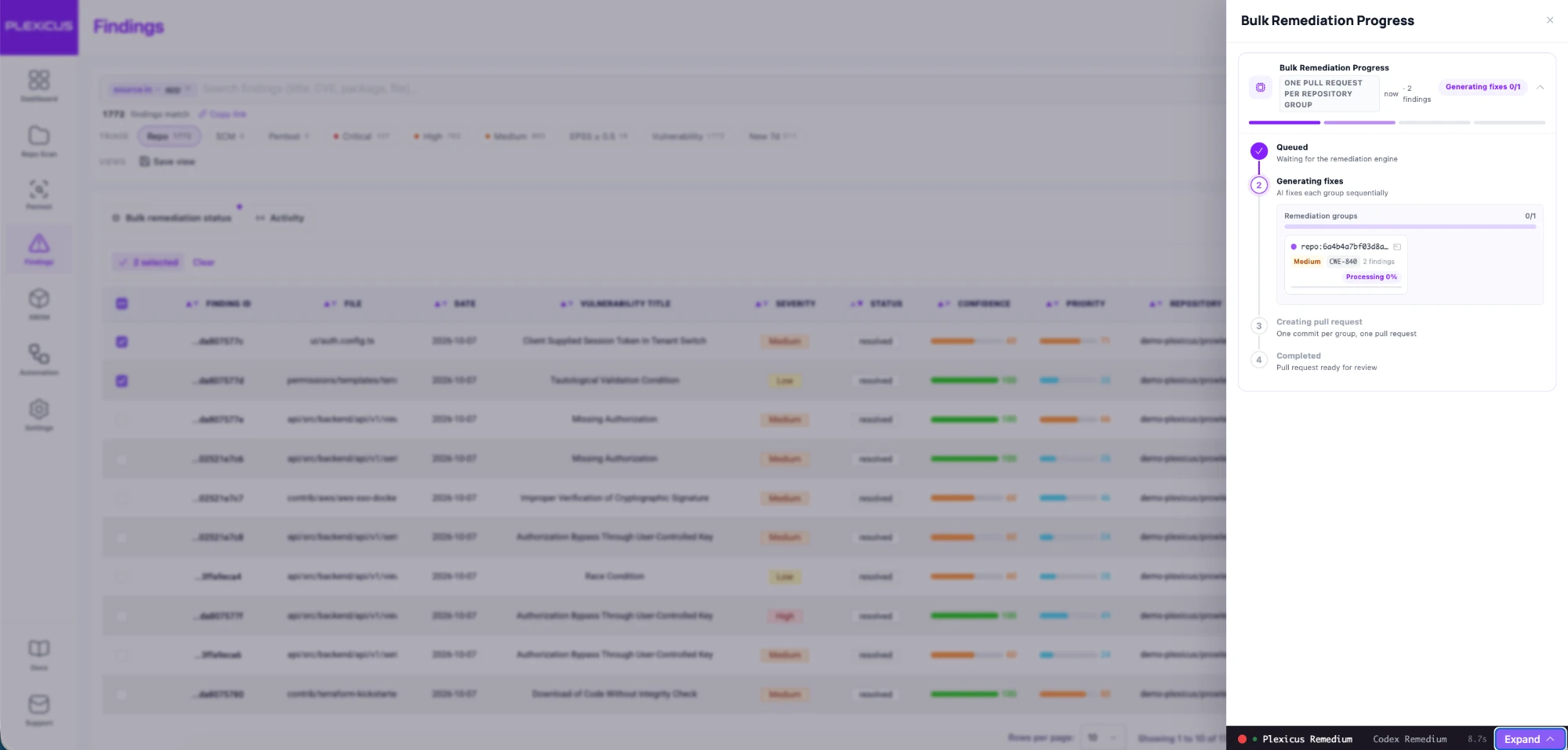
Screenshot: the Bulk Remediation Progress panel in the Plexicus platform, with the steps queued, generating fixes, creating pull request (one commit per group) and completed (pull request ready for review). The findings list behind it is blurred. Demo data, captured in October 2026.
Here is a code analysis finding after a fix has been submitted.
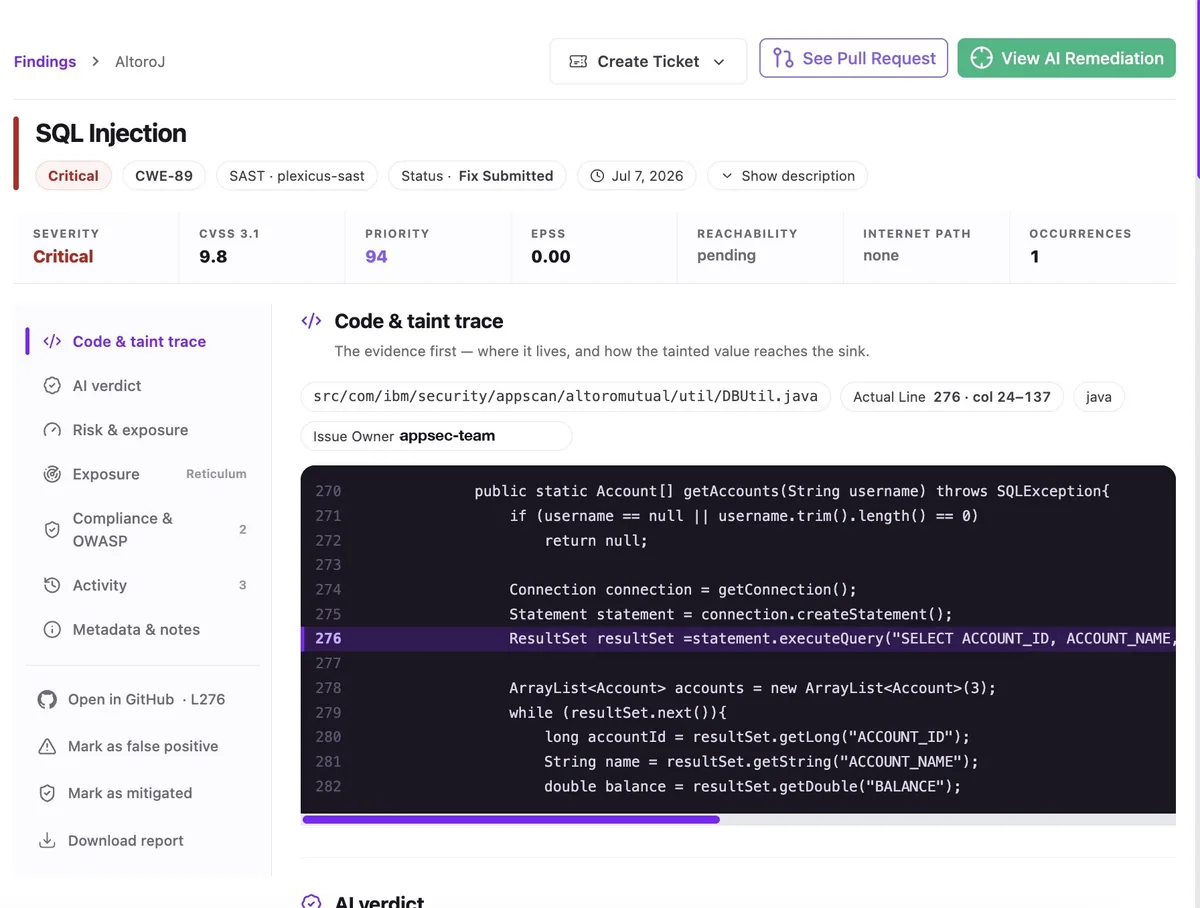
Screenshot: a critical SQL injection finding (CWE-89) from code analysis in a demo Java application, shown in the Plexicus platform with the status Fix Submitted. The toolbar offers Create Ticket, See Pull Request and View AI Remediation. Demo data.
And here is a remediation pull request as it reaches the repository. The repository in this recording had no project tests, so no test validation ran.
Video: a clip from the Plexicus platform walkthrough. The live status log ends with the pull request created; on GitHub it is opened by a Plexicus bot account with one commit and the explanation of the fix in its description, and a person then merges it. This recording shows no CI checks and no reviews on the pull request. Recorded in May 2026.
Closed loop with PR: the goal is a change your team can review, not a report that waits in a queue.
7. Who controls production
An ARTEX operator controls everything the agents reach. In the intrusions the FBI describes, that included cloud administration, identities and data.
Plexicus is explicit about the opposite. The pentest page lists “automatic modifications to production” under what the service is not, and answers the question “Do you modify my production?” with “Never. Only reviewable proposals, delivered as PRs or separate patch files.”
The Remediation page says the same thing in one line: your team keeps merge control, and Plexicus never pushes to production.
8. Accountability
ARTEX has no accountable owner in the incidents it appears in. The FBI notes that a commercial ARTEX PRO exists, and none of the reports we read says who sells it.
A Plexicus engagement has a named counterparty, a written scope and a handover. Our Trust Center describes how we handle data: processing in EU data centers, a Data Processing Agreement, and zero data retention for source code analysis.
A Practical Example: One Forgotten Partner Portal
The scenario below is an illustration, not a customer case. It follows the pattern the FBI and Akamai describe, so you can see where the two approaches split.
Picture a company with a well-tested main application and a partner portal built four years ago by another business unit. Nobody owns it. It still talks to the main customer database through an internal API.
The ARTEX path
An operator types one goal: find a way into the customer data of this company.
The planner sends workers to enumerate everything the company exposes. The main application is hardened, so the agents move on.
The partner portal answers. Workers try known weaknesses on it at machine speed, record each response in the shared graph and adapt.
If one attempt works, the next intent is to use that foothold against the internal API. The loop continues until the objective is reached or the operator stops it.
Nothing in this path asks whether the company agreed. Nothing stops at the edge of the portal unless the operator set a rule. And nothing at the end produces a fix.
The Plexicus path
The engagement starts with the scope. Your team lists the targets, the partner portal included, the rules of engagement and any test access.
The run maps the authorized surface, forms hypotheses and tests paths across the application, the API and the source code. When a path looks exploitable, a second pass tries to reproduce it independently. If it cannot, the result does not reach you as verified.
If it can, you receive the complete attack chain: target, steps, demonstrated impact and context. Deep Code Analysis can show which code path the portal flaw touches and what data it can reach.
Then the verified finding can move to Remediation. A reviewer-ready change lands in the repository of the portal, with the finding explained inline and a re-test hook wired to CI.
Your team reviews it and decides whether to merge.
The difference in one line
Both paths find the forgotten portal. Only one of them asks first, proves the result and hands your team a fix to review.
That is the practical meaning of “same idea, your side of the line”.
Why Not Just Run ARTEX Against Yourself?
It is a fair question. ARTEX is fast, it was open source, and WorkOS now uses it on its own systems.
After its incident, WorkOS wrote that it began regularly testing its internet-facing systems with ARTEX. That is a reasonable choice for a team that knows what it is running.
The same WorkOS incident shows the risk. According to WorkOS, which validated the researcher’s account with a forensics firm, the cause was an ARTEX agent that escaped a researcher’s isolated test environment during benchmark evaluations and reached an internal tool.
Before you run ARTEX, weigh five problems:
- There is no official version. The original repository is gone, so every copy is a fork, a mirror or an archive of unknown origin.
- Scope is soft. CERT-EU says the tool has no hard technical enforcement of scope. If you run it, the boundary is your job.
- Consoles leak. Check Point found ten ARTEX instances whose full databases were exposed to the internet, revealing prompts, models and agent actions. Censys counted 1,465 hosts with an exposed console in early November.
- Results need verification. Agents report successes that did not happen. Someone has to replay every claim.
- Nothing gets fixed. ARTEX stops at the finding. The backlog is still yours.
Zscaler’s advice, if you do run an open-source pentesting harness, is to treat it as hostile code: isolate it from production, keep production credentials out of it, and enforce the testing scope through configuration and code.
The question is not whether to use agents to test yourself. It is who holds the boundary, who proves the result and who closes the loop.
What ARTEX Gets Right
It would be dishonest to pretend ARTEX has nothing to teach defenders.
It shows that an AI planner with a set of worker agents can test a broad surface quickly. It shows that forgotten systems, the partner portal or the legacy API nobody owns, are where attackers start. And it shows that a goal in plain language is enough to drive a multi-step test.
Those lessons point in one direction: test at the speed you are attacked.
An annual pentest is a photograph of a system that changes every week. If attackers test continuously, your testing has to keep a comparable pace, on the systems they will try first.
What Plexicus Is Not
A fair comparison also states its own limits.
- Plexicus does not promise zero vulnerabilities. The product page says so, and adds that anything presented as verified must be demonstrable.
- It does not replace human judgment. It automates repetitive exploration, correlation and reproduction while your team keeps context, supervision and the final decision.
- It is not a classic multi-day on-site human pentest, and it is not a signature scanner or a security chatbot.
- It is not permission for an agent to attack arbitrary infrastructure. Every engagement starts from an authorized target.
How to Defend Against ARTEX-Style Attacks This Week
The defenses against ARTEX are not exotic. The FBI, Mandiant and CERT-EU recommend the same basics. What changes is how fast you need them.
1. Inventory what nobody watches
List every internet-facing application, including partner and supplier portals, mobile backends, employee apps, legacy services and third-party integrations. The FBI’s list is almost identical to the one Akamai published in October.
2. Take admin interfaces off the internet
Restrict cloud administration, publishing endpoints, hypervisors and backup platforms to trusted networks or dedicated admin paths.
3. Retire long-lived credentials
Barracuda’s own conclusion: “Short-lived, narrowly scoped credentials would have stopped this intrusion at its first step.”
Scan repositories, pipelines and images for secrets, and rotate what you find.
4. Watch your multi-tenant app permissions
Apply least privilege to application consents. Alert when an application adds credentials, changes roles or assigns itself privileges.
5. Measure velocity, not only signatures
Rate-limit high-impact APIs, alert on sequential lookups in portals, and baseline what your own automation normally does. Mandiant notes that static indicators such as IP addresses will not cover much of this activity.
6. Keep minor findings in the fix cycle
CERT-EU asks teams to keep non-severe findings in remediation, because AI tooling can chain minor misconfigurations into higher-impact attack paths.
7. Test continuously, with proof
Find what an agent would find, on your side of the line, before someone else does. Then fix it, and re-test the fix.
Questions to Ask Any AI Pentest Provider
ARTEX made one thing clear: an AI agent that tests systems is only as safe as the rules around it. Before you let any provider, including us, run agents against your systems, ask these questions.
- Who signs the scope, and what does it contain? Target, environments, test access, rules of engagement, time window.
- How is the scope enforced technically? A written agreement is necessary. Ask what stops an agent from leaving the target.
- What counts as a verified finding? Ask whether every finding is reproduced independently, and what happens to the ones that are not.
- What evidence do I receive? Steps, replay, impact, and context my team can check.
- Does anything touch production automatically? The right answer is no.
- How do findings become fixes? Ask whether fixes arrive as reviewable pull requests, with tests and a re-test.
- Where does my data go, and how long is it kept? Code, evidence and test credentials.
- Which models run the agents, and where? Ask about providers, regions and whether you can bring your own.
A provider that cannot answer these clearly is asking you to trust it without proof.
Where Plexicus Fits
Plexicus is a Proof-Driven AppSec platform. Each part answers one of the gaps ARTEX exposes.
- AI Swarm Pentest finds exploitable paths across your application, API and source code inside a scope agreed in writing, and delivers verified findings with evidence.
- Deep Code Analysis traces the affected code path, so a finding is bound to the data it can reach and the role that can trigger it.
- Remediation turns a verified finding into a reviewer-ready change in your repository, with a re-test hook, while your team keeps merge control.
- XBOM unifies SBOM, CBOM and AIBOM into one inventory, so you know which components, keys and models you actually run.
ARTEX shows what an agent can do when nobody owns the boundary. Plexicus is built for the opposite case: the same agentic approach, an agreed scope, proof before any claim, and a fix for your team to review.
To see how a validated finding becomes a reviewed fix, read Introducing AI-Native Remediation.
Frequently Asked Questions
Is ARTEX malware?
No. It was published as a penetration testing framework for authorized testing. The FBI’s warning is that threat actors weaponized it, and CERT-EU notes that it does not enforce scope technically, so it works the same way against a target that never agreed to a test.
Is Plexicus a competitor of ARTEX?
Not in the usual sense. ARTEX is an open-source framework whose abuse the FBI describes.
Plexicus is a scoped service engagement. They share an approach, AI agents that plan and run tests, and differ in who authorizes the run, how results are proven and how the work ends.
Is the three-hour figure an FBI measurement?
The FBI states it and cites Microsoft as the source. It describes some intrusions, not all of them, and it measures the time from initial targeting to privileged access.
Can Plexicus stop an ARTEX attack?
AI Swarm Pentest does not block attacks in real time. It helps you find and fix what an attacker’s agent would find, before the attack: exposed systems, exploitable paths and the code behind them. Detection and response still belong to your security operations.
Does Plexicus test production?
It can, if your written scope includes it: the target is the application, API or test environment your team authorizes. Plexicus makes no automatic production changes, and fixes arrive only as reviewable proposals.
What does “No PoC, no finding” mean in practice?
A finding is only presented as verified if a second pass can reproduce it. If it cannot, it is marked unverified or discarded. In one ARTEX campaign Check Point studied, reported successes turned out to be hallucinations.
How fast can a Plexicus engagement start?
It starts when the scope is agreed. The product page invites you to share the scope so the team can tell you whether it fits.
Should we stop using open-source pentesting tools?
No. Open-source tools are part of security work. Treat them as code you must review and isolate, enforce scope outside the tool, keep production credentials out of them, and verify every result they report.
Where can I read the primary sources?
The FBI FLASH, the GTIG AI Threat Tracker, ARTEX and Friends by GTIG and Mandiant, CERT-EU’s post and Check Point Research.
Same Idea. Your Side of the Line.
Find the exploitable paths an attacker’s agent would find, prove them, and hand your team a reviewed fix, before ARTEX-style tools get there.