From Alert to Fix: A Proof-Driven AppSec Vulnerability Remediation Process
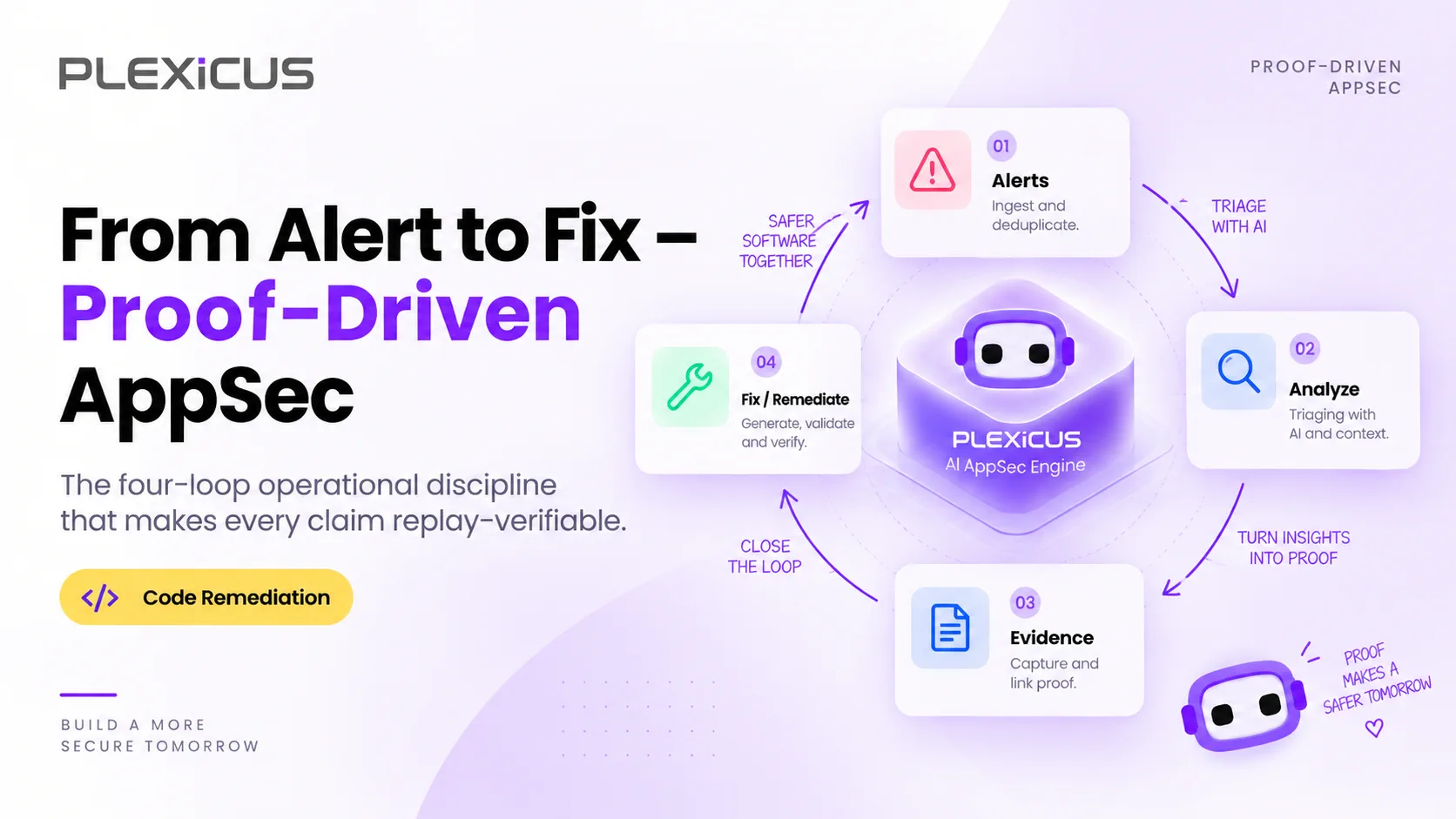
Proof-Driven AppSec is a vulnerability remediation process that closes the loop from alert to merged fix once, with replayable evidence at every step: detect, verify, fix, audit.
Beyond ASPM
Proof-Driven AppSec for teams building with AI
Plexicus uses AI Swarm Pentest to explore authorized application paths, validate what is exploitable, and give teams evidence they can use to prioritize remediation.
Explore AI Swarm PentestA vulnerability remediation process is the sequence of steps that takes a security finding from detection to a verified, deployed fix: detect, verify, fix, and audit. Proof-Driven AppSec is our version of that process, with one rule: every step must produce evidence that a developer, an auditor, or a CI gate can re-run.
Most AppSec programs look the same. A scanner finds a vulnerability. The finding lands in a queue. A human triages it, eventually. A ticket opens. A developer picks up the ticket — when they get to it. The developer opens a PR. The PR sits in review. The review takes a week because the diff is large and the developer is the only one who understands the file. The PR merges. The CI gate passes. The finding is closed.
Meanwhile, attackers are getting faster and cheaper. The research agent RapidPen reached shell access on a vulnerable target in 200–400 seconds for well under a dollar per run. On the defender side, Edgescan’s 2026 Vulnerability Statistics Report puts the mean time to remediate high and critical application and API vulnerabilities at 54.81 days. A multi-week time-to-fix is not a security metric. It is a marketing slide for the attackers.
Proof-Driven AppSec is the operational discipline that closes the loop once, makes every step provable, and gets the median time-to-fix from weeks to days. This is the canonical definition.
What Proof-Driven AppSec Is
Proof-Driven AppSec is the discipline of running application security programs where every claim is grounded in evidence an auditor, a developer, or a CI gate can re-run. Not CVSS scores. Not severity tags. Not “high/medium/low.” A reproducible artifact attached to the finding.
Three properties define the practice:
- Every finding has a path. Not a regex hit. Not a pattern match. A reachability path from a real input source to a real capability-bearing sink, bound to a specific file and line number.
- Every finding has evidence. A request that can be re-run, a CI job that can be replayed, a sandbox state that can be resumed. If a finding cannot be reproduced, it is not a finding — it is a hypothesis.
- Every fix has an evidence chain. The patch came from the same finding. The patch closes the original exploit. The patch was reviewed with the original evidence attached. The patch’s regression test is the original exploit, inverted.
That is the practice. Anything that does not check all three is a screenshot of an AppSec program, not an AppSec program.
The Four-Loop Vulnerability Remediation Process
The operational pattern has four loops. Each loop has a job. Each handoff preserves the evidence.
Loop 1 — Detect
The first pass scans the codebase (and the IaC that defines the runtime) and produces a graph of hosts, endpoints, parameters, and capabilities. Findings are positions in the graph, not lines in a file.
This is what Deep Code Analysis does (the reasoning behind it is in What Is Deep Code Analysis?). The output is a set of proposed findings — each bound to a graph node, a reachability path, a capability class, and a line number.
Loop 2 — Verify
The second pass takes each proposed finding and tries to reproduce it. The agent that performs this pass is not the agent that proposed the finding. This is the critical step. Self-consistency is not verification.
The output of Loop 2 is a smaller set of verified findings, each with the evidence attached. Findings that do not reproduce are discarded with a stated reason. The reason codes matter — they are how your team debugs the pipeline later. Common ones include: no real path from a public endpoint to the sink, an upstream check that makes the finding inert, a runtime control that neutralises it, or the second agent could not reproduce the result.
Loop 3 — Fix
The third pass takes each verified finding and drafts a reviewer-ready patch. The patch is not a generic fix. It is the minimum change that removes the reachability path while preserving business logic. The patch includes regression tests (the original exploit becomes a test). The patch includes documentation updates.
This is what a structured security remediation workflow such as Plexicus Remediation does. The output is a pull request, not a code snippet. For how this step runs end to end without manual hand-offs, see the autonomous remediation playbook.
Loop 4 — Audit
The fourth pass ensures that the patch closes the original finding. The verifier re-runs the original exploit against the patched branch. If the exploit reproduces, the patch is reverted. If the exploit is mitigated, the patch is signed and the finding is closed.
The output of Loop 4 is an audit record: original finding, graph node, evidence reference, patch diff, regression test result, reviewer approval, deploy timestamp. One record per finding. Signed. Replayable.
Why This Is Not “AI-Native AppSec” With Better Marketing
The term “AI-native AppSec” was useful when it meant “the scanners use machine learning models.” Every scanner uses machine learning models now. The differentiator is not whether AI is involved. It is whether the AI is grounded.
Three failure modes of the AI-native era:
- AI that summarises findings without grounding. The model reads the SAST output and produces a more readable PDF. The auditor still cannot re-run anything.
- AI that proposes fixes without verification. The model writes a patch. The patch compiles. The patch changes the meaning of the code. A human reviewer is expected to catch this. They cannot, at scale — especially when, in our analysis, 78% of AI-generated PRs contained a vulnerability to begin with.
- AI that runs without evidence. The model explores the application. It finds something interesting. It reports it as a finding. The report cannot be reproduced.
Proof-Driven AppSec is the answer to all three. The structure is the bar:
- Detection must produce a path, not a pattern.
- Verification must be independent, not self-consistent.
- Fix must be grounded in the same evidence, not a generic suggestion.
- Audit must be replayable, not narrative.
Anything that does not check all four is the same AppSec program with a different logo.
Vulnerability Remediation in Practice
Across the Plexicus customer base running the full four-loop pattern, the practical effect is the same shape: triage time compresses from days to minutes, false positives drop after verification, and the time-to-merge drops because the reviewer is reading a small, evidence-backed diff instead of an unverified list.
Two numbers define whether the practice is working: how often the auditor can re-run the evidence and confirm the finding, and how often the auditor accepts the patch as fixing what the finding claimed. Everything else is throughput.
The exact medians vary by codebase, language mix, and CI maturity. The pattern is what scales.
What the Threat Landscape Demands
The threat landscape in 2026 is structurally faster than the defender cycle:
- Time-to-exploit keeps shrinking. Mandiant measured an average time-to-exploit of five days in 2023, down from 63 days in 2018–2019.
- Most exploitation starts before a fix exists: 70% of the vulnerabilities in that Mandiant dataset were exploited as zero-days.
- Offensive AI agents are cheap to run. RapidPen reported shell access in 200–400 seconds at roughly $0.30–$0.60 per run.
- AI lowers the skill bar. Amazon Threat Intelligence documented a single low-skilled actor using commercial generative AI to compromise more than 600 FortiGate devices across 55 countries in about five weeks.
The attacker pipeline is already proof-driven. They verify their exploits before they ship them. They replay their payloads. They audit their results. The asymmetry is not “attackers use AI and defenders don’t.” The asymmetry is “attackers use a closed loop and defenders use a series of open queues.”
Proof-Driven AppSec is the operational pattern that closes the defender’s loop.
Building a Security Remediation Workflow With Your Existing Tools
The four-loop structure is not a vendor-specific thing. The pattern can be implemented with the tools your team already has:
- Loop 1 (Detect) — static analysis that produces reachability paths. Plexicus Deep Code Analysis, or any scanner that binds findings to the call graph instead of the line number.
- Loop 2 (Verify) — a scoped pentest engagement. Plexicus AI Swarm Pentest, or a manual pentest engagement with evidence capture (see our comparison of AI pentest tools).
- Loop 3 (Fix) — a patch generator with regression tests. Any AI coding workflow with explicit instructions to ground patches in the original finding.
- Loop 4 (Audit) — a CI re-test hook that runs the original exploit against the patched branch. This is also the evidence NIST’s Secure Software Development Framework (SP 800-218) expects under its “Respond to Vulnerabilities” practices.
The four loops have to be wired together. The evidence from Loop 2 has to land in Loop 3. The patch from Loop 3 has to be re-verified by Loop 2. The audit record from Loop 4 has to include the evidence references from Loops 1, 2, and 3.
If any of those handoffs loses the evidence, the loop is broken. The practice stops being proof-driven.
The Bar for 2026
Three questions to ask your security program:
- Can your scanner produce a reachability path for every finding? If the answer is “no, just a line number,” your triage queue is going to keep growing.
- Can your pentester re-run the finding against a clean build? If the answer is “we’d have to set up a new engagement,” your evidence trail is not replayable.
- Can your developer open the PR with the original exploit attached? If the answer is “they’d have to ask the security team to re-find it,” your audit trail is not continuous.
If all three answers are “yes,” you are running Proof-Driven AppSec. If any of them is “no” or “kind of,” the gap is in the evidence handoff, not in the tooling.
Frequently Asked Questions
What is the vulnerability remediation process?
The vulnerability remediation process is the set of steps that takes a security finding from detection to a verified fix in production. In Proof-Driven AppSec it has four loops: detect the flaw with a reachability path, verify it independently, fix it with a minimal patch and regression test, and audit the result by re-running the original exploit against the patched code.
What is the difference between vulnerability remediation and mitigation?
Remediation removes the vulnerability itself, usually by changing code, upgrading a dependency, or fixing a configuration. Mitigation reduces the risk without removing the flaw, for example with a WAF rule, a feature flag, or network isolation. Mitigation buys time; remediation closes the finding. A good process records which one was applied and re-tests both.
What is Proof-Driven AppSec?
Proof-Driven AppSec is a way of running application security where every claim is backed by evidence someone else can re-run. Findings need a reachability path and a reproducible exploit, fixes need a regression test built from that exploit, and the audit record links them together. If a finding cannot be reproduced, it is treated as a hypothesis, not a finding.
How do you verify that a security remediation worked?
Re-run the original exploit against the patched build. If the exploit no longer succeeds and the regression test derived from it passes in CI, the fix is verified. If it still reproduces, the patch is incomplete and should be reverted. Keep the exploit, the patch diff, and the test result together in one audit record.
How should teams prioritize vulnerabilities for remediation?
Prioritize findings that are verified and reachable from a real input over raw severity scores. A medium-severity flaw with a confirmed path from a public endpoint is usually more urgent than a critical one that cannot be reached. Reachability, exploit evidence, and the capability an attacker would gain are better signals than CVSS alone.
Where This Goes
In the next two years, every regulator is going to ask the same question: can you replay the evidence that proved this control was working when the incident happened? Teams running Proof-Driven AppSec will answer “yes” with the original artifact. Teams running the old pattern will answer “we have a PDF.”
The investment to close the gap is not large. The discipline to keep it closed is.
Related reading:
- What Is Deep Code Analysis? — Loop 1
- 78% of AI-Generated PRs Contain a Vulnerability — why verification is the new bottleneck
- The Autonomous Remediation Playbook — Loop 3 in detail
- OWASP MAESTRO Field Guide for Threat Modellers — the reference architecture for the agents running the loops