What Is Penetration Testing? The Complete Guide to Types, Process and Reports for 2026
A complete guide to penetration testing in 2026: what a pentest is, how it differs from scanning and red teaming, the phases, the types, what the report should contain and what it cannot tell you.
Beyond ASPM
Proof-Driven AppSec for teams building with AI
Plexicus uses AI Swarm Pentest to explore authorized application paths, validate what is exploitable, and give teams evidence they can use to prioritize remediation.
Explore AI Swarm PentestEvery security tool you run tells you what might be wrong.
A scanner lists outdated libraries. A code analyzer flags a risky query. A dashboard counts open issues.
None of them answers the question your board, your auditor and your attacker all care about: what can someone actually reach?
Penetration testing answers that question by attacking your own system, with permission, using the same tools and techniques an adversary would, and documenting what worked.
The UK’s National Cyber Security Centre defines it as “a method for gaining assurance in the security of an IT system by attempting to breach some or all of that system’s security, using the same tools and techniques as an adversary might.” It adds that a pentest should be viewed as a way to gain assurance in your vulnerability management processes, not as the primary way to find vulnerabilities. NCSC
That question is more urgent in 2026. In the executive summary of its 2026 Data Breach Investigations Report, Verizon found that exploitation of vulnerabilities is now the most common known initial access vector for breaches, at 31%, ahead of credential abuse at 13%.
This guide explains what a penetration test is, how it differs from scanning and red teaming, how an engagement runs from scope to re-test, the main types, what a good report contains, and what a pentest cannot tell you.
What Is Penetration Testing?
Penetration testing, often shortened to pentesting, is authorized, simulated attack work against a defined system to find out which weaknesses can be exploited and how far an attacker could get with them.
NIST’s Technical Guide to Information Security Testing and Assessment (SP 800-115) describes it as security testing in which evaluators mimic real-world attacks to find ways to circumvent the security features of an application, system or network. NIST Glossary
The same definition adds the part that makes a pentest different from a scan: most penetration tests look for combinations of vulnerabilities that give more access than any single one could. NIST Glossary
That is the core idea. A scanner reports weaknesses one by one. A penetration tester asks how they connect.
Four things define a real penetration test:
- Authorization: the owner of the system agreed to the test, in writing, before it started.
- Scope: the targets, the techniques and the time window are agreed and bounded.
- Adversary technique: the tester uses the methods an attacker would, not only a compliance checklist.
- Evidence: every finding comes with proof of what was done and what it reached.
Without authorization it is not a test. It is an attack.
What do people call it?
Penetration test, pentest, pen test and ethical hacking all describe the same activity. OWASP’s Web Security Testing Guide notes that penetration testing is also commonly known as ethical hacking, and describes the tester as someone who acts like an attacker and attempts to find and exploit vulnerabilities.
Why Penetration Testing Matters in 2026
Penetration testing is decades old. Four facts keep it at the center of an AppSec program.
1. Exploited vulnerabilities are the top way in
The 2026 DBIR puts exploitation of vulnerabilities first among the known initial access vectors for breaches, at 31%, with credential abuse, the previous leader, down to 13%. The incidents in that edition took place between November 1, 2024 and October 31, 2025.
A vulnerability that exists is a line in a report. A vulnerability that can be exploited is a breach waiting for someone to try. A pentest is the exercise of trying first.
2. The top web risk needs judgment, not signatures
The OWASP Top 10
ranks Broken Access Control first.Access control flaws are hard for tools. A scanner does not know that user A should never see user B’s invoices. A tester with two accounts and a model of who owns what can check that in minutes.
3. Regulators now name it
The EU’s Digital Operational Resilience Act (DORA), Regulation (EU) 2022/2554, has applied since January 17, 2025.
Its Article 25 lists penetration testing among the tests a financial entity’s digital operational resilience testing programme should provide for. Its Article 26 requires identified financial entities to carry out advanced testing by means of threat-led penetration testing (TLPT) at least every three years, on live production systems, a frequency the competent authority may raise or lower for a given entity.
For a bank, an insurer or a payment company in the EU, penetration testing is now named in the law, and for the entities identified under Article 26, threat-led testing is mandatory.
4. Applications change faster than test cycles
The NCSC warns that it is not uncommon for a year or more to pass between penetration tests, so vulnerabilities can sit unnoticed for long periods if the pentest is your only check. NCSC
Teams that ship every day, often with AI coding assistants, change their attack surface far more often than once a year. That gap is one reason the way pentests are run is changing.
Penetration Testing vs. Vulnerability Scanning
These two are confused more than any other pair in security.
| Vulnerability scan | Penetration test | |
|---|---|---|
| Question | What known weaknesses are present? | What can an attacker actually do with them? |
| Method | Automated checks against signatures and versions | Hypotheses, manual and automated attack work, chaining |
| Exploitation | Usually none | Yes, inside the agreed scope |
| Output | A list of potential issues | Findings with proof, impact and a path |
| False positives | Common | Rare, because each finding was demonstrated |
| Frequency | Continuous or weekly | Periodic, per release or per change |
A scan says “this server runs a version with a known flaw”. A pentest says “we used that flaw to read this table, and here is the request”.
A scan finds candidates. A pentest proves which candidates matter.
You need both. Scanning gives breadth and runs all the time; penetration testing gives depth on what matters most.
Penetration Testing vs. Red Teaming
A red team exercise is a penetration test with a different goal.
DORA defines threat-led penetration testing as a framework that mimics the tactics, techniques and procedures of real-life threat actors and delivers a controlled, bespoke, intelligence-led (red team) test of a financial entity’s critical live production systems. EUR-Lex
The European Central Bank’s TIBER-EU framework describes itself as a European framework for threat intelligence-based ethical red-teaming, and says it can help authorities and financial entities meet DORA’s requirements for threat-led penetration tests.
| Penetration test | Red team exercise | |
|---|---|---|
| Goal | Find and prove as many exploitable weaknesses in scope as possible | Reach a defined objective the way a specific threat actor would |
| Who knows | The defenders usually know the test is happening | Few people inside the organization know |
| Scope | A system, an application, an API, a network segment | The organization: people, processes and technology |
| Measures | The security of the target | Also detection and response |
| Duration | Days to weeks | Weeks to months |
The NCSC draws the same line in its list of test types: scenario-driven testing can aim to find vulnerabilities, or it can also gauge the detection and response capabilities an organization has in place. NCSC
A pentest asks “where are we weak?”. A red team asks “would we notice, and could we stop it?”.
For most teams, regular penetration testing comes before a red team exercise.
Penetration Testing vs. SAST and DAST
Automated testing tools and penetration testing work on the same application from different angles.
- SAST reads the source code without running it. Our guide What Is SAST? covers it.
- DAST sends requests to the running application and flags responses that look like a known weakness.
- Penetration testing uses those signals and human or agent reasoning to prove what an attacker could do.
OWASP’s Web Security Testing Guide explains why scanners alone fall short: web applications are almost always bespoke, so testing them is closer to pure research than to running known exploits, and automated tools alone can be poor at it. OWASP WSTG
The same guide’s example is a “magic parameter”: an administrative backdoor behind one 30-character value. A black-box scanner would need trillions of requests to guess it, while a reviewer who reads the code would spot it quickly. OWASP WSTG That is one reason code access makes a penetration test deeper.
For a side-by-side of the two automated methods, read SAST vs. DAST: the difference and why to use both.
Tools give breadth. A penetration test gives depth and proof.
How a Penetration Test Works
Methodologies use different names, but they describe the same arc.
The NCSC’s model engagement follows five steps: initial engagement, scoping, testing, reporting and follow-up, with a severity rating for every issue found. NCSC
The Penetration Testing Execution Standard (PTES), as summarized in OWASP’s list of penetration testing methodologies, splits the work into seven phases: pre-engagement interactions, intelligence gathering, threat modeling, vulnerability analysis, exploitation, post exploitation and reporting.
Put together:
Scope        -> who authorizes, what is in, what is out, the rules
Recon        -> map hosts, endpoints, roles, technologies
Model        -> decide which attack paths matter most
Analyze      -> find weaknesses that could open those paths
Exploit      -> prove each weakness, inside the rules
Chain        -> link steps toward an objective
Report       -> evidence, impact, severity, how to fix
Re-test      -> confirm the fix closed the path
1. Scope and rules of engagement
Everything starts with permission and boundaries.
The NCSC lists what the scoping document should state: the technical boundaries of the test, the types of test expected, the timeframe and effort, the scenarios to test, what the testers need in advance (such as test accounts), any compliance requirements, and any reporting requirements such as CVSS scores. NCSC
A good scope also names what is out or off limits: third-party services you do not own, destructive actions and real customer data. Test risky flows such as payments with test accounts and test transactions instead of excluding them.
Scope is a safety control, not paperwork. It is what makes the work legal and keeps it from becoming an incident.
2. Reconnaissance
The tester maps the target before attacking it: hostnames, exposed services, application routes, API endpoints, user roles, frameworks and versions.
This phase can surface endpoints, subdomains or admin panels a team did not know it still exposed.
3. Threat modeling
With the map in hand, the tester decides where an attacker would focus.
A payment API and a marketing page do not deserve the same hours. Threat modeling turns “test everything” into “test the paths to what matters”: customer data, money movement, administrative control.
4. Vulnerability analysis
Now the tester looks for weaknesses that could open those paths. That includes automated scanning, manual inspection of requests and responses, and testing of authentication, authorization, session handling and input validation.
OWASP’s Web Security Testing Guide is the reference for web applications in this phase.
5. Exploitation
This is where a pentest differs from every other kind of testing. The tester tries to use the weakness, and records exactly what happened.
Exploitation is controlled. The goal is proof, such as reading one record that should be private, not damage. The NCSC notes that testers should make every effort to avoid undue impact, but that the nature of the work means unexpected reactions cannot be fully ruled out. NCSC
That is why the NCSC also asks for a technical point of contact who is available at short notice throughout the test.
6. Post-exploitation and chaining
One weakness is rarely the whole story.
A leaked identity can lead to an authorization bypass. The bypass can lead to data access. The data can include credentials for the next system. This is the “combinations of vulnerabilities” idea in NIST’s definition. NIST Glossary In our view, chains are often where the real risk in a report sits.
A chain of three medium findings can be worth more attention than one isolated critical.
7. Reporting
The report turns the work into decisions. It is covered in detail below, because it is the only part of the engagement most of the organization will ever see.
8. Remediation and re-test
The test is not finished when the report arrives.
OWASP’s Web Security Testing Guide notes that focused penetration testing, which tries to exploit vulnerabilities already found, is useful to check whether specific vulnerabilities are actually fixed in the deployed code. OWASP WSTG
A fix that was never re-tested is a hypothesis, not a closed finding.
How Much Should the Tester Know? Black-Box, White-Box and Grey-Box
Penetration tests also differ in how much the tester knows at the start.
The NCSC describes two ends of the range. In transparent or open-box testing, full information about the target is shared with the testers. In opaque or closed-box testing, nothing about the internals is shared, which models an unaffiliated attacker more closely but can leave vulnerabilities undiscovered in the time available. NCSC
Black-box (closed box)
The tester starts with a URL or an IP range and nothing else.
Strengths: realistic view of an outside attacker; tests what is really exposed.
Limitations: time goes into discovery instead of depth; hidden features may never be found.
White-box (open box)
The tester gets documentation, architecture diagrams, credentials and often the source code.
Strengths: the deepest coverage per hour; code access turns guesses into targeted tests.
Limitations: less like a real outside attacker; needs more preparation from your team.
Grey-box
The tester gets partial knowledge, usually accounts for each role and a description of the application. Accounts are common in practice: the Web Security Testing Guide notes that in many cases the tester is given one or more valid accounts on the system. OWASP WSTG
Strengths: the usual balance for web applications and APIs; makes authorization testing possible.
Limitations: results depend on which accounts and documents the tester was given.
For most application tests, grey-box with one account per role is the best use of the time you pay for.
What Can a Penetration Test Target?
Tests are also named by their target. The list below is illustrative, not complete.
Web application penetration testing
Tests a web application’s authentication, authorization, session management, input handling, business logic and configuration. The OWASP Web Security Testing Guide is the main reference.
Strengths: covers the layer where most custom code, and most custom bugs, live.
Limitations: every application is different, so quality depends on the tester’s understanding of this one.
API penetration testing
Tests REST, GraphQL and other APIs directly, without a browser. The focus is object-level and function-level authorization, authentication and data exposure.
Strengths: reaches operations a user interface never calls.
Limitations: needs the API definition and test accounts; an outdated definition means untested endpoints.
Mobile application penetration testing
Tests the app on the device and the APIs behind it. OWASP’s methodology list points to its mobile testing guide for this work, now the Mobile Application Security Testing Guide (MASTG).
Network penetration testing, external and internal
External tests attack what is exposed to the internet. Internal tests assume the attacker is already on the network, for example through a compromised laptop.
Strengths: finds exposed services, weak network segmentation and lateral movement paths.
Limitations: says little about the logic of your own applications.
Cloud penetration testing
Tests cloud accounts, identities, storage and the services an application depends on, inside the provider’s published testing rules.
Social engineering and physical testing
Tests people and buildings: phishing, pretexting, tailgating. The Open Source Security Testing Methodology Manual (OSSTMM) covers human, physical, wireless and telecommunications security testing alongside data networks. OWASP WSTG
Scenario-driven testing
Instead of a target, the test starts from a situation. The NCSC gives examples: a lost laptop, an unauthorized device connected to the internal network, a compromised host in the DMZ. It suggests picking scenarios based on your own previous incidents. NCSC
What a Penetration Test Report Should Contain
The report is the product of a pentest. Everything else is process.
The NCSC lists what the test report should include: NCSC
- every security issue uncovered;
- the test team’s assessment of the risk each vulnerability poses;
- a way to resolve each issue;
- an opinion on how accurate your own vulnerability assessment is;
- advice on improving your internal vulnerability assessment process.
A useful report has two layers.
The executive layer answers four questions in plain language: what was tested, what an attacker could reach, how serious it is for the business, and what to do first.
The technical layer has one entry per finding:
| Field | What it holds |
|---|---|
| Title and weakness class | for example, an authorization bypass, mapped to a CWE |
| Location | host, URL, endpoint, parameter |
| Severity | a rating with its reasoning, often with a CVSS score |
| Evidence | the requests, responses and screenshots that prove it |
| Reproduction steps | enough for an engineer to repeat it |
| Impact | what it gave access to, and what it chains into |
| Remediation | a concrete fix, not only a link to a generic page |
| Status | open, fixed, verified in re-test, or accepted risk |
In the Plexicus platform, AI Pentest results appear in the Findings view, with severity, confidence and priority for each finding:
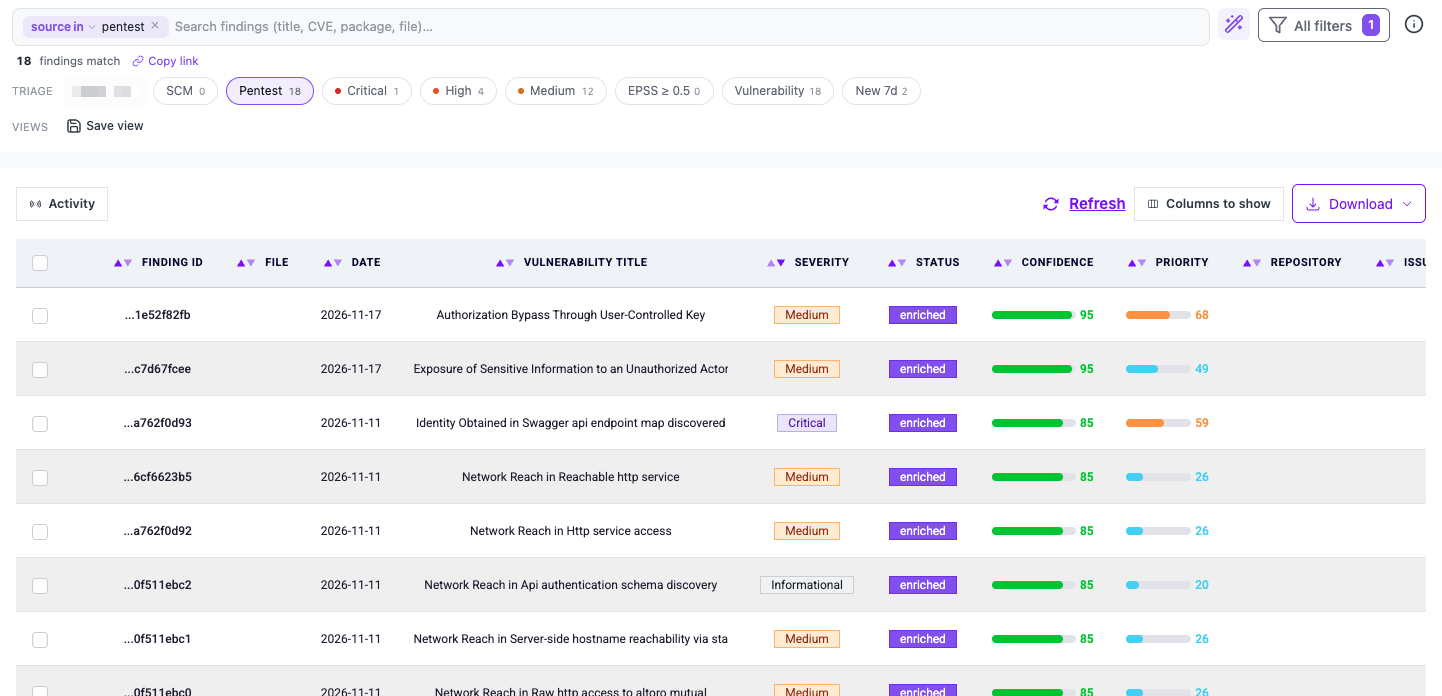
Screenshot: the Findings page of the Plexicus platform filtered to AI Pentest results, with severity, confidence and priority for each finding. Captured November 2026.
How severity is rated
Many testers use the Common Vulnerability Scoring System, maintained by FIRST and now in its fourth major version. The NCSC notes that it is common for penetration testers to use CVSS, often at the customer’s request, and that its CHECK scheme requires its own HIGH, MEDIUM, LOW or INFORMATIONAL rating, with CVSS only in addition. NCSC
A base score describes the vulnerability in general. It does not know your environment.
The NCSC makes the same point: other controls can reduce the effect of a vulnerability, and other vulnerabilities can amplify it, so any deviation from the standard rating should be documented and justified. NCSC
Ask for severity that explains itself: the score, plus why it matters in your system.
Who decides what to fix
The test team rates each issue and proposes a fix. The NCSC is explicit that risk assessment and decisions on fixes remain the system owner’s responsibility, because the testers may not know the full business impact. It also notes that the proposed fix may not be the only option. NCSC
Vulnerability risk is a business decision. A pentest informs it; it does not make it for you.
What a Penetration Test Cannot Tell You
A penetration test is strong evidence. It is also bounded evidence. Four limits follow from how it works.
1. It covers a moment, not a period
The NCSC says a penetration test can only validate that systems are not vulnerable to known issues on the day of the test. NCSC Tomorrow’s deploy is untested.
2. It covers a sample, not everything
OWASP’s guide quotes Gary McGraw on the point: in practice a penetration test can only identify “a small representative sample of all possible security risks in a system”. OWASP WSTG
A clean report means the testers did not find a path in the time and scope they had. It does not mean there is none.
3. It depends on the tester
The NCSC notes that penetration tests cannot be entirely procedural, that no exhaustive set of test cases can be drawn up, and that the quality of a test is closely linked to the abilities of the testers involved. NCSC
4. It arrives late in the lifecycle
The Web Security Testing Guide lists coming too late in the SDLC among the disadvantages of penetration testing, and argues for a balanced approach that tests in every phase, from manual reviews to tests integrated in CI/CD. OWASP WSTG
None of these limits is a reason to skip pentesting. They are the reasons a pentest should sit inside a continuous program, not replace one.
How Often Should You Run a Penetration Test?
There is no single correct cadence. There are three sensible inputs.
Regulation. If DORA applies to you, threat-led penetration testing is required at least every three years for identified entities, and Article 24 requires appropriate tests at least yearly on all ICT systems and applications that support critical or important functions. EUR-Lex Other sector rules and customer contracts set their own minimums.
Change. A new authentication flow, a new public API, a new payment integration or a major infrastructure move all change what an attacker can reach. Each is a good reason to test, whatever the calendar says.
Risk. Systems that hold customer data, move money or grant administrative control deserve more frequent and deeper testing than a brochure site.
The question is not “how many pentests a year?”. It is “how long can a change stay untested?”.
How to Get More From a Penetration Test
1. Know your own weaknesses first
The NCSC’s ideal is that you already know what the testers will find, and use the test to verify your own expectations. NCSC Run your own scanning and code analysis before you pay someone to rediscover the same issues.
2. Put the scope in writing
Targets, exclusions, dates, techniques, test accounts, contacts and reporting format. Signed before the first request is sent.
3. Give the testers an account for every role
Authorization flaws only show up when the tester can compare what different users see. One account per role turns hours of guessing into minutes of checking.
4. Test something that looks like production
A test environment with different authentication, a different proxy or different headers tests a different system. Keep it close to production, with data you can afford to lose.
5. Keep a technical contact on call
So the testers can report a critical issue the moment they find it, and get unblocked when something in the environment breaks. The NCSC recommends it for the whole testing phase. NCSC
6. Demand evidence for every finding
Requests, responses, steps and impact. A finding nobody can reproduce will not get fixed, and should not take a developer’s afternoon.
7. Treat new findings as process feedback
The NCSC says any vulnerability you did not already know about deserves special attention, with the aim of spotting that kind of issue yourself next time. NCSC
8. Re-test every fix
Re-run the same proof after the fix merges. Only then close the finding.
Which Mistakes Waste a Penetration Test?
Mistake 1: Buying a scan and calling it a pentest
If the report has no exploitation, no chaining and no evidence per finding, it was a vulnerability scan with a different cover page.
Mistake 2: Scoping out the risky parts
Excluding authentication, the payments API or the admin panel to “avoid disruption” removes exactly the paths attackers target. Exclude destructive actions instead, and keep the paths in scope.
Mistake 3: Testing once a year and assuming the result holds
The result described the system on the test dates. Every release since then is untested.
Mistake 4: Measuring the test by the number of findings
A long report of low-impact issues is not a better test than a short report with one proven path to customer data. Count proven paths and how quickly they closed.
Mistake 5: Filing the report instead of fixing it
A finding that sits in a PDF for six months is still open. Findings belong in the backlog of the team that owns the code, with the evidence attached.
Which Standards and Frameworks Apply?
NIST SP 800-115
NIST’s Technical Guide to Information Security Testing and Assessment, published in September 2008 and superseding SP 800-42, helps organizations plan and conduct technical security tests, analyze findings and develop mitigation strategies. Its keywords include penetration testing and vulnerability scanning. It is old, but it is still the current final edition on NIST’s site.
OWASP Web Security Testing Guide
The WSTG is OWASP’s reference for testing web applications. Its stable web-hosted release, the one this guide links to, is current, and the project says the next major version is in development.
Penetration Testing Execution Standard (PTES)
A community standard with seven phases from pre-engagement to reporting, plus technical guidelines on testing procedures, as summarized in the WSTG’s methodologies chapter.
OSSTMM
The Open Source Security Testing Methodology Manual covers operational security across physical, human, wireless, telecommunications and data network testing. The WSTG describes it as a supporting reference for ISO 27001 rather than a hands-on application testing guide. OWASP WSTG
NCSC penetration testing guidance
The UK NCSC’s guidance on commissioning and using penetration tests, published in August 2017 and reviewed in January 2022, covers scoping, testing, reporting and follow-up.
DORA and TIBER-EU
For EU financial entities, DORA sets the testing duties, including threat-led penetration testing, and the ECB’s TIBER-EU framework can help entities meet those threat-led testing requirements.
CVSS
FIRST’s Common Vulnerability Scoring System, now in its fourth major version, is a common way to express the base severity of each finding.
How AI Is Changing Penetration Testing
Several of the limits above trace back to one constraint: skilled human time is scarce. Tests are expensive, so they are infrequent, and they cover a sample.
AI agents change the economics of the repetitive parts: mapping the surface, trying variations, correlating results, reproducing a finding a second time. They do not remove the need for scope, rules and judgment.
The useful question for an AI pentest is the same as for a human one: does every finding come with proof?
Our post What Is AI Swarm Pentest? explains how a swarm of agents approaches this, and our review of AI pentest tools compares the field.
Where Plexicus Fits
Plexicus is built around the part of a penetration test that matters most: proof.
Test an authorized scope. AI Swarm Pentest validates exploitable paths across your application, API and source code. Before work starts, the authorized application, API or environment, the rules of engagement and any test access are defined, and the scope and rules of engagement are agreed in writing. Plexicus does not act outside that scope, and it makes no automatic production changes.
Think like an attacker, not a signature list. The product page puts the difference directly: a scanner compares signatures, while AI Swarm Pentest forms hypotheses, explores attack paths and connects the evidence. It automates repetitive exploration, correlation and reproduction while your team keeps context, supervision and the final decision.
In the platform, the Nexus war room shows a run as it happens:
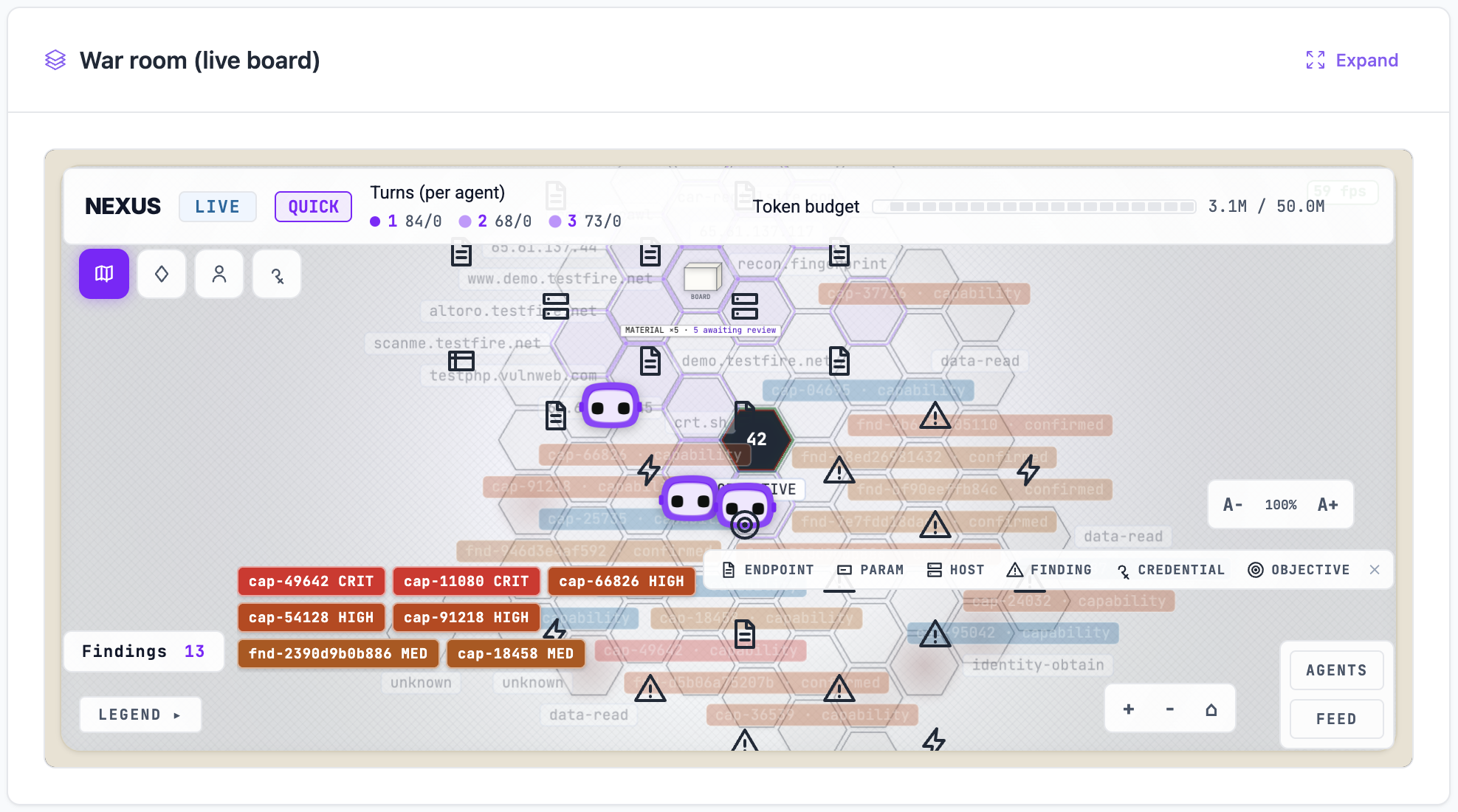
Screenshot: the Nexus war room of a live AI Pentest run in the Plexicus platform, showing the agents, the hosts and endpoints they reached and the findings raised so far. Captured November 2026.
Verify before reporting. The engagement maps the surface, forms hypotheses and tests paths. A second pass independently confirms each finding before it is marked verified; if it cannot reproduce the result, the finding is marked unverified or discarded. That is no PoC, no finding in practice.
Report the chain, not only the parts. The deliverable includes the complete attack chain: target, steps, demonstrated impact and the context your team needs, in a two-layer report with an executive readout and a PDF evidence pack. Findings are prioritized by real risk, CVSS plus context, not by order of arrival.
In the platform, the Chain of proof panel of a run shows how the steps link together:
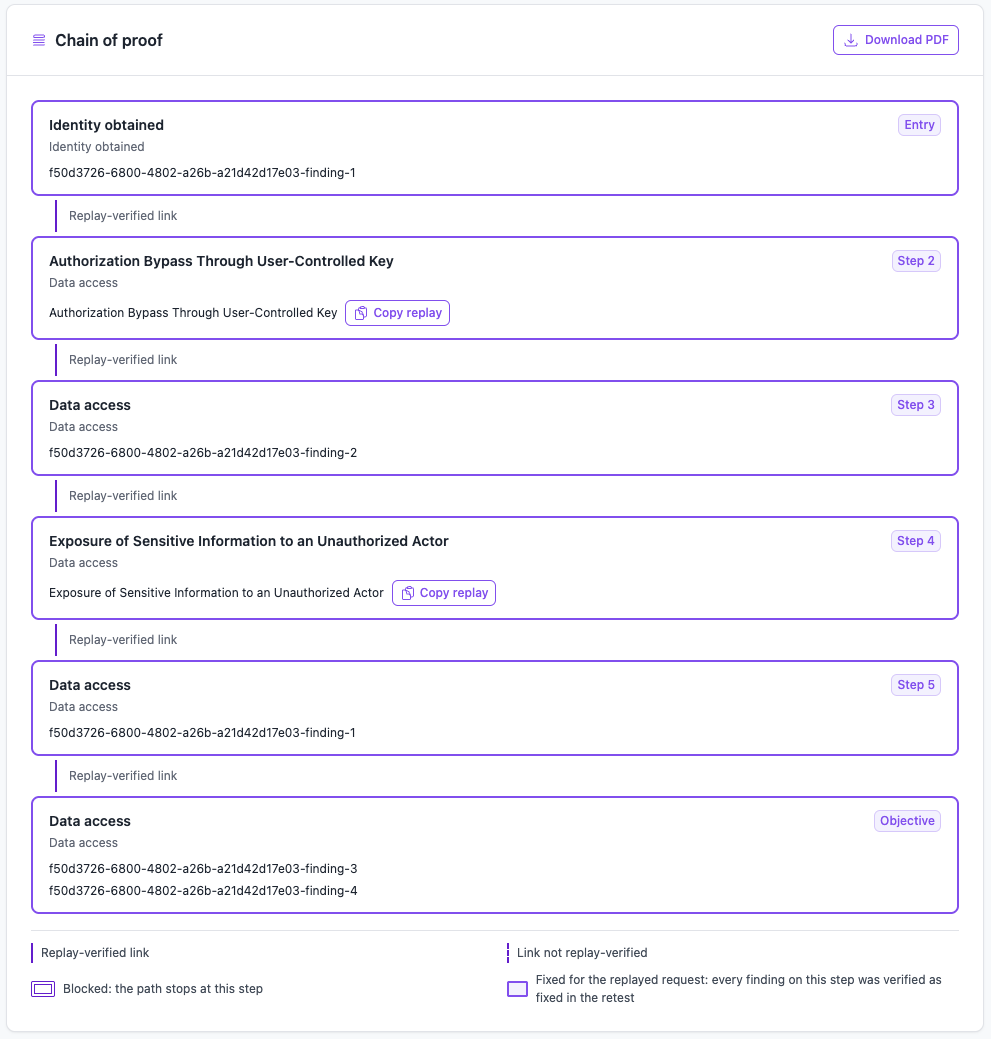
Screenshot: the Chain of proof panel of an AI Pentest run in the Plexicus platform, six linked steps from the entry point to the objective, each link marked replay-verified. Lab target, captured November 2026.
Close the loop. Once a finding is verified, Plexicus Remediation prepares the remediation context and a suggested change, with regression tests and notes where relevant and a re-test hook wired to CI. Your team keeps merge control: Plexicus never pushes to production. Deep Code Analysis adds the code and impact context for every finding.
That is Proof-Driven AppSec: a scoped test, evidence for every finding, and a reviewed change with a CI re-test hook that your team decides to merge. A closed loop with PR.
To see where penetration testing sits in a full program, read our complete guide to application security. For what happens after a finding is verified, see Introducing AI-Native Remediation.
Frequently Asked Questions
What is penetration testing in simple terms?
It is an authorized, simulated attack on your own system. Testers use the tools and techniques an attacker would, inside an agreed scope, and report which weaknesses they could exploit, what those gave access to, and how to fix them.
What is the difference between a penetration test and a vulnerability scan?
A vulnerability scan is automated and lists known weaknesses it detects. A penetration test tries to exploit weaknesses, links them together and proves what an attacker could reach, with evidence for each finding.
What are the main types of penetration testing?
By knowledge: black-box, grey-box and white-box. By target: web application, API, mobile, network (external and internal), cloud, social engineering and physical. Scenario-driven tests start from a situation, such as a lost laptop.
What are the phases of a penetration test?
Scoping and rules of engagement, reconnaissance, threat modeling, vulnerability analysis, exploitation, post-exploitation and chaining, reporting, then remediation and re-test. PTES names seven phases from pre-engagement interactions to reporting.
What should a penetration test report include?
Every issue found, a risk assessment for each, evidence and reproduction steps, a way to resolve each issue, and an executive summary of what an attacker could reach. The NCSC also recommends an opinion on how accurate your own vulnerability assessment is, and advice on improving it.
How often should you do penetration testing?
At least as often as your regulation or contracts require, and after significant changes such as a new authentication flow or a new public API. For systems that change daily, an annual test leaves most releases untested.
Is penetration testing required by law?
In some sectors, yes. The EU’s DORA requires identified financial entities to perform threat-led penetration testing at least every three years, and lists penetration testing among the tests of its resilience testing programme. Other rules and many customer contracts set their own requirements.
What is the difference between penetration testing and red teaming?
A penetration test tries to find and prove as many exploitable weaknesses as possible in a defined scope. A red team exercise pursues a specific objective the way a real threat actor would, and also measures whether the organization detects and responds.
Can AI do penetration testing?
AI agents can take on the repetitive parts: mapping, trying variations, correlating and reproducing results. Scope, rules of engagement and the final decision still need people. Judge any AI pentest by the same rule as a human one: every finding needs proof.
Prove What an Attacker Can Reach
Test inside an agreed scope, prove every path, and give your team a fix it can review.
Want a first look at your own code as well? Run the free SAST tool, a static scan of your GitHub source code.