What Is an SBOM? Software Bill of Materials Explained: The 2026 Guide
A complete guide to the software bill of materials in 2026: what an SBOM contains under the new CISA minimum elements, the six SBOM types, SPDX and CycloneDX, the rules that require one, and how to generate and use it.
Beyond ASPM
Proof-Driven AppSec for teams building with AI
Plexicus uses AI Swarm Pentest to explore authorized application paths, validate what is exploitable, and give teams evidence they can use to prioritize remediation.
Explore AI Swarm PentestAsk your team a simple question: which libraries are in the build you shipped last Tuesday?
Without an inventory, the answer means opening repositories, images and build logs one by one.
A software bill of materials (SBOM) is a formal, machine-readable record of the components in a piece of software and how they relate to each other: the ingredients list of your code.
That list used to be a nice-to-have. In 2026 it is a baseline.
On July 29, 2026, CISA, NSA, FBI and international partners released the 2026 Minimum Elements for a Software Bill of Materials, which update and replace the 2021 NTIA checklist.
The EU Cyber Resilience Act makes an SBOM part of the technical documentation for products with digital elements, with its main obligations applying from December 11, 2027.
Third parties are also part of more and more breaches. In its 2026 Data Breach Investigations Report executive summary, Verizon reported that breaches with third-party involvement reached 48% of the breaches in its dataset.
This guide explains what an SBOM is, what it must contain under the 2026 minimum elements, the six types of SBOM, the two formats you will meet, the rules that require one, and how to generate and use an SBOM that stays true to what you ship.
What Is an SBOM?
An SBOM is an inventory of every component that makes up a piece of software, with enough detail to identify each one and its place in the dependency tree.
CISA calls it “an ingredients list for software”. The analogy holds: a food label does not tell you whether a meal is safe, but you cannot check for an allergen without one.
The term entered US policy in May 2021. Executive Order 14028, signed on May 12, 2021, defined an SBOM as a formal record of the components used to build software and of how they relate in the supply chain.
The same order described three groups that benefit from it: those who build software, those who buy it, and those who operate it.
That split is still the clearest way to think about SBOMs:
| Who | What the SBOM lets them do |
|---|---|
| Builders | Keep components up to date and respond fast to a new vulnerability |
| Buyers | Check vulnerabilities and licenses before they sign |
| Operators | Find out quickly whether a new advisory affects a system they run |
What does an SBOM look like?
An SBOM is a structured file, usually JSON or XML. Here is a shortened example in the CycloneDX format, describing one component:
{
  "bomFormat": "CycloneDX",
  "specVersion": "1.7",
  "version": 1,
  "components": [
    {
      "type": "library",
      "name": "lodash",
      "version": "4.17.21",
      "purl": "pkg:npm/lodash@4.17.21",
      "licenses": [{ "license": { "id": "MIT" } }]
    }
  ]
}
A real SBOM for a web application lists hundreds or thousands of these entries, plus metadata about who made the SBOM, with which tool, and when.
Nobody reads an SBOM line by line. Machines read it, so humans can ask questions of it.
First-party and third-party components
The CISA 2026 document describes an SBOM as roughly hierarchical. Software consists of components, each of which may have subcomponents, and so on down the tree.
First-party components come from the party that writes the SBOM. Third-party components come from an external source: open-source packages, commercial libraries, firmware, container base images.
Both belong in the SBOM. A vulnerable internal library is just as exploitable as a vulnerable open-source one.
Why SBOMs Matter in 2026
You cannot patch, replace or explain a component you do not know you have.
Four facts make the case in 2026.
1. Third parties are involved in nearly half of breaches. Verizon’s 2026 executive summary found that third-party involvement reached 48% of breaches, up 60% from the year before, and that exploitation of vulnerabilities was the most common known initial access vector in breaches not caused by error or misuse, at 31%.
2. Remediation is slow. The same report found that only 26% of critical vulnerabilities listed in CISA’s Known Exploited Vulnerabilities catalog were fully remediated by organizations in 2025, down from 38% the year before. The median time to full resolution rose to 43 days.
In our view, an inventory shortens the first step of that work: finding where the vulnerable component is.
3. Log4Shell showed what happens without an inventory. In its Log4j guidance, since archived, CISA described active, widespread exploitation of the Log4j vulnerability CVE-2021-44228. In a 2022 update to that page, it advised organizations to consider all assets, including internally developed software.
With a current SBOM, that question is a query. Without one, it means opening every repository, image and appliance by hand.
4. The baseline is now international. On September 3, 2025, CISA and NSA, together with international cybersecurity organizations, published A Shared Vision of Software Bill of Materials for Cybersecurity. The July 2026 minimum elements were written by 18 authoring organizations: CISA and 17 partners from North America, Europe, Asia and Oceania.
An SBOM is no longer a US federal procurement detail. It is how software suppliers are expected to describe their products in the US, the EU and beyond.
A Short History of the SBOM
The idea of a bill of materials comes from manufacturing. A car maker knows which supplier made every part, so a faulty batch can be traced to the cars it went into.
Software took longer to adopt the idea. Here is how the SBOM became a baseline:
| Date | Milestone |
|---|---|
| May 12, 2021 | Executive Order 14028 directed the US government to define SBOM minimum elements and listed providing an SBOM among the secure software practices it asked for |
| July 12, 2021 | NTIA published The Minimum Elements for a Software Bill of Materials |
| March 29, 2023 | Section 524B of the US Federal Food, Drug, and Cosmetic Act took effect, requiring an SBOM in premarket submissions for cyber devices |
| April 21, 2023 | A CISA-facilitated working group published Types of Software Bill of Materials |
| December 10, 2024 | The EU Cyber Resilience Act entered into force |
| September 3, 2025 | CISA, NSA and international partners published a shared vision for SBOM |
| July 29, 2026 | CISA and partners released the 2026 Minimum Elements, replacing the 2021 NTIA document |
The 2021 NTIA list is now history. If your SBOM process was built to that checklist, it no longer meets the current baseline.
What Must an SBOM Contain? The 2026 Minimum Elements
The 2026 minimum elements PDF defines two kinds of requirements: data fields, which say what goes into the SBOM, and practices and processes, which say how it is made and shared.
It applies to SBOMs for all software, including open-source software, AI software and software as a service.
The minimum elements do not create new requirements. They refine how organizations should generate and request SBOMs. Contracts and regulations decide whether you must provide one.
The 17 data fields
The fields fall into two groups. SBOM metadata describes the document itself. Component data describes the software and every subcomponent it lists.
| Group | Field | What it records |
|---|---|---|
| SBOM metadata | SBOM Author | The entity that created the SBOM data, not the tool |
| SBOM metadata | SBOM Author Signature | A digital signature attributable to the author |
| SBOM metadata | SBOM Data Format Name | The format used, such as SPDX or CycloneDX |
| SBOM metadata | SBOM Data Format Version | The version of that format |
| SBOM metadata | SBOM Generation Context | The lifecycle phase when the SBOM was made, such as before build, build or after build |
| SBOM metadata | SBOM Timestamp | When the SBOM data last changed |
| SBOM metadata | SBOM Tool Name | The tool used to generate or amend the SBOM |
| SBOM metadata | SBOM Tool Version | The version of that tool |
| SBOM metadata | SBOM Version | The version of the SBOM document itself |
| Component data | Component Producer | The entity that created the component |
| Component data | Component Name | The name the producer gave it |
| Component data | Component Version | The producer’s version identifier |
| Component data | Component Identifiers | Machine-readable identifiers such as CPE or PURL |
| Component data | Component Hash Value | A cryptographic hash of the executable artifact |
| Component data | Component Hash Algorithm | The algorithm used for that hash |
| Component data | Component License | The license identifiers under which the component is available |
| Component data | Component Dependency Relationship | Which component includes which, to build a dependency graph |
The six practices
The document adds six practice elements. They matter as much as the fields, because a perfect file delivered once a year is still a stale file.
- Accommodation of updates. SBOM authors correct errors promptly, and recipients accept corrections.
- Coverage. All components, including transitive dependencies, with no minimum depth.
- Distribution and delivery. SBOMs are available promptly to those who need them, for example alongside the installation, at a version-specific URL or through an API.
- Explicitly identifying unknown information. If a field is empty, the author says whether the data is unknown or withheld. Recipients may consider an SBOM incomplete if essential component data is withheld.
- Frequency. Each software version or update has an associated SBOM, and a new build or release gets a new SBOM.
- Machine-processable data. The SBOM uses a widely used, interoperable format that tools can read.
What changed from the 2021 elements?
The 2026 document lists 10 new elements: SBOM Author Signature, SBOM Data Format Name, SBOM Data Format Version, SBOM Generation Context, SBOM Tool Name, SBOM Tool Version, SBOM Version, Component Hash Value, Component Hash Algorithm and Component License.
Four changes have the biggest effect in practice.
Component Producer replaced Supplier Name. CISA says Supplier Name proved ambiguous, especially around distributors.
Now only one organization should be named as the producer of a component. If nobody can tell who made a component, the SBOM should say its provenance is unknown.
Generation Context tells the reader what kind of truth they hold. An SBOM made from source code before the build describes intent. One made by analyzing the built artifact describes what shipped.
Hashes make identity checkable. A component name and version can be spoofed or mislabeled.
A hash of the executable artifact lets the recipient check that the component in the SBOM is the one in the package. If the author has no access to the artifact, the field should say the value is unknown.
The Access Controls element is gone. Its concerns moved into Distribution and Delivery: access controls may limit sharing with unauthorized parties, but should not block sharing between authorized ones.
Component identifiers: PURL, CPE and others
Names are for humans. Identifiers are for machines.
The CISA document asks for at least one identifier per component and names the common ones: Common Platform Enumeration (CPE) and Package-URL (PURL). It also allows UUIDs, commit hashes and intrinsic identifiers such as OmniBOR and the Software Hash Identifier (SWHID). If a component has more than one identifier, the SBOM should include all of them.
PURL is the one most developers meet first. It encodes the package type, the name and the version in one string, such as pkg:npm/lodash@4.17.21.
In December 2025, Ecma International published PURL as a standard: ECMA-427, first edition. It defines the syntax and notes that PURLs are used in SBOMs, vulnerability databases and exploitability reports.
A good identifier is what turns “lodash” into a database lookup. Without it, matching an SBOM against vulnerability data becomes guesswork.
SBOM vs. SCA: Document or Tool?
These two terms are often used as if they were the same thing. They are not.
| SBOM | Software Composition Analysis (SCA) | |
|---|---|---|
| What it is | A document: the inventory | A process and tool category: the analysis |
| Output | A CycloneDX or SPDX file | Findings: vulnerabilities, license issues, outdated components |
| Who reads it | Customers, auditors, regulators, your own tools | Developers and security teams |
| Changes when | A new build or release ships | A new advisory is published, even with no code change |
SCA is one of the main ways an SBOM gets produced, and an SBOM is one of the main things SCA consumes. The CISA-facilitated types document says a Source SBOM is typically generated by SCA tooling.
The difference matters when a customer asks for “your SBOM”. They want the inventory, in a standard format, not a screenshot of your scanner. For the analysis side, read our guide to software composition analysis.
SBOM vs. Lockfile: Why a Manifest Is Not Enough
Your package-lock.json, poetry.lock or go.sum already lists dependencies. Why make another file?
Because a lockfile is written for one package manager, in one language, for one purpose: reproducing an install.
| Lockfile | SBOM | |
|---|---|---|
| Scope | One package manager | Every language and package manager in the product, plus containers, firmware and copied code |
| Format | Tool-specific | Standard: SPDX or CycloneDX |
| Metadata | Versions and integrity hashes for that package manager | Producer, identifiers, licenses, hashes, author, tool and generation context |
| Audience | The package manager | People and tools outside your team |
A lockfile is an input to an SBOM, not a substitute for one. A product with a Java backend, a JavaScript frontend and a container base image has three lockfile formats and needs one SBOM.
CISA adds a detail that lockfiles miss entirely. Code copied from another project, rather than imported, is effectively a dependency. The 2026 document recommends tracking it as a named fork with a dependency relationship, because tracking it that way improves vulnerability management.
SBOM vs. VEX: Inventory and Status
An SBOM tells you a component is present. It does not tell you whether a known vulnerability in it affects your product.
VEX (Vulnerability Exploitability eXchange) is a machine-readable statement of whether a product is affected by a specific vulnerability.
The OpenVEX specification defines four statuses: not_affected, affected, fixed and under_investigation. A not_affected statement needs a justification, such as “vulnerable code not in execute path”, or an impact statement.
The CISA 2026 document names VEX and the Common Security Advisory Framework (CSAF) as security advisories that narrow the scope of at-risk components and help avoid unnecessary work.
| SBOM | VEX | |
|---|---|---|
| Question | What is in this product? | Is this product affected by this CVE? |
| Changes when | The product changes | New analysis or a fix changes the status |
| Typical author | The producer, at build time | The producer or a security team, after analysis |
A VEX statement is a claim. Its value depends on the evidence behind it. “Not in the execute path” is only useful if someone traced the path.
SBOM vs. XBOM
An SBOM covers software components. Your product also depends on cryptography and, more and more, on AI models and datasets.
An XBOM (extended bill of materials) links the SBOM with a cryptographic bill of materials (CBOM) and an AI bill of materials (AIBOM), so one item keeps one identity across all three views.
The CISA 2026 document says AI systems may have components the minimum elements do not capture, and that it adds no AI-specific elements. It points to separate G7 guidance on SBOM for AI from May 2026.
The SBOM is the first and largest part of any broader inventory. Everything in this guide still applies inside an XBOM. For the full picture, read What Is XBOM?, and for the post-quantum side of the CBOM, our analysis of quantum readiness for the software supply chain.
The Six Types of SBOM
Not every SBOM describes the same thing.
In April 2023, a community working group facilitated by CISA published Types of Software Bill of Materials. It defines six types by the artifact or data the SBOM is made from, and says the list is not tightly tied to the software lifecycle. The document itself notes it is not an official US government document.
| Type | Made from | Typically generated by |
|---|---|---|
| Design | A design specification, RFP or concept | Planning, before code exists |
| Source | The development environment, source files and dependencies | SCA tooling, with manual clarifications |
| Build | The build process that creates a releasable artifact | The build pipeline |
| Analyzed | Artifacts after the build: executables, packages, containers, VM images | Third-party analysis tools |
| Deployed | Software present on a system, with its configuration | Recording what was installed |
| Runtime | Instrumenting the running system | Tools that observe execution |
The 2026 Generation Context field can record this, for example as before build, build or after build.
Design SBOM
A Design SBOM lists the components a product is planned to include, some of which may not exist yet.
Strengths: it can highlight incompatible components ahead of a licensing purchase or acquisition, and it defines an approved component list for developers.
Limitations: the working group notes it may be very difficult to generate and is unlikely to carry as much detail as the other types.
Source SBOM
A Source SBOM is generated from the repository: manifests, lockfiles and source files.
Strengths: it does not need access to the build, it shows the dependency tree, and it points to where a vulnerable component can be fixed at the source.
Limitations: it can list components that never run or are compiled out. Depending on the language, it may miss runtime, plugin or platform components.
Build SBOM
A Build SBOM is produced as part of the build that creates the release artifact.
Strengths: the working group says it increases confidence that the SBOM matches the artifact, because it uses data only available during the build. The same workflow can sign both the artifact and the SBOM.
Limitations: you may need to change the build process, the result depends on the build environment, and dynamically linked dependencies may be replaced at runtime.
For most teams, the Build SBOM is the one to share with customers. It describes what shipped, not what you meant to ship.
Analyzed SBOM
An Analyzed SBOM is made by examining a finished artifact, such as a binary, a package or a container image. It is sometimes called a third-party SBOM.
Strengths: it works without the source or the build, for example for legacy firmware, and it can verify SBOMs from other sources or find hidden dependencies.
Limitations: it relies on heuristics, so it may contain omissions, errors or approximations when a tool cannot recognize a component precisely.
Deployed SBOM
A Deployed SBOM inventories the software present on a system, combining the SBOMs of installed artifacts with configuration data.
Strengths: it shows what is actually installed, including system components used to run the application.
Limitations: it may require changes to install and deploy processes, and it may not reflect what runs.
Runtime SBOM
A Runtime SBOM, also called an instrumented or dynamic SBOM, records what is loaded while the system runs, including dynamically loaded components and external connections.
Strengths: it shows what is in use and which parts are active.
Limitations: it requires analyzing the system while it runs, with overhead, and some components only appear after the full functionality has been exercised.
No single type is the truth. A Source SBOM can both over- and under-report, a Runtime SBOM shows only what is loaded while the system runs, and the gap between them is useful information.
SBOM Formats: SPDX vs. CycloneDX
The CISA 2026 document names two formats as widely used: SPDX and CycloneDX. Both are open, machine-processable and human-readable.
SPDX
SPDX (System Package Data Exchange) is maintained under the Linux Foundation. Its version 2.2.1 was published as the international standard ISO/IEC 5962
, according to the SPDX project.The current release is SPDX 3.0.1. Version 3 organizes the specification into profiles, including Core, Software, Security, Build, AI and Dataset. A release candidate for the next version exists as a pre-release.
SPDX license identifiers, such as MIT or Apache-2.0, are used far beyond SPDX documents. The CISA 2026 document recommends them for the Component License field.
CycloneDX
CycloneDX is an OWASP Foundation project.
It is also an Ecma standard: ECMA-424, whose second edition, from December 2025, defines the current version of CycloneDX. The standard covers software and hardware components, services, dependencies, vulnerabilities, cryptographic assets and machine learning models.
CycloneDX has native support for VEX, so an inventory and its vulnerability statements can travel in one document.
How to choose
| SPDX | CycloneDX | |
|---|---|---|
| Maintained by | Linux Foundation | OWASP Foundation |
| Standard | Version 2.2.1 published as ISO/IEC 5962 | ECMA-424, 2nd edition, December 2025 |
| Current release | 3.0.1 | The version defined by ECMA-424, 2nd edition |
| Beyond software | AI and Dataset profiles | Cryptography (CBOM), machine learning (ML-BOM), services, hardware |
| VEX | Through its Security profile or separate documents | Native |
Pick the format your customers and regulators ask for, and be able to produce both. CISA says organizations should accept any widely used, interoperable, machine-processable format.
One rule applies to both. The 2026 document says format versions declared deprecated by their maintainers should not be used, and recommends avoiding SBOMs for new software generated in deprecated versions. Check which version your tools export.
How an SBOM Is Created
An SBOM is an output of your pipeline, not a document someone writes.
Scope -> Generate -> Enrich -> Sign -> Store -> Share -> Regenerate
1. Decide the scope
Pick the unit: one SBOM per release artifact, per container image or per product. CISA allows one large SBOM or an SBOM that links to separate SBOMs for subcomponents, as long as the recipient can reach all linked documents.
2. Generate during the build
Run the generator where the artifact is created, so the SBOM describes what was built. Record the Generation Context.
Most languages and package managers now have an SBOM generator. For example, the npm sbom command produces an SBOM of a Node.js project’s dependencies; you choose SPDX or CycloneDX with the sbom-format option:
npm_config_sbom_format=cyclonedx npm sbom
The CycloneDX project keeps a tool center that lists SBOM generators and consumers by language and build system.
3. Enrich the data
Generators do not always fill every field. Check that each component has a producer, a version, at least one identifier, a hash where the artifact is available, and a license. Mark the gaps as unknown.
4. Sign it
The SBOM Author Signature field gives the recipient assurance that the SBOM was not modified after signing. CISA recommends using your existing software signing infrastructure and key management for it.
5. Store and version it
Keep every SBOM next to the artifact it describes, with an SBOM Version that changes when its content changes. An SBOM you cannot find for an old release is no help during an incident.
6. Share it
Deliver it with the installation, at a version-specific URL, through an API or in a repository, as the Distribution and Delivery element describes. Decide in advance who may receive it.
7. Regenerate on every release
A new build gets a new SBOM. A corrected SBOM gets a new version. This is the Frequency element, and it is the step most often skipped.
How to Use an SBOM
Producing an SBOM is half the work. The value comes from reading it, yours and your suppliers’.
1. Validate what you receive
Check the format and format version, the timestamp, the generation context and the signature. An unsigned SBOM generated before the build tells you less than a signed one from the build.
2. Match components to vulnerability data
Use the identifiers to match each component against vulnerability databases and advisories. This is where a missing PURL or CPE turns into a missed vulnerability.
3. Add exploitability context
A raw match produces a long list. VEX statements from the supplier, or from your own analysis, say which entries affect the product and which do not.
4. Check licenses
The Component License field lets legal teams spot copyleft, proprietary or unknown licenses before they become a contract problem.
5. Watch for new advisories
The inventory does not change when a new CVE is published. Its meaning does. Keep a watch on the components you care about so a new exploitation report reaches the owner the same day.
6. Compare versions
Diff the SBOM of each release with the previous one. Added, removed and changed components are where new risk enters.
On its own, an SBOM is data. The value comes from the analysis you run on it.
What the Rules Require in 2026
United States
The CISA 2026 minimum elements are guidance. Their force comes from the contracts, procurement rules and sector regulations that reference them.
Executive Order 14028 started the US push in 2021 by listing an SBOM, given to a purchaser directly or published on a public website, among the secure software development practices it asked guidance to cover.
Medical devices: FDA Section 524B
For medical devices, the rule is direct. According to the FDA, Section 524B of the Federal Food, Drug, and Cosmetic Act took effect on March 29, 2023. Manufacturers of devices that meet the definition of a “cyber device” must include an SBOM in their premarket submissions.
The FDA’s current premarket cybersecurity guidance, dated February 2026, supersedes the version issued on June 27, 2025.
European Union: the Cyber Resilience Act
The Cyber Resilience Act (Regulation (EU) 2024/2847) defines an SBOM as a formal record of the components in a product’s software and their supply chain relationships.
Annex I, Part II requires manufacturers to document the vulnerabilities and components of their products, including through an SBOM in a common, machine-readable format that covers at least the top-level dependencies.
| Date | What applies |
|---|---|
| December 10, 2024 | The regulation entered into force |
| September 11, 2026 | Reporting of actively exploited vulnerabilities and severe incidents |
| December 11, 2027 | The main obligations, including the SBOM duty |
Two details matter in practice.
The SBOM does not have to be public. It is part of the technical documentation, and a market surveillance authority can request it. Whether users get it is the manufacturer’s choice.
Top-level dependencies are a floor. The CRA says “at the very least”. The CISA 2026 Coverage element asks for transitive dependencies.
Since September 11, 2026, manufacturers must report actively exploited vulnerabilities, as the Commission’s CRA reporting page explains. That duty is easier to meet when you know every level of your dependencies.
Germany: BSI TR-03183-2
Germany’s Federal Office for Information Security publishes TR-03183, whose Part 2 covers SBOMs. It is at version 2.1.0 and maps its data fields to SPDX and CycloneDX.
The BSI states the guideline is not binding and is not a presumption of conformity with the CRA.
Best Practices for SBOMs
1. Generate from the build artifact
Make the SBOM where the release is made, and say so in the Generation Context. A Source SBOM is useful for developers; a Build SBOM is what customers should receive.
2. Cover transitive dependencies
Attackers do not stop at the first level, and neither does the CISA Coverage element. If a component is missing, the recipient will conclude it is not there.
3. Use stable identifiers
Give every component a PURL, and a CPE where one exists. Deduplicate across repositories before you count anything.
4. Include hashes and licenses
Hashes make identity checkable. License identifiers make legal review possible. Both are now part of the minimum.
5. Sign and version every SBOM
Sign with your existing release keys, and change the SBOM Version whenever the content changes.
6. State what you do not know
Mark unknown producers, versions, hashes and licenses explicitly. Never fill a gap with a guess.
7. Attach VEX with evidence
Pair the inventory with exploitability statements, and never mark a vulnerability not_affected without a justification you can show.
8. Diff every release
Review what changed between SBOMs on every build. A new dependency deserves a look the day it arrives, not at the annual audit.
Common SBOM Mistakes
- Generating once for a contract. An SBOM that is never regenerated is a receipt, not an inventory.
- Shipping a Source SBOM as if it described the release. Without a Generation Context, the reader cannot tell intent from reality.
- Listing names without identifiers. “openssl” without a version and a PURL or CPE cannot be matched reliably against vulnerability data.
- Stopping at top-level dependencies. The CRA floor is not the CISA baseline, and transitive dependencies carry real vulnerabilities.
- Hiding gaps. A silent omission reads as “not present”. Write “unknown”.
- Using a deprecated format version. CISA advises against accepting SBOMs for new software in deprecated versions of any format.
- Treating every CVE match as urgent. Without VEX and evidence, teams spend their week on components that cannot be reached.
- Forgetting copied code, containers and firmware. If it ships, it belongs in the inventory.
A Practical Example
Here is how an SBOM works during one illustrative incident. The product, the versions and the advisory are invented.
Your company ships release 4.2.0 of a payments API as a container image. The build pipeline generated a signed CycloneDX SBOM for the image, with Generation Context “build”.
On a Monday morning, a critical vulnerability is published in a widely used XML parsing library. It is already being exploited.
- Query. Your security team searches the stored SBOMs for the library’s PURL. It appears in releases 4.2.0 and 4.1.0, as a transitive dependency of a document export module, at an affected version.
- Scope. The SBOMs of the other 11 services do not list the component. Because those SBOMs cover transitive dependencies, the team can rule them out.
- Evidence. A validation run against the payments API shows the vulnerable parser can be reached through the export endpoint. The VEX status becomes
affected. - Fix. The team upgrades the parent module, rebuilds, and the pipeline generates a new SBOM for release 4.3.0. The diff shows the old parser version removed and the fixed one added.
- Communicate. The team sends customers the new SBOM and a VEX statement saying release 4.3.0 is
fixed, and answers the question every customer asks first: “are we affected?”.
The SBOM did not fix anything. It turned a week of searching into an hour of work, and it left a record you can show.
What an SBOM Is Not
- Not a vulnerability report. It lists components. Vulnerability data and analysis are separate layers.
- Not proof of exploitability. A vulnerable component in the SBOM may be unreachable. Only analysis or testing shows whether it can be exploited.
- Not a compliance certificate. It supports CRA, FDA and procurement evidence. It does not replace a conformity assessment.
- Not a one-time export. An SBOM that is not regenerated with each release describes software you no longer ship.
- Not complete for AI or SaaS on its own. CISA’s own document says these systems may have components the minimum elements do not capture.
Where Plexicus Fits
Plexicus XBOM unifies SBOM, CBOM and AIBOM into a single source of truth, with VEX statements, watchlists, drift detection and standards-ready exports in CycloneDX, SPDX and PDF.
The SBOM is the first view of that inventory. Here is how it looks in the Plexicus platform:
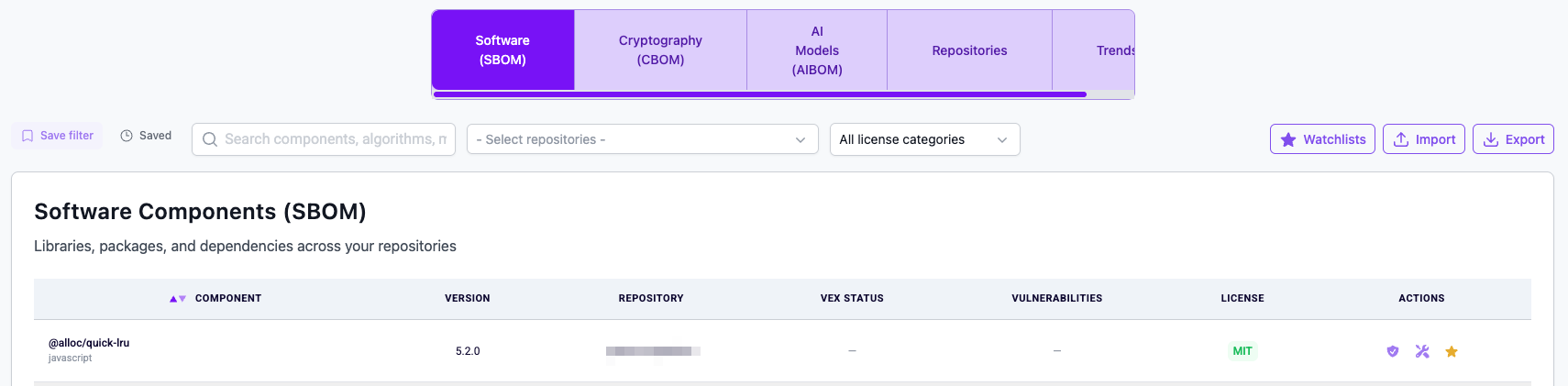
Screenshot: the XBOM inventory in the Plexicus platform, with tabs for software, cryptography and AI models, the filters and the software components table; the repository name is pixelated. Captured November 2026.
According to the XBOM product page, the SBOM view covers libraries, packages and dependencies across every repository, with license category, VEX status and provenance attached. It is CycloneDX and SPDX compatible, scores license risk (copyleft, proprietary, unknown) and keeps a diff between scans, not just a snapshot.
The product page describes how the SBOM stays explainable and current:
- Per-component VEX: one statement per CVE per component, with the statuses affected, not affected, fixed or under investigation.
- Linked to the evidence: VEX justifications reference the reachability path, the agent verdict and the source commit.
- Bulk VEX import: import a supplier SBOM and VEX in one upload; Plexicus reconciles package URLs and surfaces the components you own.
- Watchlists: watch any name, package URL or CVE, and get notified when a new finding matches.
- Diff, not snapshots: every scan is compared with the previous one for the same repository, with added, removed and changed components, and VEX is preserved across the diff.
- Exports: CycloneDX
1.5JSON, SPDX2.3JSON, a PDF attestation, and a BSI TR-03183-2 export profile for the EU CRA.
According to the product page, the same component, key or model has one identity across every view. This is the cryptography view of the same inventory:
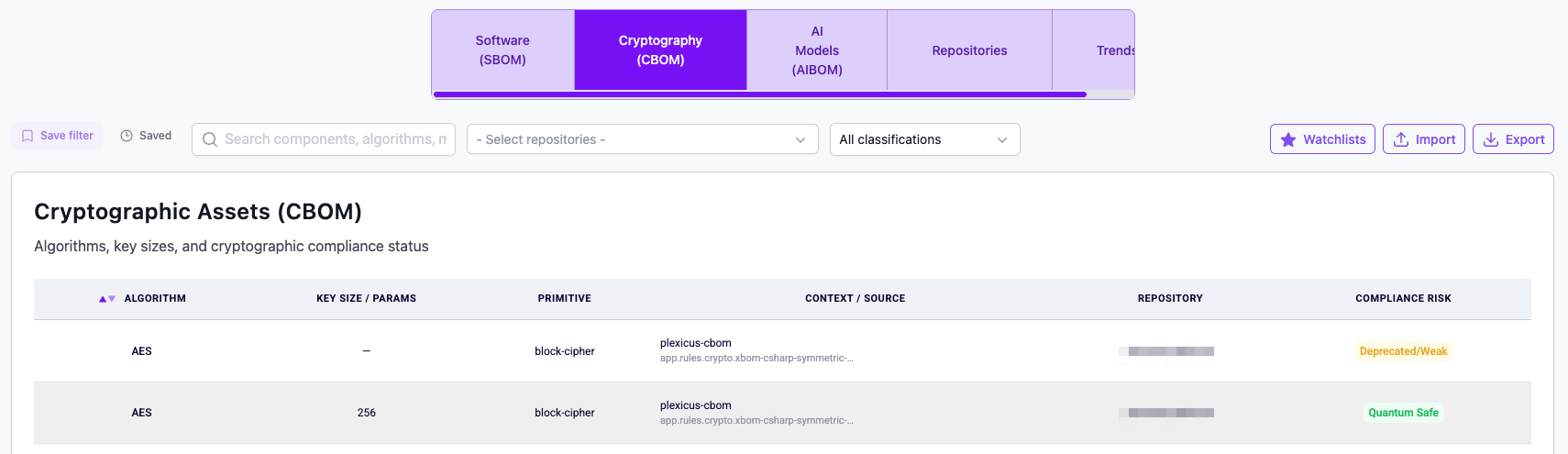
Screenshot: the Cryptography (CBOM) tab of the XBOM inventory in the Plexicus platform, listing algorithms with key size, primitive and a compliance risk such as Quantum Safe; repository names are pixelated. Captured November 2026.
No PoC, no finding. An SBOM tells you where a vulnerable component is. The rest of the closed loop tells you whether it matters: AI Swarm Pentest validates exploitable paths across your application, API and source code within an agreed, authorized scope, Deep Code Analysis adds code and impact context for every finding, and Remediation turns a verified finding into a reviewed, merge-ready fix with a verification re-test.
To see where the SBOM sits in a full program, read What Is Application Security?, our guide to XBOM and our comparison of SCA tools.
Frequently Asked Questions
What does SBOM stand for?
SBOM stands for software bill of materials. It is a formal, machine-readable record of the components in a piece of software and their supply chain relationships.
What is included in an SBOM?
Under the CISA 2026 minimum elements, an SBOM has 17 data fields. Nine describe the SBOM itself, such as author, tool, timestamp and generation context. Eight describe each component: producer, name, version, identifiers, hash value, hash algorithm, license and dependency relationships.
What changed in the 2026 SBOM minimum elements?
The July 2026 document replaces the 2021 NTIA minimum elements. It adds 10 new elements, including Component Hash Value, Component Hash Algorithm, Component License, SBOM Tool Name and SBOM Generation Context, replaces Supplier Name with Component Producer, and folds access controls into Distribution and Delivery.
What are the types of SBOM?
A CISA-facilitated working group defined six: Design, Source, Build, Analyzed, Deployed and Runtime. They differ by the artifact or data the SBOM is made from. A Build SBOM best describes what you shipped.
Which SBOM format should I use, SPDX or CycloneDX?
Both are widely used, and CISA asks organizations to accept any widely used, machine-processable format. SPDX 2.2.1 was published as ISO/IEC 5962
, and the current CycloneDX version is defined by ECMA-424. Use the one your customers ask for, avoid deprecated versions, and be able to produce both.Is an SBOM required by law?
It depends on the product and market.
In the EU, the Cyber Resilience Act requires an SBOM for most products with digital elements, with the main obligations applying from December 11, 2027. In the US, cyber devices need an SBOM in FDA premarket submissions under Section 524B. Elsewhere, contracts and procurement rules decide.
Does an SBOM have to be public?
No. Under the CRA it is part of the technical documentation, and the manufacturer decides whether to share it with users. CISA’s Distribution and Delivery element allows access controls, as long as they do not block sharing with authorized parties.
What is the difference between an SBOM and SCA?
An SBOM is the inventory document. Software composition analysis is the process and tooling that builds that inventory and finds vulnerabilities, license issues and outdated components in it.
What is the difference between an SBOM and VEX?
An SBOM lists what is in a product. VEX states whether a specific vulnerability affects that product: affected, not affected, fixed or under investigation.
How often should an SBOM be updated?
With every build or release, and whenever an error is corrected. The CISA Frequency element asks for an SBOM for each software version or update.
Know What You Ship, and Prove What Matters
Keep a current, signed SBOM for every release, and prove which of its vulnerabilities can hurt you before your team spends a day on them.