10 Best Open-Source AI Pentesting Tools in 2026, Ranked & Compared
Open-source AI pentesting has split into distinct categories: autonomous application pentesters, multi-agent orchestration platforms, verification-first agents, and MCP tool layers. We reviewed 10 actively developed projects and explained what each one is genuinely good at.

Beyond ASPM
Proof-Driven AppSec for teams building with AI
Plexicus uses AI Swarm Pentest to explore authorized application paths, validate what is exploitable, and give teams evidence they can use to prioritize remediation.
Explore AI Swarm PentestAI penetration testing has moved far past asking a chatbot which command to run next.
The newest generation of open-source AI pentesting tools can analyze source code, drive browsers and terminals, orchestrate security tooling, map attack paths, execute exploits, and in some cases verify vulnerabilities with reproducible proof.
But these projects are not interchangeable.
Some are autonomous pentesters. Others are orchestration layers that give an LLM access to existing security tools. A few focus heavily on exploit validation, while others are built for broader red-team operations.
We reviewed the most interesting actively developed projects and narrowed the list down to 10 open-source AI pentesting tools worth watching in 2026.
Note: Rankings are editorial, not a standardized benchmark. Benchmark results reported by individual projects may use different environments and methodologies, so they should not be compared directly.
If you want the commercial landscape rather than the open-source one, see our guide to the 15 best AI pentest tools for 2026.
Quick Comparison
| Rank | Tool | Best For | Key Strength |
|---|---|---|---|
| 1 | Strix | Autonomous application pentesting | Dynamic testing plus PoC validation |
| 2 | Shannon | Web apps and APIs | Source-aware exploit validation |
| 3 | PentAGI | Self-hosted autonomous pentesting | Multi-agent orchestration |
| 4 | PentestGPT | Research and autonomous pentesting | Research-backed agent architecture |
| 5 | RedAmon | Full attack-chain automation | Recon to exploit to remediation |
| 6 | Decepticon | Red-team operations | Realistic multi-stage attack chains |
| 7 | HexStrike AI | Security-tool orchestration | 150+ offensive-security tools |
| 8 | Pentest-AI | Verified vulnerability findings | Independent machine verification |
| 9 | DarkMoon | Broad attack-surface testing | 50 specialist agents |
| 10 | CyberStrikeAI | AI security operations | Agent, MCP, and RAG workspace |
1. Strix
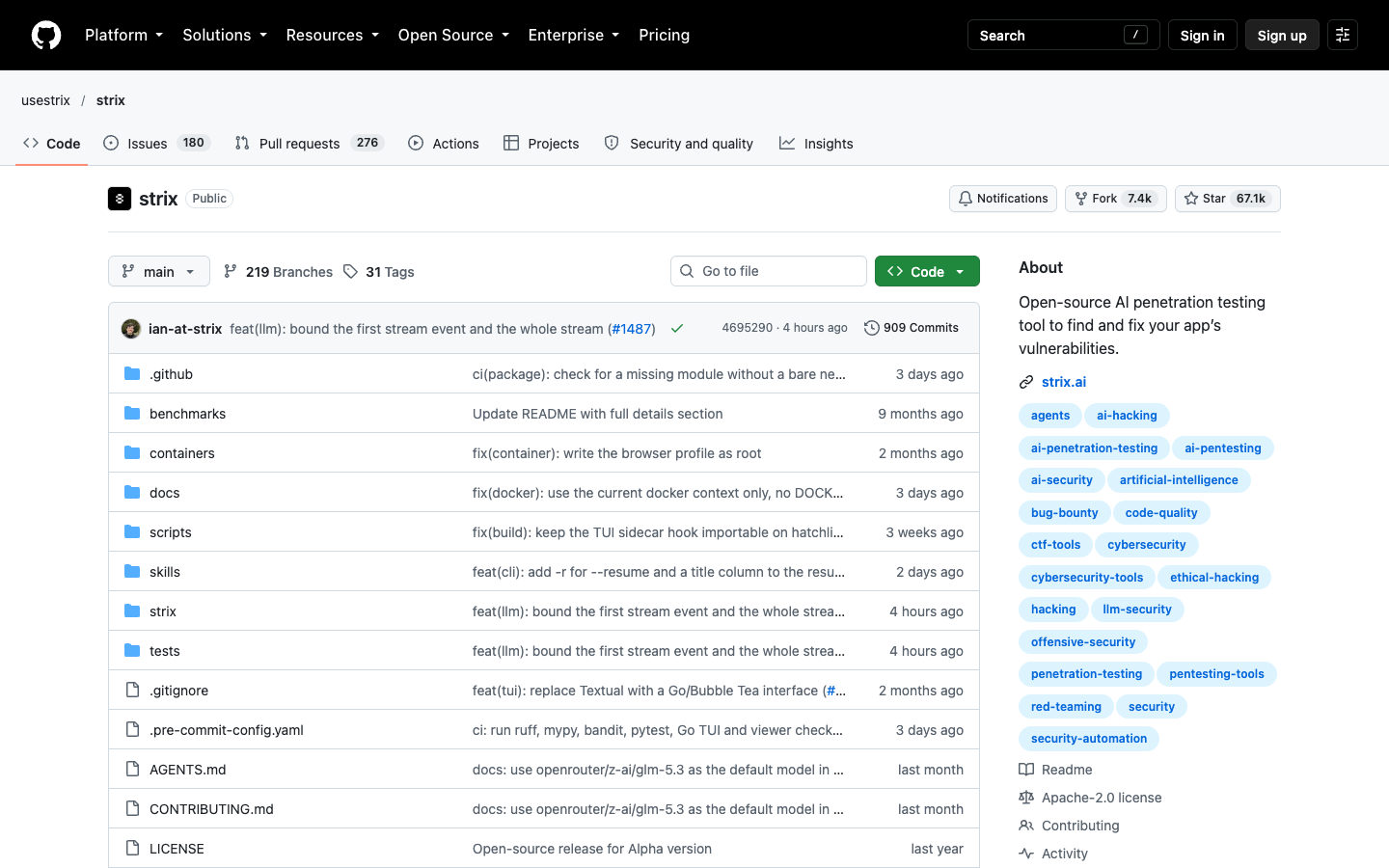
Best overall open-source AI pentesting tool
Strix is an autonomous AI security agent designed to behave more like a pentester than a traditional vulnerability scanner.
It interacts with applications through browser automation, HTTP tooling, terminals, Python execution, and source-code analysis. Instead of stopping after identifying suspicious behavior, Strix is designed to validate vulnerabilities with proof-of-concept exploitation.
It can also run in CI/CD workflows and work against applications, URLs, domains, and IP addresses.
Best for: AppSec teams, developers, autonomous application testing
Why it stands out: Strong combination of autonomous reasoning, real tool execution, and vulnerability validation.
2. Shannon
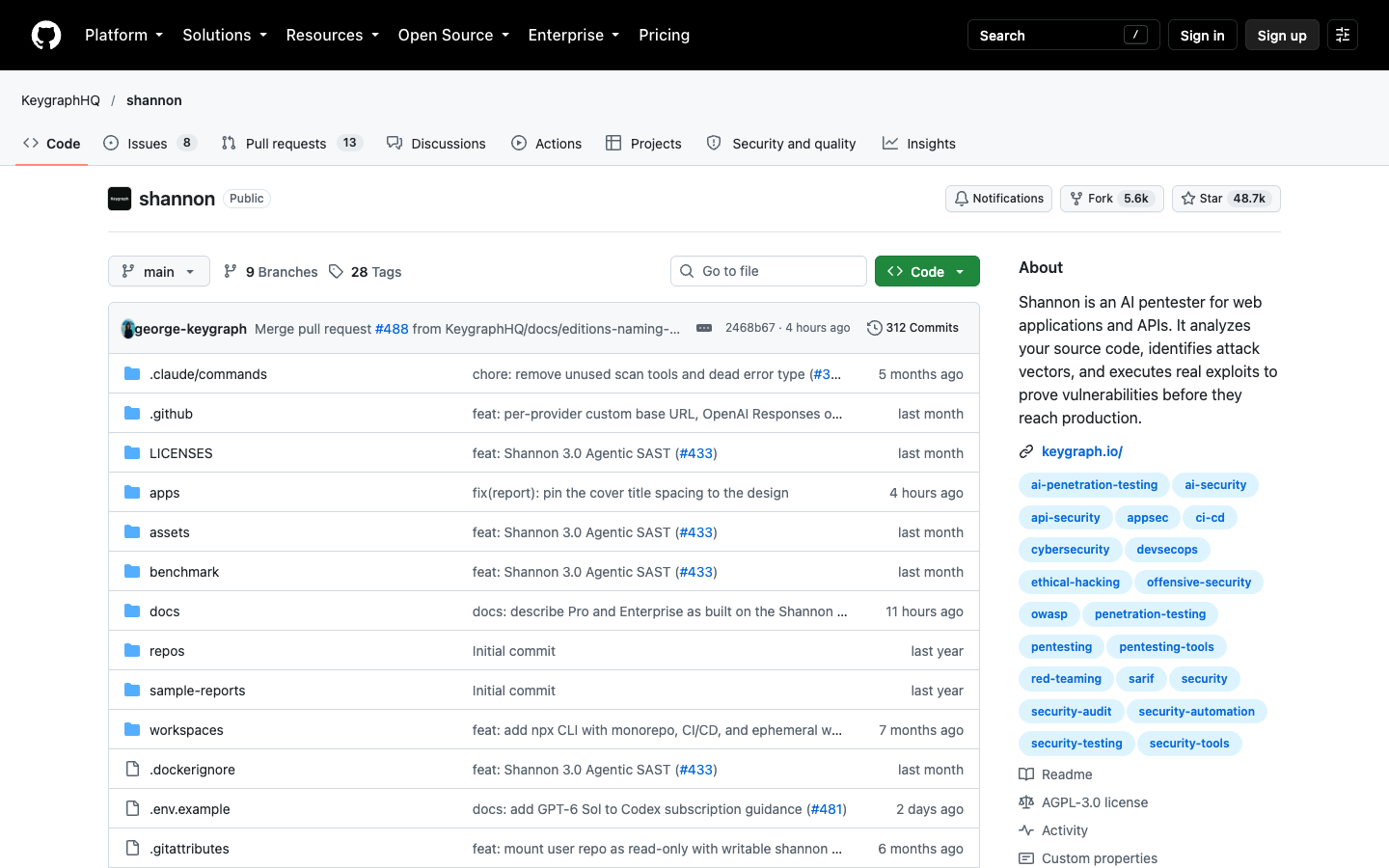
Best for source-aware web and API pentesting
Shannon is an autonomous AI pentester focused specifically on web applications and APIs.
Its workflow combines two sources of information: the application source code and the running application.
Shannon analyzes the codebase to identify potential attack paths, then uses browser automation and command-line tools to attempt real exploitation. Its reporting philosophy is worth noting: a vulnerability is only promoted to a finding when a working proof of concept exists.
The project also supports CI/CD workflows and SARIF output.
Best for: Web applications, APIs, source-available applications
Why it stands out: Excellent combination of code context and runtime exploitation.
3. PentAGI
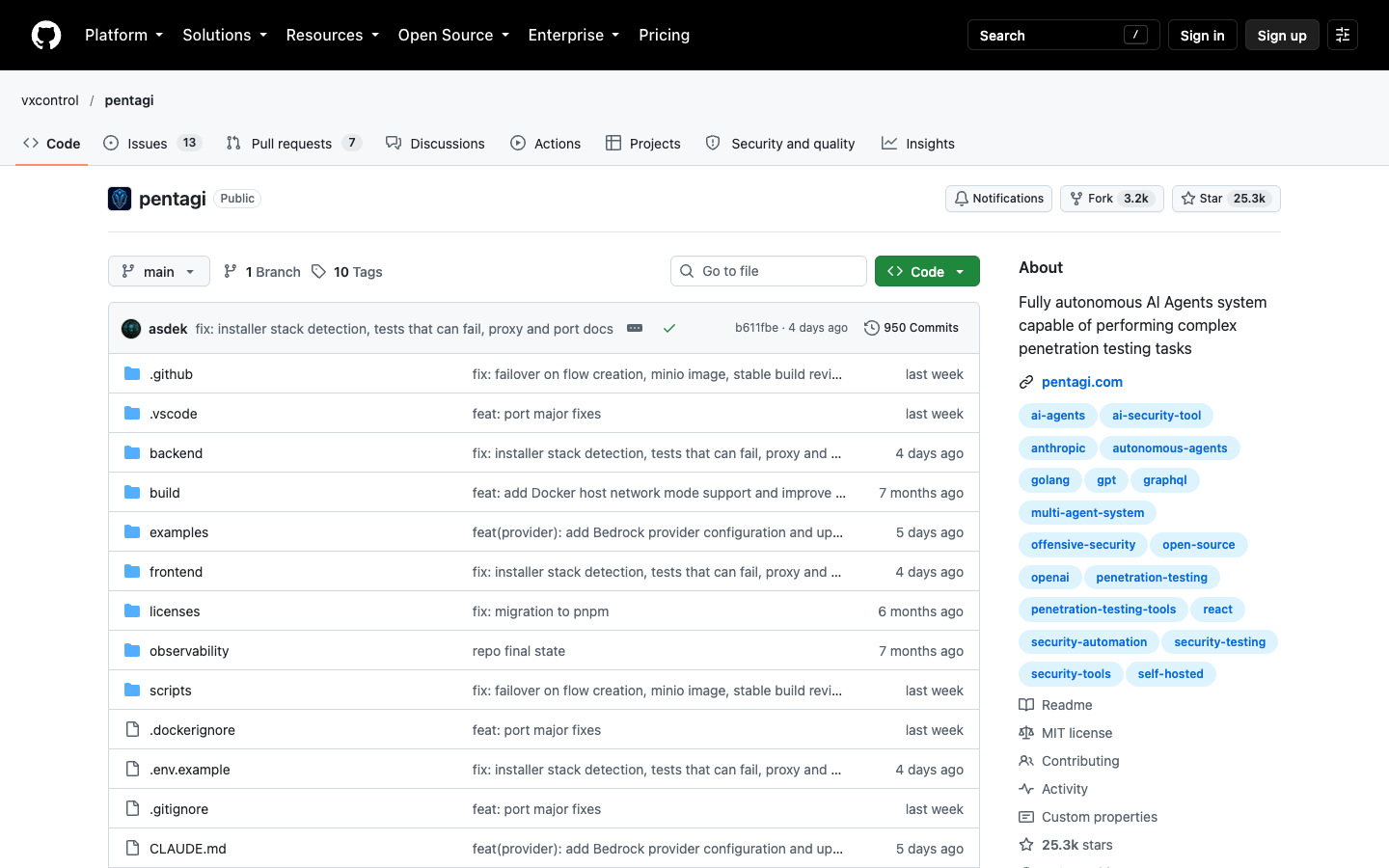
Best self-hosted multi-agent pentesting platform
PentAGI takes a broader approach.
Rather than creating a single security agent, it provides a multi-agent system capable of planning and executing penetration-testing tasks inside isolated environments.
The platform includes autonomous agents, security-tool integrations, memory, Docker-based execution, observability, and support for multiple AI providers.
Its GitHub repository describes PentAGI as a fully autonomous AI-agent system for complex penetration-testing tasks.
Best for: Security researchers and teams wanting a customizable self-hosted environment
Why it stands out: One of the most complete open-source autonomous pentesting platforms.
4. PentestGPT
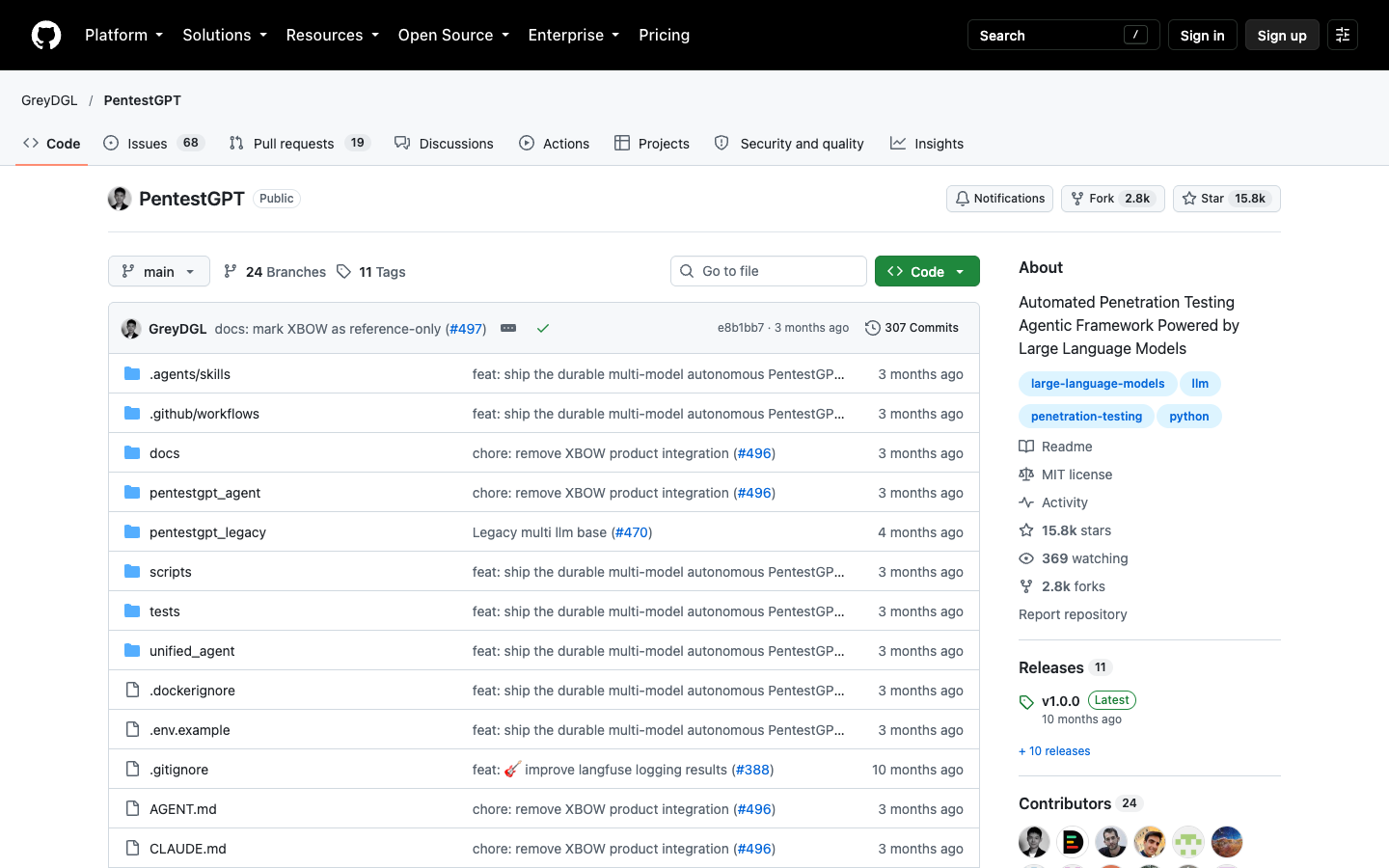
Best research-backed AI pentesting framework
PentestGPT is one of the projects that helped establish AI-assisted penetration testing as a serious research field.
Originally designed as an LLM assistant for pentesters, it has evolved toward autonomous penetration testing.
Its newer architecture uses staged workflows such as reconnaissance, vulnerability identification, exploitation, and reporting, while letting agents operate security tools with reduced human intervention.
The original research was presented at USENIX Security 2024, which gives it a stronger academic foundation than most projects in this category.
Best for: Research, experimentation, CTFs, autonomous pentesting
Why it stands out: Strong academic pedigree combined with an increasingly agentic architecture.
5. RedAmon
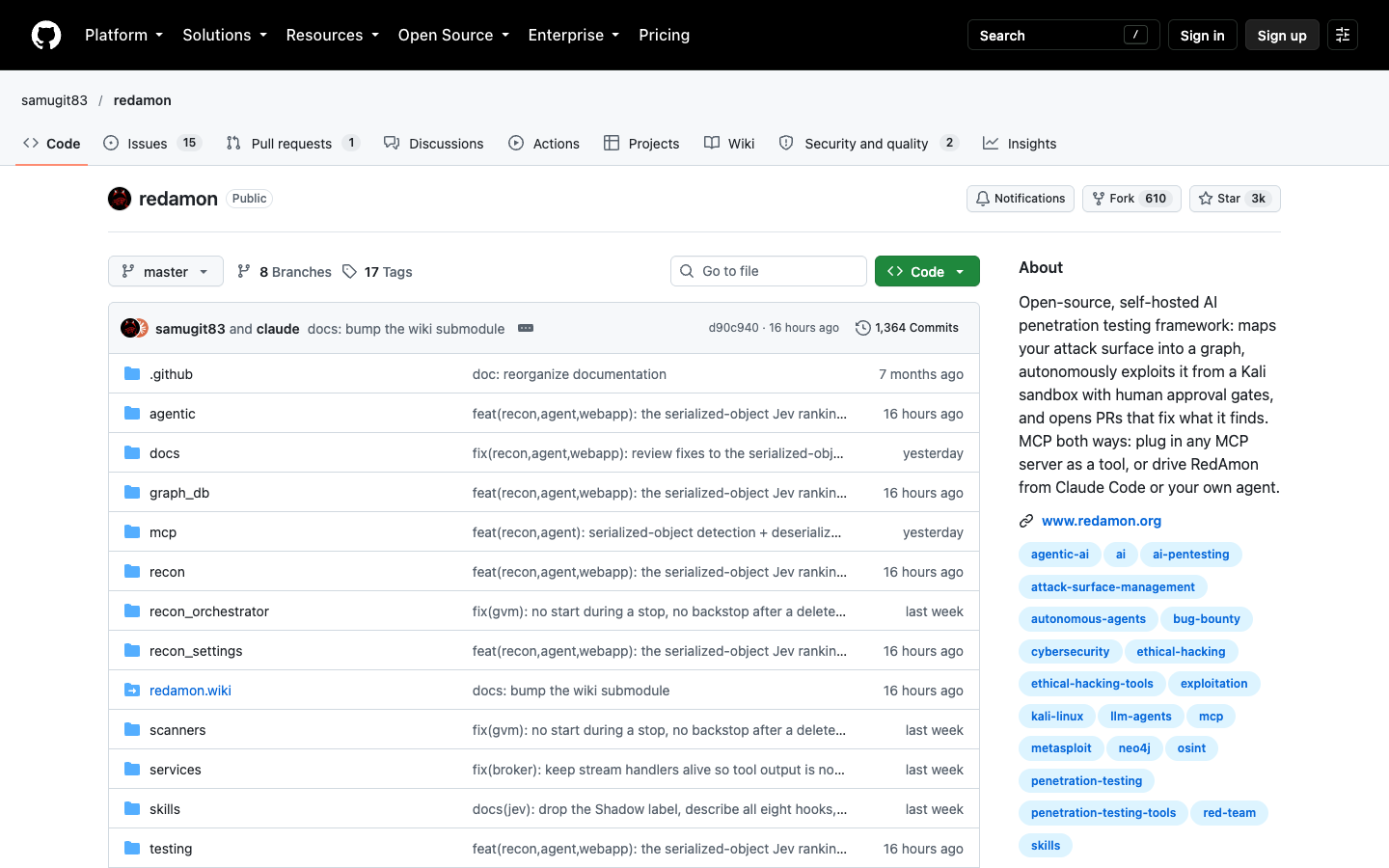
Best end-to-end attack-chain platform
RedAmon combines attack-surface mapping, reconnaissance, autonomous exploitation, and remediation into one framework.
Its AI agent reasons over discovered assets, selects security tools, executes attacks inside a Kali sandbox, and maintains attack-chain context using a graph-based architecture.
The project also includes human approval controls, and it can move past finding vulnerabilities by generating fixes and opening pull requests. That last part matters if you are weighing how evidence-driven remediation differs from alert triage.
Best for: Continuous red teaming and attack-surface-driven pentesting
Why it stands out: Particularly strong at connecting reconnaissance, exploitation, attack-path context, and remediation.
6. Decepticon
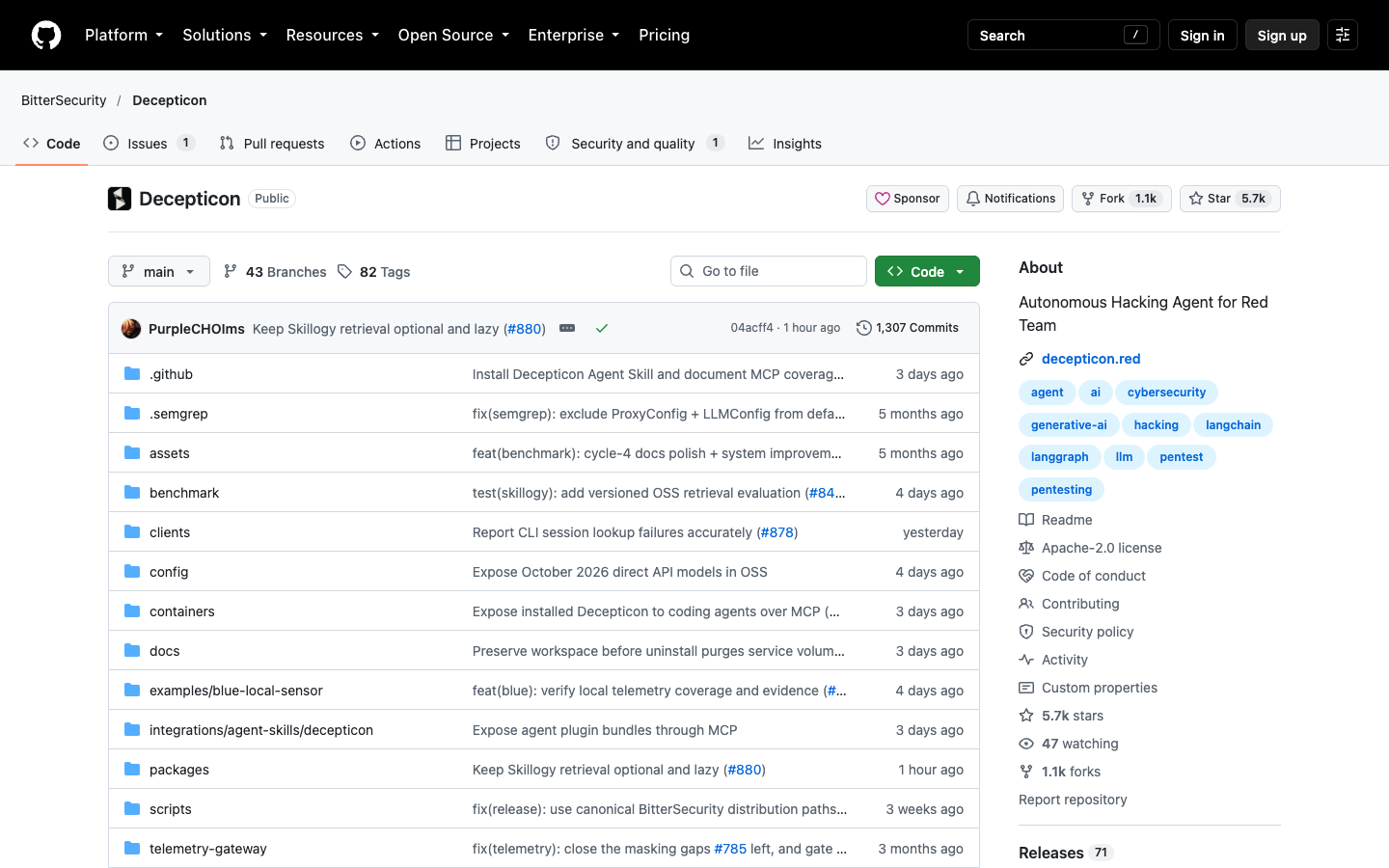
Best for autonomous red-team operations
Decepticon goes beyond application vulnerability testing.
It is designed as an autonomous red-team agent capable of running longer attack chains involving reconnaissance, exploitation, privilege escalation, lateral movement, and command-and-control infrastructure.
It also integrates specialist security environments and tools including BloodHound, Sliver, Ghidra, and persistent interactive shells.
Best for: Internal networks, adversary simulation, professional red-team workflows
Why it stands out: Closer to an autonomous red-team operator than a vulnerability scanner.
7. HexStrike AI
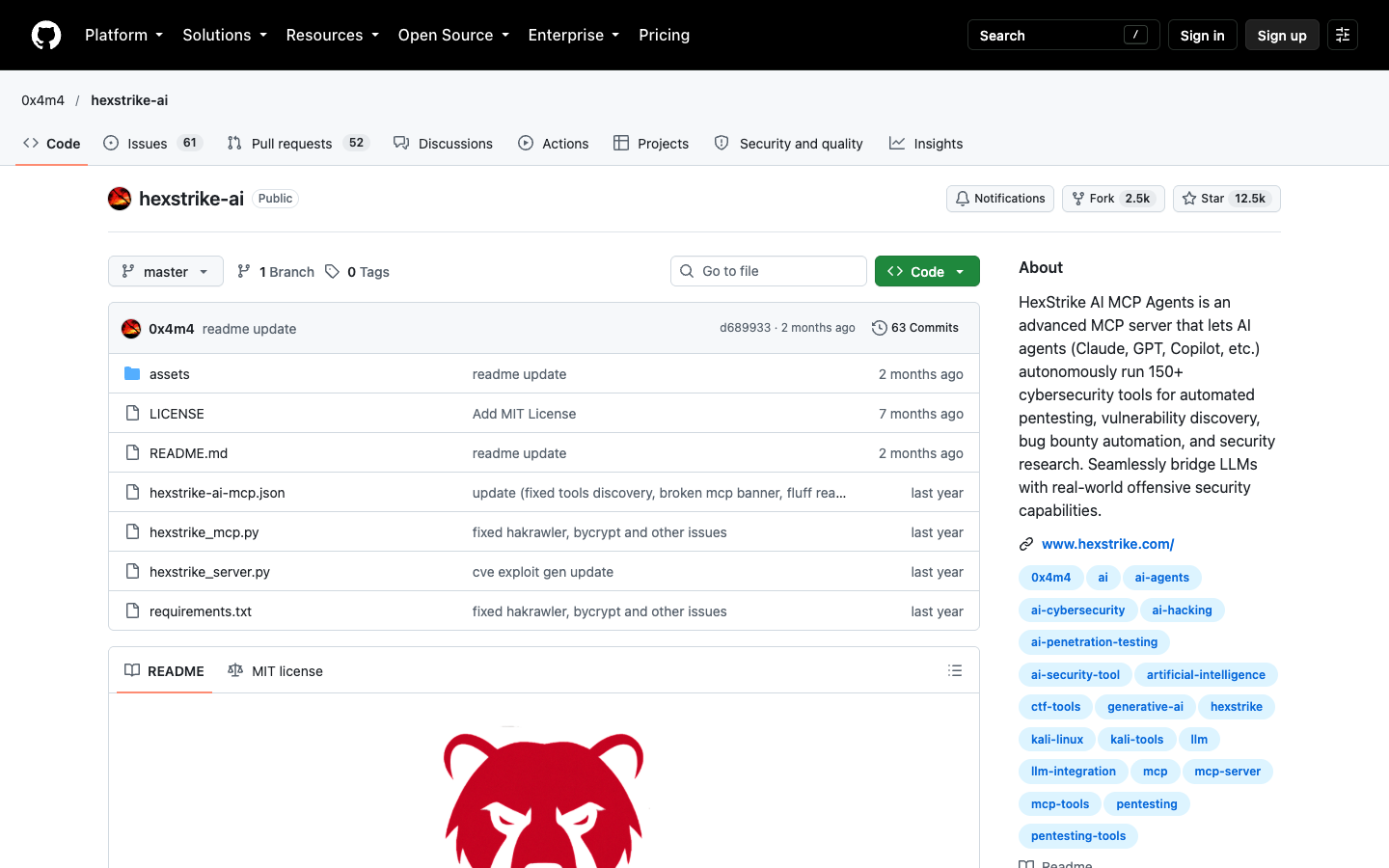
Best AI orchestration layer for offensive-security tools
HexStrike AI takes a different approach.
Rather than building an entirely new pentesting stack, it exposes a large offensive-security toolkit to AI agents through MCP.
The project advertises support for more than 150 security tools and 12 or more AI agents, covering reconnaissance, vulnerability discovery, web security, cloud security, CTFs, and bug bounty research.
That flexibility is powerful, but it also means HexStrike behaves more like an AI security-tool orchestration framework than a specialized autonomous application pentester.
Best for: Researchers who want Claude, GPT, Copilot, or another MCP client to operate existing security tools
Why it stands out: Massive tool coverage and flexible MCP integration.
8. Pentest-AI
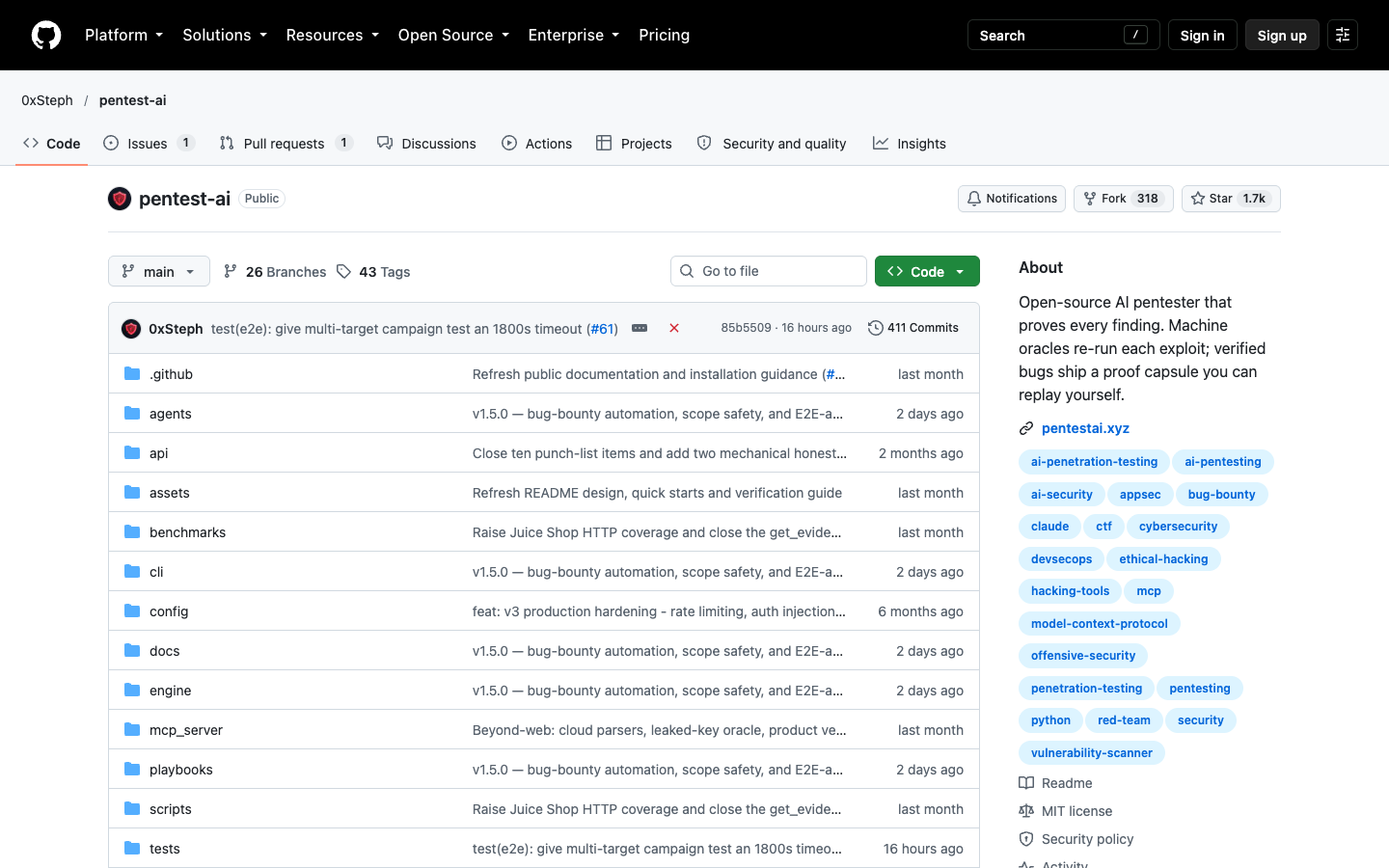
Best verification-first AI pentester
Pentest-AI addresses one of the biggest problems with autonomous security agents:
How do you know the AI actually exploited the vulnerability it claims to have found?
Its architecture separates AI reasoning from verification.
The AI investigates potential vulnerabilities, but independent machine oracles attempt to reproduce the exploit before a vulnerability receives a verified verdict. Successful findings include replayable evidence.
This is an important architectural direction, because an LLM conclusion on its own should not be treated as security evidence. If you want the reasoning behind that shift, see what deep code analysis adds on top of SAST and LLM review.
Best for: Teams that care strongly about reducing AI-generated false positives
Why it stands out: Verification is treated as a separate engineering problem rather than another LLM judgment.
9. DarkMoon
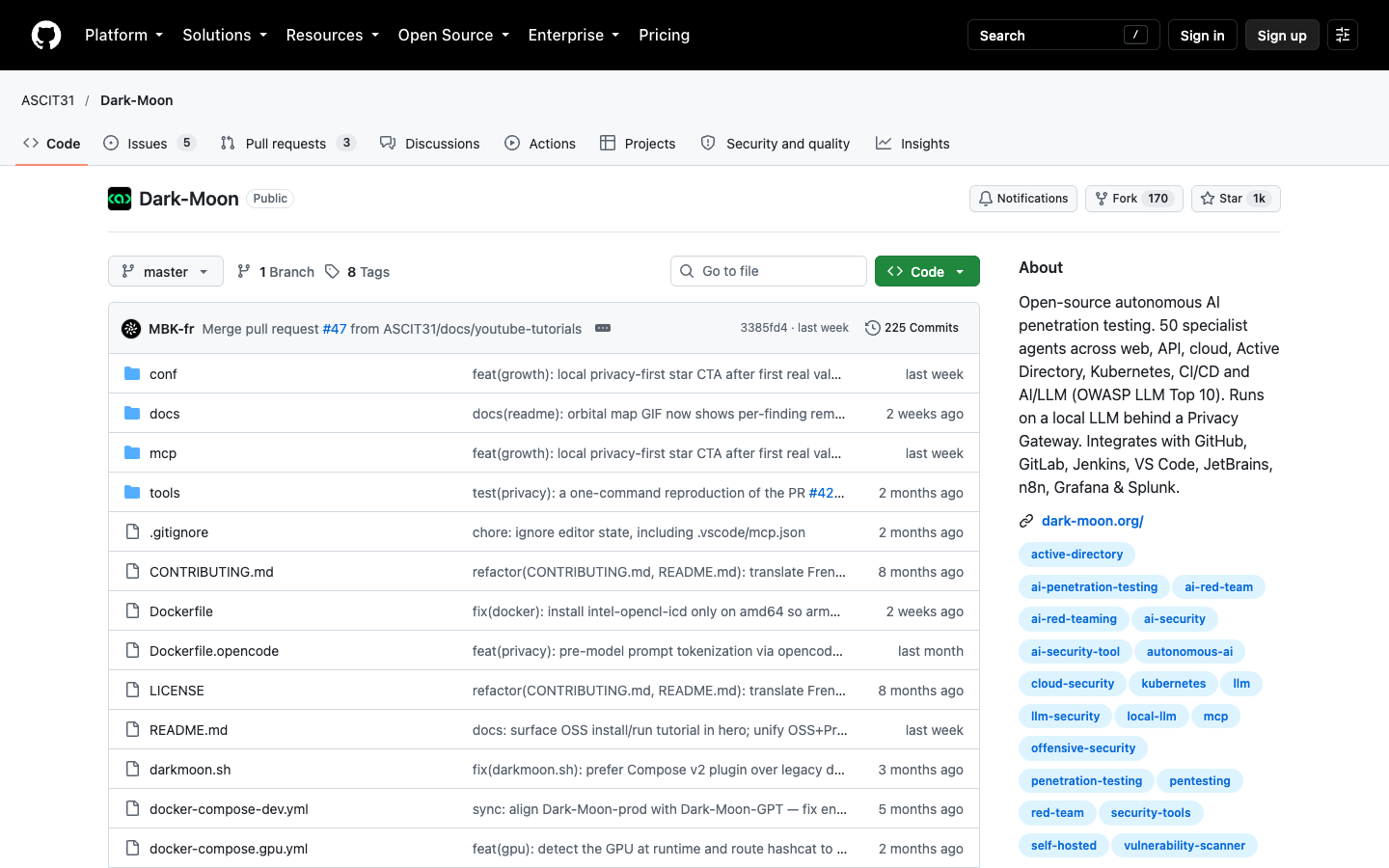
Best for broad multi-surface security testing
DarkMoon aims for unusually broad security coverage.
Its architecture includes dozens of specialist agents covering areas such as web applications, APIs, Active Directory, Kubernetes, cloud infrastructure, CI/CD, and AI/LLM security.
It ships with a large containerized security toolkit and can also operate with local models, which makes it interesting for organizations experimenting with private AI security workflows.
Best for: Security labs and researchers wanting broad attack-surface coverage
Why it stands out: One of the widest scopes among open-source AI pentesting projects.
10. CyberStrikeAI
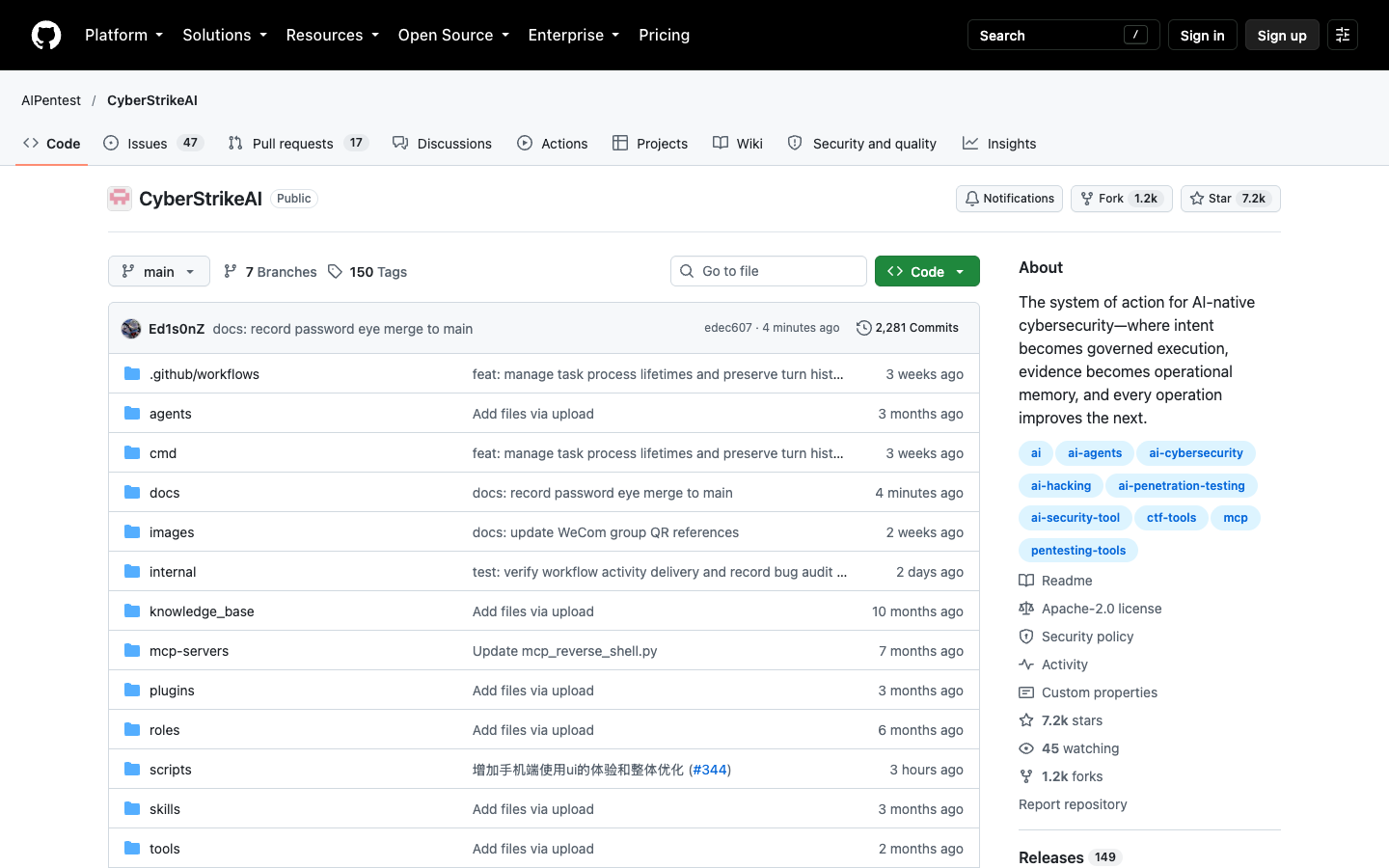
Best AI-native security operations workspace
CyberStrikeAI combines AI agents, security tools, MCP integrations, knowledge retrieval, asset management, workflows, and attack-chain analysis into a broader security workspace.
Its architecture supports multiple agent orchestration strategies and incorporates human-in-the-loop controls for higher-risk operations.
It focuses less on autonomous application pentesting than Strix or Shannon, but it is much broader as an environment for AI-assisted offensive-security operations.
Best for: Security teams building customized AI security workflows
Why it stands out: Strong combination of agent orchestration, MCP, knowledge management, and operational controls.
Which Open-Source AI Pentesting Tool Should You Choose?
There is no universal winner.
For experimenting with autonomous application pentesting, Strix and Shannon are excellent starting points.
For building a customizable multi-agent security environment, PentAGI stands out.
For red-team and infrastructure-oriented testing, RedAmon and Decepticon provide broader offensive capabilities.
If your goal is connecting an LLM to a large existing security toolkit, HexStrike AI offers one of the widest MCP-based integrations.
Open source also comes with trade-offs.
You may need to deploy and secure the infrastructure yourself, manage model providers and API costs, maintain security tooling, investigate failed agent runs, interpret results, build reporting pipelines, and determine whether an AI-generated vulnerability is actually exploitable.
That is fine for security researchers. It becomes much harder when security testing has to become part of a production AppSec program.
Looking for a Production-Ready Alternative? Try Plexicus
Open-source AI pentesting tools are an excellent way to experiment with autonomous security testing.
But organizations often need more than an autonomous agent running security tools.
Plexicus is built around Proof-Driven AppSec.
Instead of treating every suspicious signal as a vulnerability, Plexicus AI Swarm Pentest investigates attack paths and produces evidence your team can review.
It combines autonomous testing with Deep Code Analysis to add application context, followed by remediation workflows that move teams from discovery toward fixing the underlying issue.
That makes Plexicus relevant for teams that want the benefits of AI pentesting without assembling and maintaining the whole AI-security stack themselves. It is the same reasoning behind building guardrails for AI-generated code.
Open source is great for experimentation. Plexicus is built for teams that need to operationalize it.
Ready to go beyond experimental AI pentesting?
Run your next security assessment with Plexicus, and see how Proof-Driven AppSec closes the loop from detection to merged fix.